You did the better roof. Your shingles are straighter, your flashing is cleaner, your crew cleaned up every nail. But the homeowner picked the other guy. Why? Because his Google profile showed 4.8 stars and 210 reviews, and yours showed 4.2 stars and 23 reviews. That gap decided the job before you ever got to bid.
Here is the direct answer: roofers lose jobs to competitors with better reviews because homeowners use star ratings as a shortcut for trust on a purchase they do not understand. Research shows 68% of consumers will not even consider a business rated under 4 stars (BrightLocal, 2026), and the competitor's higher rating, review count, and review recency win the click, the call, and the estimate long before workmanship enters the picture.
Quick Answer
Roofers lose jobs to better-reviewed competitors because homeowners use star ratings as trust shortcuts on a $9,600 purchase they cannot judge themselves. 68% of consumers will not consider a business rated under 4 stars, 47% require at least 20 reviews, and 74% only trust reviews from the last three months (BrightLocal, 2026).
How Does a Homeowner Actually Pick a Roofer From Google?
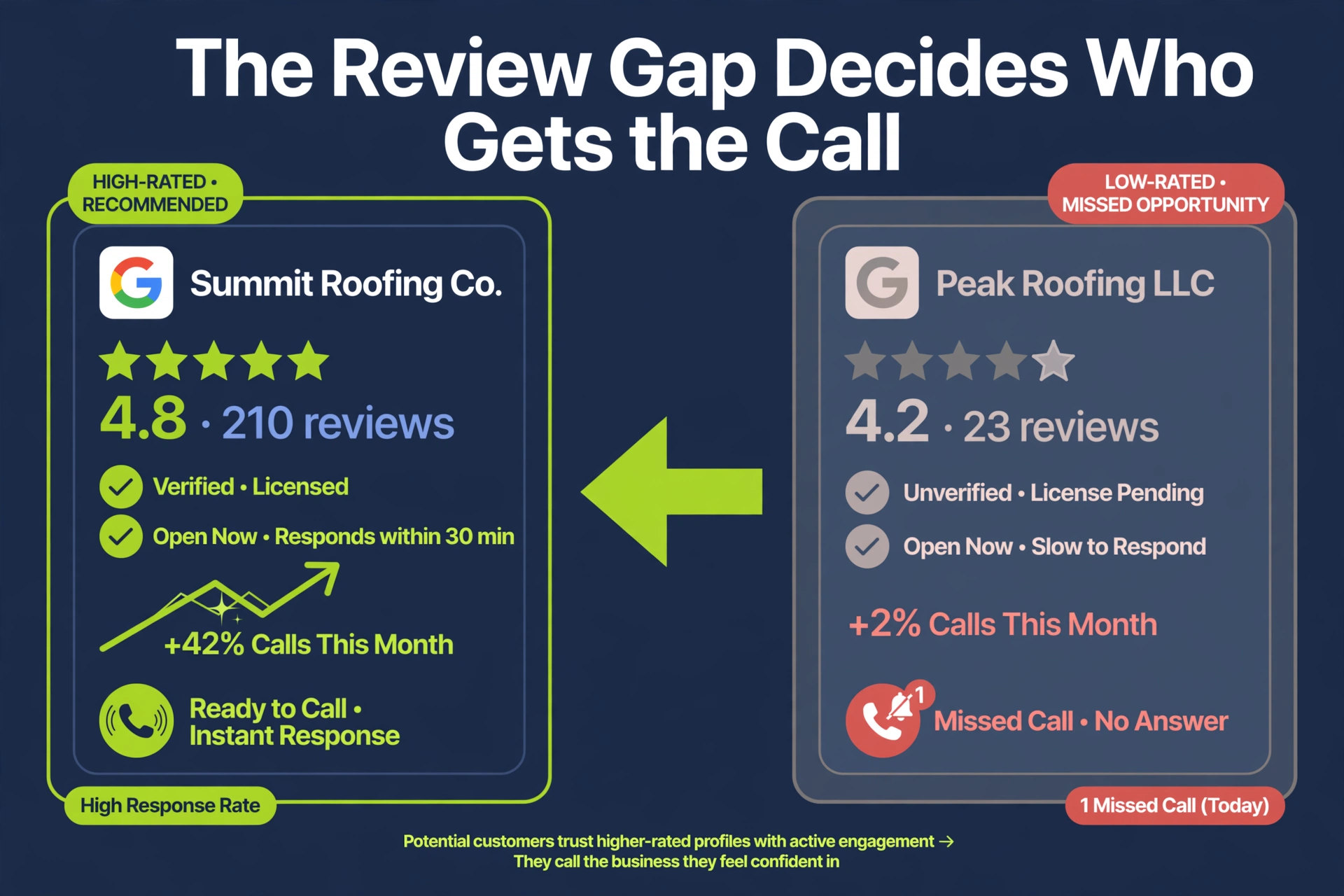
Put yourself in the homeowner's shoes. There is a water stain on the ceiling. They are not roofers. They cannot tell a good shingle installation from a bad one by looking at a website. So they do what everyone does: they Google "roofing company near me."
Google shows the map pack. Three companies. Star ratings right next to the names. The homeowner glances, sees 4.8 with 187 reviews, 4.6 with 142 reviews, and 4.1 with 31 reviews. Who gets the first call? The 4.8. Maybe the 4.6 too. The 4.1 almost never gets called.
This is not a guess about human nature. BrightLocal's 2026 Local Consumer Review Survey found that 97% of consumers read online reviews for local businesses, and 41% always read them before choosing. For roofing, the stakes make reviews matter even more: the average roof replacement costs about $9,600 nationally (Angi, 2026), and it can run $15,000 to $30,000 on larger or steep-pitch homes. Nobody hands over five figures to a stranger without checking the proof first.
The homeowner is not evaluating your craftsmanship at this stage. They cannot. They are evaluating whether you look trustworthy, and your review profile is the trust proxy.
What Does One Star Actually Cost a Roofing Company?
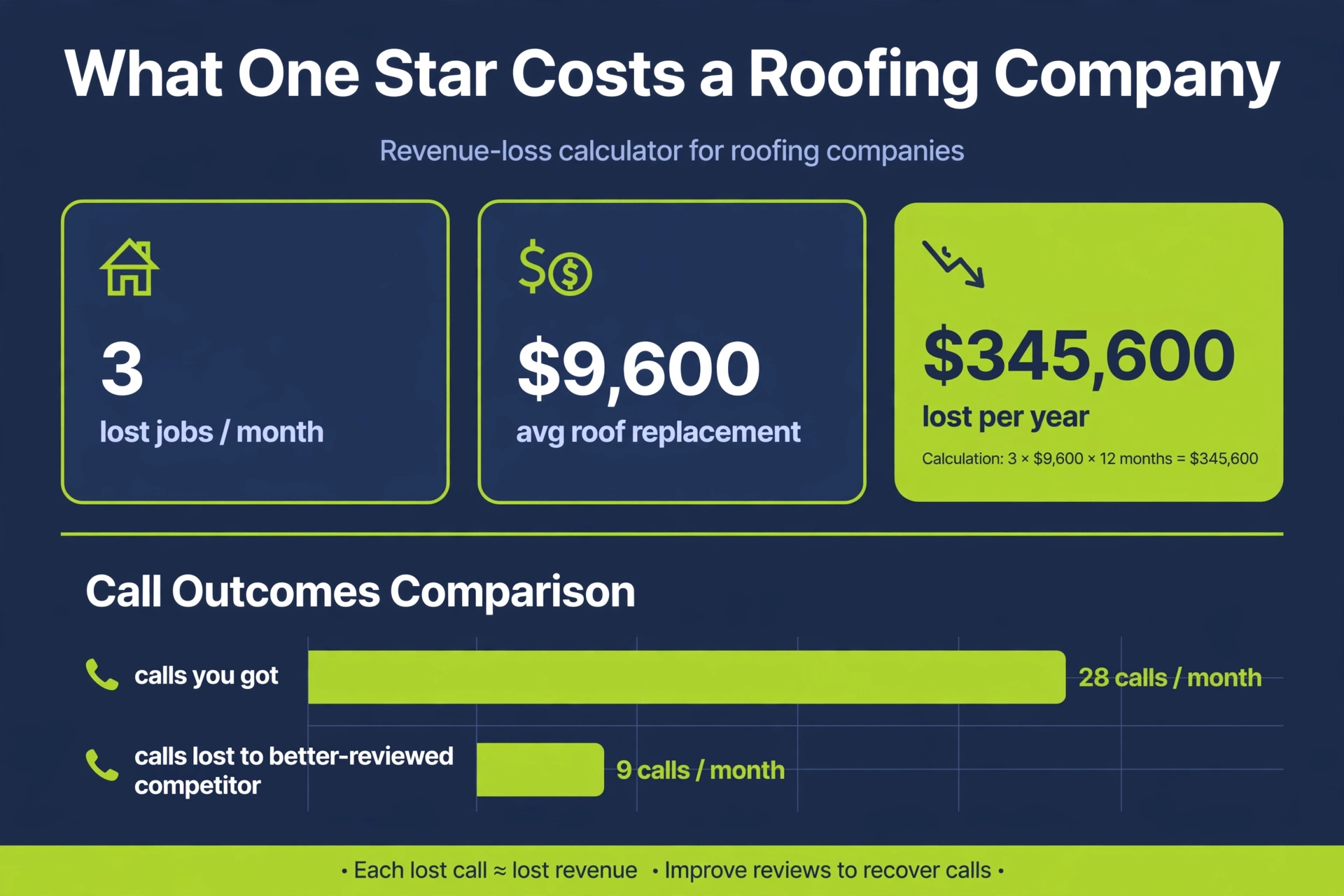
This is where roofers underestimate the damage, because the losses are invisible. You do not see the calls you never received.
Start with the research. Harvard Business School's Michael Luca found that a one-star increase in online ratings leads to a 5 to 9 percent increase in revenue, and the effect is driven almost entirely by independent businesses, not chains (Luca, 2016). Roofing is a 100% independent trade. There is no national brand carrying your reputation. Your rating is your brand.
Now the illustrative math for a typical residential roofing company:
This is illustrative math, not a guarantee, but the structure is real. The only question is the size of the gap. And the gap is probably bigger than you think, because of where exactly the jobs get lost.
Where Exactly Do the Jobs Get Lost? Three Leak Points
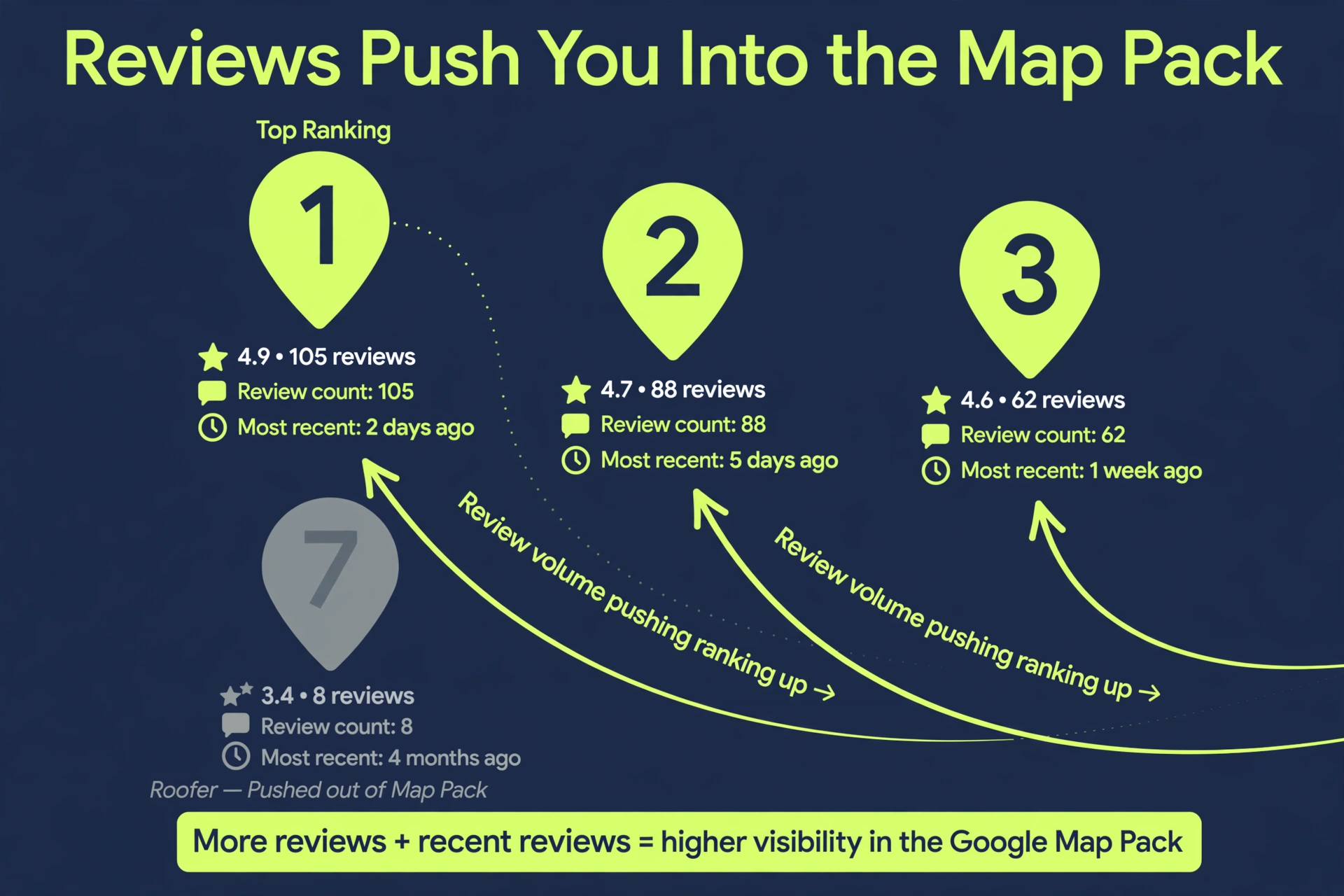
The review gap does not cost you jobs at the estimate table. It costs you before you ever get invited to the table. There are three specific leak points.
Leak point 1: The map pack. Google weighs review signals heavily in local ranking. Businesses with 50 or more Google reviews are 266% more likely to appear in the Local Pack than businesses with fewer than 10 (BrightLocal, 2026). If your competitor's review volume is pushing him into the top three and you are sitting at number seven, you are not losing the job to him. You are not even being considered. Review recency matters here too: 74% of consumers only trust reviews written in the last three months. A competitor getting 5 new reviews a month will outrank you on freshness even if your total count is similar.
Leak point 2: The click. Even when you both show up, the higher-rated profile wins the click. Research on consumer choice shows purchase likelihood peaks when a business displays 4.2 to 4.5+ stars with healthy review volume (Spiegel Research Center, Northwestern University). Below 4 stars, the click-through collapses: 68% of consumers will not use a business rated under 4 stars at all. The difference between your 4.2 and his 4.8 is not 0.6 stars. It is the difference between being in the consideration set and being filtered out.
Leak point 3: The estimate comparison. Smart homeowners get 3 estimates. When they compare you side by side after the walkthrough, they go back to your profiles. The roofer with 200 reviews mentioning clean job sites, on-time crews, and no surprise charges wins the tiebreaker. The roofer with 25 reviews, three of them complaining about a callback, loses it. You never find out why. The homeowner just says "we went with someone else."
Why Does Review Count Beat Your Better Workmanship?
Because workmanship is unverifiable before the job, and reviews are the only verification the homeowner has.
Think about what a homeowner can actually judge during an estimate: were you on time, did you seem knowledgeable, did the quote look professional. Everything about the actual roof is a promise. Your competitor's 187 five-star reviews are 187 people saying the promise was kept. Your 23 reviews, even if they are all five stars, say almost nothing at scale.
This is why review volume has a threshold effect. BrightLocal's 2026 data shows 47% of consumers will not use a business with fewer than 20 reviews. Below that, you look like a risk. Above 100 reviews, you look established. Above 200, you look like the safe choice. The competitor does not need better shingles. He needs enough people saying his shingles are fine.
There is also the negative review asymmetry. Moz research found that a single negative review on the first page of results costs a business about 22% of potential customers, and with three or more negative reviews that rises to 59%. If your profile is thin, one angry review dominates it. If your competitor's profile has 200 reviews, one angry review is noise. Volume does not just attract customers. It insulates you.
How Do Recent Reviews Change Who Gets the Call?
Old reviews are depreciating assets. A 5-star review from 2022 does almost nothing for you in 2026, because the homeowner does not trust that it describes your company as it is today. Your crew changed. Your office staff changed. Maybe your quality changed.
The data backs this up hard. BrightLocal's 2026 survey found 74% of consumers only care about reviews written in the last three months, and 32% look specifically for reviews from the last two weeks. When a homeowner compares your profile (last review 8 months ago) against a competitor (6 reviews in the last month), the competitor wins on recency even if your overall average is higher.
This is also where storm season becomes a review weapon. Roofing demand spikes after hail and wind events. The roofer who captures reviews during the surge owns the profile for the next six months. The roofer who does the storm work but never asks for reviews gets nothing to show for it. Volume and recency compound: every job is a chance to bank proof for the next slow season.
And Google notices. Review recency and velocity are confirmed local ranking signals. A steady flow of new reviews tells Google your business is active and trusted right now. A stagnant profile tells Google the opposite.
How Fast Can a Roofer Close the Review Gap?
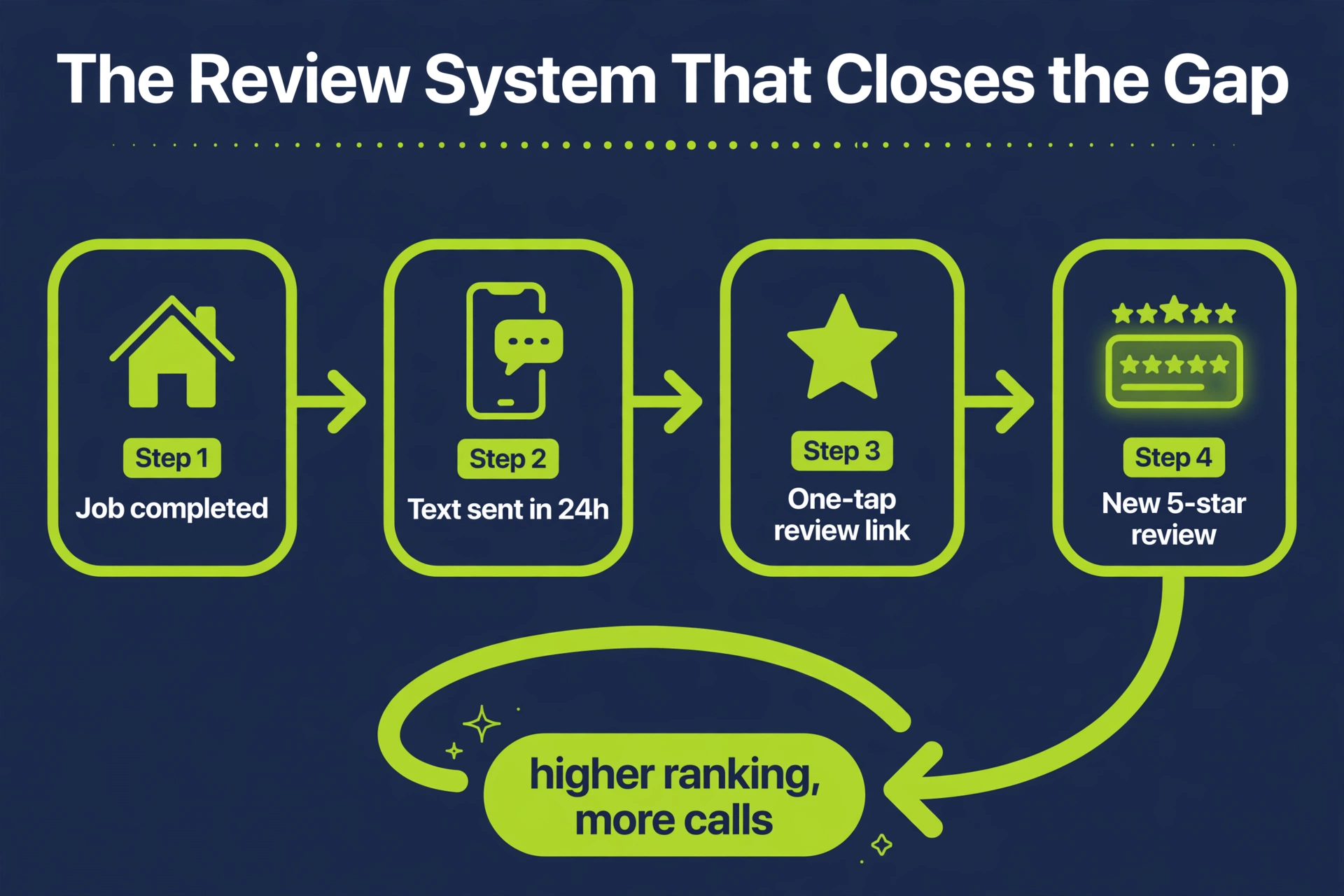
Faster than you think, because the gap is almost always a system problem, not a quality problem. You already did the jobs. You just never captured the proof.
The system is simple: ask every customer for a Google review within 24 hours of the final walkthrough, by text, with a one-tap review link. Follow up once by email if they do not respond. That is it.
The illustrative math on closing the gap: a roofer doing 15 jobs a month who asks 100% of customers and converts 35 to 40% of asks into reviews gains 5 to 6 reviews a month. That is 60 to 72 reviews a year. A roofer starting at 25 reviews passes 100 within 18 months and catches most local competitors within two years. (Conversion benchmarks from industry-reported automated review request performance.)
While you build volume, protect your rating. Respond to every review, positive and negative, within a week. Businesses that respond to reviews earn about 12% more reviews and carry an average rating 0.12 stars higher (ReviewTrackers, 2026). That 0.12 sounds small until you realize it is often the difference between 4.4 and 4.6, which is the difference between "good enough" and "the one we called."
One caution: never buy reviews, never offer payment for reviews, and never let anyone pressure a customer. Google's policies treat review manipulation seriously, and a filtered profile is worse than a thin one. Real jobs, real asks, real reviews. The system works because it is honest.
Bottom Line
You are not losing jobs because your roofs are worse. You are losing them because the homeowner's decision happens on Google, and on Google, reviews are the product. The competitor with 4.8 stars and 210 recent reviews is not beating your craftsmanship. He is beating your visibility, your click-through, and your trust signal at the exact moment the homeowner decides who to call.
The good news is that this is the most fixable marketing problem in roofing. You cannot change your competitor's reviews. But you can out-system him. Every completed job is a review waiting to be asked for. Every month you run the system, the gap shrinks, the map pack moves, and the calls that used to go to him start coming to you.
This is exactly the kind of system RepuPilot is built to run for roofing companies: every job automatically triggers a review request at the right moment, every review gets a response, and the profile keeps growing while you are on the roof. The roofers winning their zip codes are not working harder than you. They just have a machine turning finished jobs into proof.
Frequently Asked Questions
How many Google reviews does a roofing company need to compete?
In most markets, 100+ reviews with a 4.6+ average and steady recent activity puts you in the top tier. 47% of consumers will not consider a business with fewer than 20 reviews (BrightLocal, 2026), so 20 is the floor and 100 is the credibility threshold. Recency matters as much as total count: 74% of consumers only trust reviews from the last three months.
What star rating do roofers need before homeowners will call?
68% of consumers will not use a business rated under 4 stars (BrightLocal, 2026), and 31% require 4.5 stars or higher. For roofers, 4.6+ is the practical target: below 4.4, click-through drops sharply, and the competitor at 4.7+ takes the calls.
Does a higher star rating actually increase revenue?
Yes. Harvard Business School research found a one-star rating increase drives 5 to 9 percent more revenue for independent businesses (Luca, 2016), and roofing is an independent trade. At a $9,600 average job value, even a small rating improvement compounds fast.
Do Google reviews affect local map pack rankings?
Yes. Review quantity, recency, and rating are core local ranking signals. Businesses with 50+ Google reviews are 266% more likely to appear in the Local Pack than those with fewer than 10 (BrightLocal, 2026). Google's own guidance states that more reviews and positive ratings improve local ranking.
How many jobs does a roofer lose to a competitor with better reviews?
It varies by market, but the illustrative math is sobering: a roofer getting 40 estimate requests a month who loses 20% of potential calls to a better-reviewed competitor loses about 3 jobs monthly. At $9,600 per job, that is roughly $345,000 a year in unseen lost revenue.
Can a roofer with fewer reviews outrank one with more?
Yes, if the reviews are fresher. 74% of consumers only care about reviews from the last three months, and Google weighs recency in rankings. A steady flow of 5+ new reviews per month can beat a competitor sitting on a large but stale total.
What is the fastest way for a roofer to get more reviews?
Ask every customer by text within 24 hours of the final walkthrough, with a direct one-tap Google review link, and send one follow-up by email. Roofers doing 15 jobs a month who ask 100% of customers typically gain 5 to 6 reviews monthly, passing 100 total reviews within about 18 months.