
A homeowner just left you a glowing 5-star review. You reply "Thanks for the review!" — and so does every other roofer in town, on every one of their reviews, word for word. Here is the direct answer: replying to positive reviews takes 60 seconds when you use a four-line formula — name the reviewer, echo one specific detail, add one trade signal, sign off warm — and personalized replies matter because 80 percent of consumers are more likely to use a business that responds to all of its reviews (BrightLocal, 2026), while half are put off by generic templated responses.
Most roofers either ignore positive reviews entirely ("why reply, it is already 5 stars?") or reply with the same three words until the whole profile reads like a robot wrote it. Both are mistakes, and both cost you jobs. Here is the system that fixes it.
Quick Answer
Use the 4-line reply formula: thank the reviewer by name, mention one specific detail from their review, add one natural trade or local signal, and sign off warmly. It takes 60 seconds per review, avoids the robotic "thanks for the review" trap that puts off 50 percent of consumers (BrightLocal, 2026), and turns every positive review into fresh, trust-building content on your profile.
Why Do Positive Review Replies Matter More Than Most Roofers Think?
Because you are not writing to the reviewer. You are writing to the next hundred homeowners who will read that review before they ever call you.
The numbers on this are some of the strongest in all of local marketing. BrightLocal's 2026 Local Consumer Review Survey found that 80 percent of consumers are more likely to use a business that responds to all of its reviews, 89 percent expect a response, and 42 percent are unlikely to use a business that ignores reviews entirely. On timing: 19 percent expect a same-day response and 81 percent expect one within a week. And here is the number that should end the "thanks for the review" era: templated or generic responses make 50 percent of consumers unlikely to choose a business. Half your readers can smell a copy-paste reply — and it counts against you.
There is also a compounding effect. An analysis of 31,326 Google profiles by SOCi found that replying to all reviews instead of none went with 16.4 percent more conversions — calls, website clicks, and direction requests. Your replies are fresh, indexable content on your profile, and they carry your voice, your trade knowledge, and your city into the exact place where homeowners are deciding. A profile with 80 five-star reviews and 80 thoughtful owner replies is a fundamentally different asset than a profile with 80 five-star reviews and silence.
And there is one more audience you are writing for: the AI engines. ChatGPT, Gemini, and Perplexity summarize review profiles for homeowners who never open Google at all. Detailed, specific owner replies give those engines more of your story to tell — the warranty you stand behind, the neighborhoods you serve, the way you treat people. Silence gives them nothing.
The takeaway: every positive review is an unfinished conversation. Finishing it takes a minute, and the homeowner reading it six months from now is your real audience.
What Is the 60-Second Reply Formula?

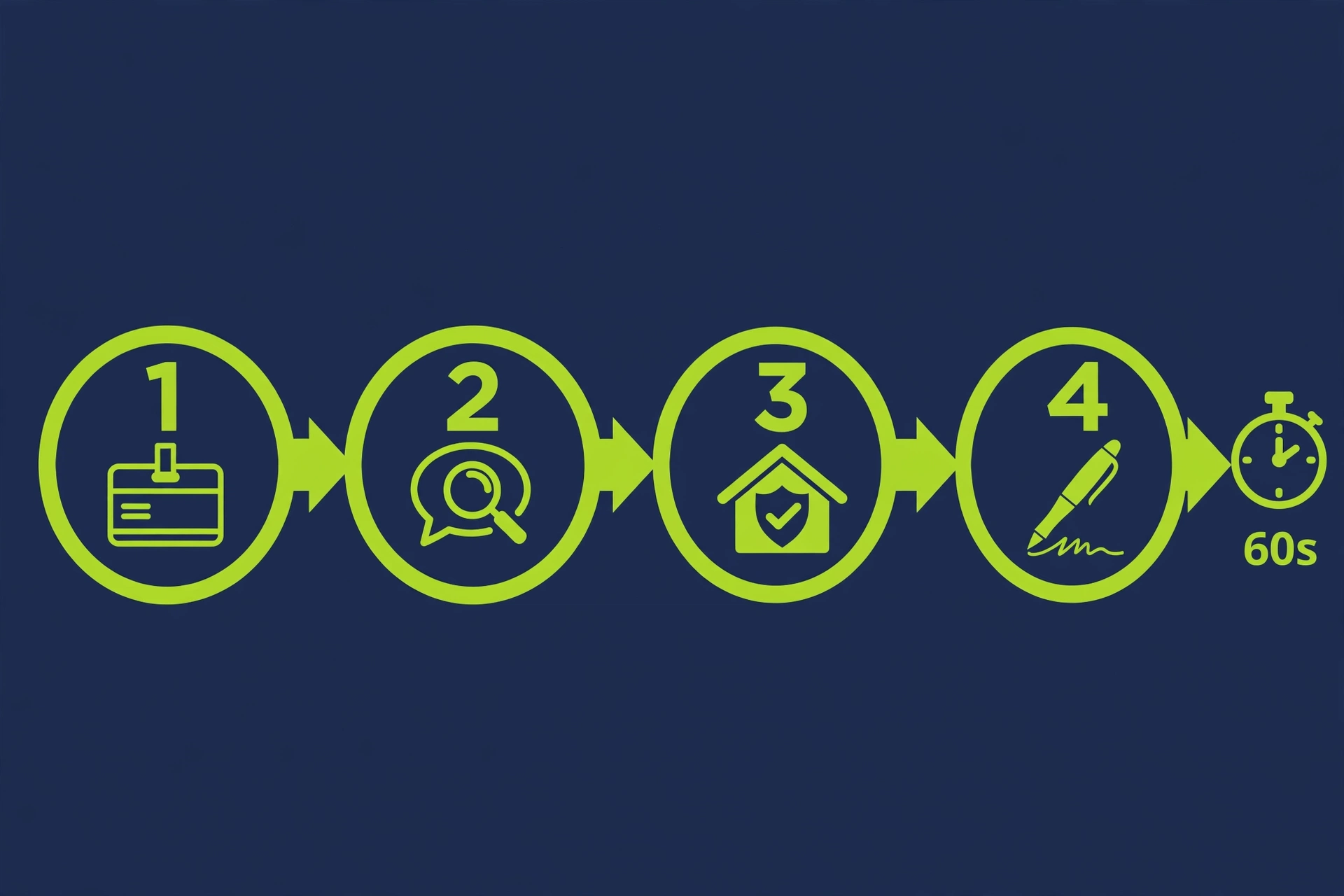
Here it is. Four lines, sixty seconds, every time:
Line 1 — Name them. "Mike, thank you" beats "Thanks" every single time. It costs you one word and it changes the whole temperature of the reply.
Line 2 — Echo one specific detail. Pick one thing from their review and repeat it back. The crew's cleanup. The timeline. The way the office communicated. The color of the shingles. This is the line that proves a human read the review. It is also the line that separates you from every roofer pasting "Thanks for the review!"
Line 3 — Add one trade signal. One natural mention of what you do or where you do it. Not keyword stuffing — a human sentence that happens to say "roof replacement," "storm damage repair," or your service city. This line does quiet SEO work and reminds the next reader what business they are looking at.
Line 4 — Sign off warm. One line, your name or your company's voice. "We are here if you ever need us" is fine. So is "Enjoy that new roof." Keep it short.
Watch it work on four real roofing review types:
The full roof replacement:
"Mike, thank you for the kind words. Glad the crew kept the yard spotless during the tear-off — that is the part most roofers get wrong, and our guys take pride in it. Enjoy that new architectural shingle roof for the next 25 years, and we are here whenever you need us. — Dave, Apex Roofing"
The storm and insurance job:
"Sarah, really appreciate you sharing this. Insurance claims are stressful enough without a contractor adding to it, so I am glad we could handle the adjuster meeting and keep you in the loop. If that hail season ever comes back around, you know where to find us. — Dave"
The repair:
"Tom, thanks for trusting us with the leak repair. Tracking a leak back to that flashing issue instead of selling you a whole new roof is exactly how we do business. Call us any time — small stuff today saves big stuff tomorrow. — Dave"
The inspection:
"Jennifer, thank you. Most homeowners are surprised to hear their roof has another five good years left — we would rather tell you the truth than sell you a roof you do not need. We will check back in before storm season. — Dave"
Sixty seconds each. None of them sound like a robot. Every one of them teaches the next reader something about how this company works.
How Do You Personalize Replies When You Get Dozens a Month?

The objection I hear most: "This is fine for five reviews, but I get thirty a month. I cannot write a novel for each one." You do not have to. Personalization at volume is a system, not inspiration.
Build an opening bank. You need ten openers, not one. "Mike, thank you"… "Really appreciate this, Mike"… "This made our day, Mike"… "Glad to hear it, Mike." Rotate them. The robot pattern is not short replies — it is identical replies. Ten openers kills the pattern.
Build a detail-echo habit. The detail comes from the review itself, so you never run out of material. Scan for: crew names, cleanup, timeline, communication, price fairness, the specific problem (leak, hail, wind), the product (shingles, metal, TPO). Echo whichever one they mentioned. If the review is just "Great company, highly recommend" with no detail, echo the rating itself: "Five stars from a homeowner we genuinely enjoyed working with — that means everything to us."
Build a trade-signal bank. Ten natural one-liners you rotate: "roof replacement," "storm damage repair," "the new roof," "your shingles," "that flashing repair," "the inspection," "our warranty," "the crew," "your neighborhood," "hail season." Drop one in line three. Over a year of replies, your profile accumulates hundreds of natural keyword mentions — written by a human, read by homeowners, indexed by Google.
Batch it. Ten minutes, once a week. Open the new reviews, reply to all of them with the formula, done. Ninety percent of the "we do not have time" problem is that replies are treated as a random task instead of a ten-minute weekly appointment. Put it on the calendar like a job.
The math of the system: ten minutes a week, 52 weeks a year, every positive review answered with a personal, keyword-rich, trust-building reply. That is the profile that wins the homeowner who is comparing you to three competitors at 11 PM.
What Should Every Reply Include — and What Should It Never Include?
The include list is short:
The never list is shorter and more important:
One more: never reply only to the positive ones. BrightLocal found that far fewer consumers are impressed by businesses that respond only to positive reviews (45 percent) or only to negative ones (47 percent), versus all reviews (80 percent). Reply to everything. The positive replies are the easy ones — they are also the ones most roofers skip, which is exactly why they are an advantage.
How Does the 10-Minute Weekly Routine Work?

Systems beat intentions. Here is the weekly routine, start to finish:
Monday morning, 10 minutes:
1. Open your Google Business Profile and sort reviews by newest. Read each new review — actually read it, looking for the detail you will echo.
2. Reply with the formula. Name, detail, trade signal, sign-off. Sixty seconds each. Five reviews is five minutes.
3. Flag anything that needs more. A review that mentions a real problem — even a 4-star — gets a personal reply and, if needed, a phone call before the reply goes up. Never let a lukewarm review sit.
4. Screenshot the best one. The best review of the week goes on your website's testimonial section, your next estimate packet, and one social post. Reviews you do not reuse are reviews you underuse.
Once a month, 10 more minutes:
5. Check your reply rate. Every review from the last 30 days should have a reply. If any slipped, reply now — late is better than never, and 81 percent of consumers are satisfied with a reply within a week (BrightLocal, 2026).
6. Scan for patterns. Three reviews mentioning the crew's cleanup? That is a marketing headline. Two mentioning slow scheduling? That is an operations problem wearing a review costume. Your replies are a window; the reviews are the view.
That is it. Twenty minutes a month keeps every positive review answered, personal, and working for you. The roofer who does this for a year has a profile that reads like a conversation with a company that cares. The roofer who does not has a profile that reads like a receipt.
Bottom Line
Positive reviews are not the finish line. They are the opening line of a conversation that the next hundred homeowners will read. "Thanks for the review!" wastes that conversation. Sixty seconds with a name, a detail, a trade signal, and a warm sign-off turns it into the hardest-working paragraph on your profile.
The formula is simple enough to teach your office manager in one sitting and fast enough to run in ten minutes a week. Start with this week's reviews. By next month, your profile will sound like you — and that is exactly what the homeowner choosing between you and three competitors is listening for.
This is the kind of quiet, compounding system RepuPilot runs for roofing companies: every review — positive or negative — gets a personal, on-brand reply within days, your profile stays fresh and human, and the homeowners reading at 11 PM see a company that clearly cares about its customers. Nobody chooses the roofer with the robotic replies when the human one is right next to him in the search results.
Frequently Asked Questions
Should roofers reply to positive Google reviews?
Yes. Eighty percent of consumers are more likely to use a business that responds to all of its reviews, and 89 percent expect a response (BrightLocal, 2026). You are not writing to the reviewer — you are writing to the next hundred homeowners who will read that review before calling you.
How long should a reply to a positive review be?
Three to four sentences is the sweet spot: thank them by name, echo one specific detail from their review, add one natural trade or local signal, and sign off warmly. That takes about 60 seconds to write and reads as personal rather than templated.
How do I reply to positive reviews without sounding robotic?
Rotate your openers and closings from a bank of ten each, and always echo one specific detail from the review itself — the crew's cleanup, the timeline, the communication. Identical replies are the robotic pattern, not short replies. The detail is what proves a human read it.
How fast should I respond to a Google review?
Nineteen percent of consumers expect a same-day response and 81 percent expect one within a week (BrightLocal, 2026). A ten-minute weekly batch routine keeps you comfortably inside that window without disrupting your day.
How should I include keywords in my review replies?
One natural mention per reply — "roof replacement," "storm damage repair," your service city — is good practice. It adds fresh, indexable, keyword-bearing content to your profile. Keyword stuffing ("best roofing contractor for roof replacement in Dallas TX") reads as spam to both humans and Google. One natural mention is the rule.
What if a positive review mentions a small problem?
Acknowledge it warmly and move on. "You are right, that rain delay pushed us a day — glad the crew made up for it" turns a flaw into proof of honesty. Never argue inside a positive reply, and consider a phone call first if the issue is real.
Do AI search engines read my review replies?
Increasingly, yes. ChatGPT, Gemini, and Perplexity summarize review profiles for homeowners who never open Google. Detailed, specific owner replies give those engines more of your story — your warranty, your neighborhoods, how you treat people — while silence gives them nothing to work with.