
Storm weeks can produce a month of reviews in five days — if every finished job gets asked. Here is the capture system that turns peak volume into peak reputation.
Roofers capture storm-season reviews by making the review ask part of the job-completion checklist: the moment a storm job passes its walkthrough, a review text goes to that homeowner the same day, and nobody gets skipped. Storm season is the highest-leverage review window a roofer gets — more jobs, more grateful customers, more fresh reviews.
Quick Answer:
Put the review ask inside the job-completion checklist: same-day text, every finished job, no filtering. Text requests convert up to 15x better than email (Podium). Google prohibits review gating and incentivized reviews, and BrightLocal’s 2026 survey found roughly 74 of 100 consumers only trust reviews from the last three months — so storm-season volume is when fresh reviews matter most.

Why Does Storm Season Produce Your Best Reviews?
Because storm customers are emotionally different from every other customer you serve. A retail replacement buyer made a considered purchase. A storm customer called you in a panic — water coming through the ceiling, tarps flapping, the adjuster scheduled for Thursday. When your crew finishes that roof, the relief is enormous. That relief powers the best, most detailed reviews a roofing company ever earns.
Storm-job reviews are specific, and specificity is what sells. They read like a paragraph: the leak over the kid’s bedroom, the crew that showed up the morning after the adjuster’s visit, the way your project manager handled the supplemental claim, the magnet sweep that caught the nails. Nothing in roofing is more specific than storm damage and the scramble that follows.
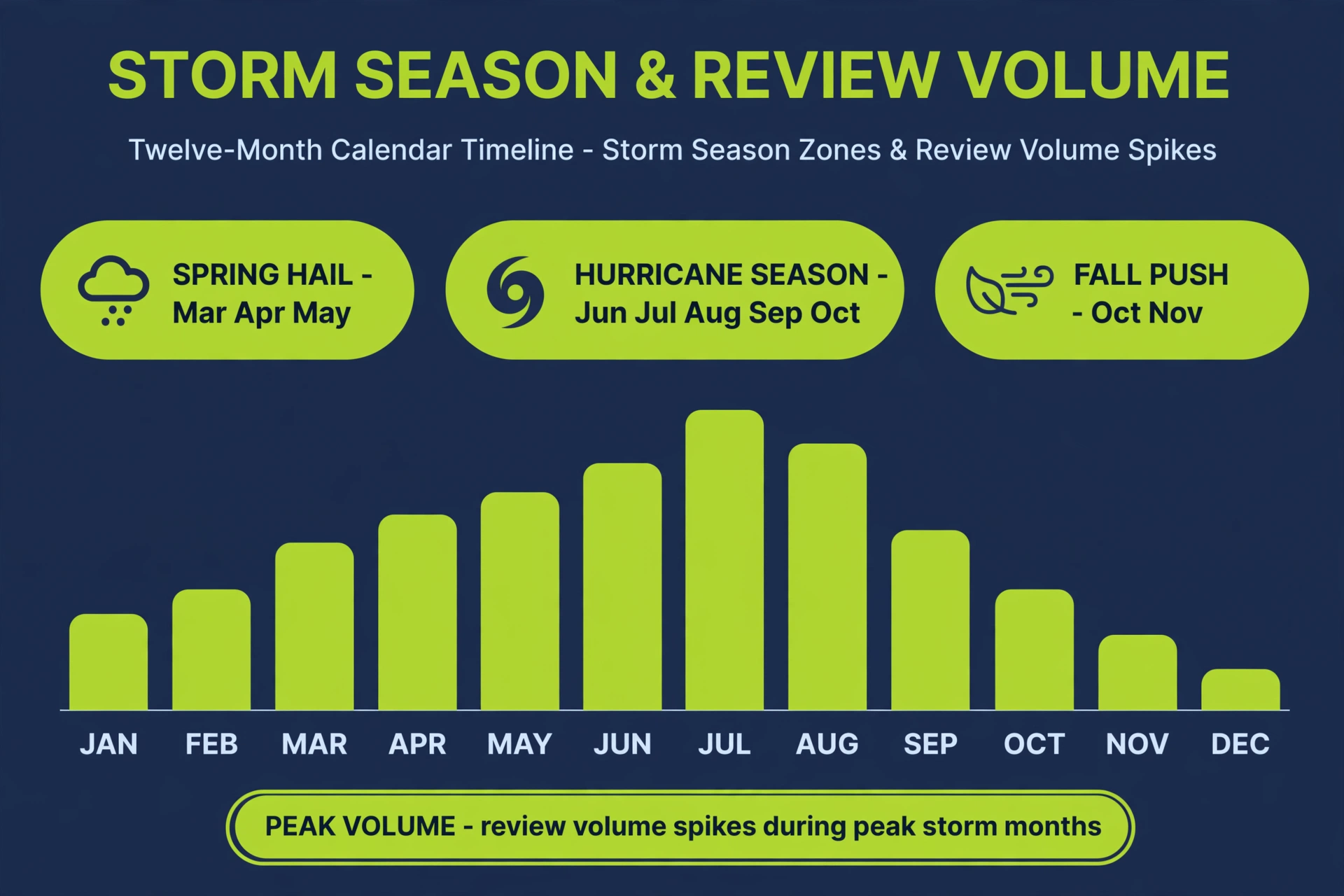
The second reason is the audience. During spring hail season in Texas and Oklahoma, during hurricane season along the Gulf Coast and the Carolinas, whole neighborhoods are roofing customers at once. When one homeowner posts a review mentioning your company name on Monday, the neighbor who is Googling “roofing company near me” on Wednesday reads a review dated this week, about a storm their own house just survived.
The third reason is recency math, and it is brutal. BrightLocal’s 2026 survey found that roughly 74 of 100 consumers only care about reviews written in the last three months. Storm season is the one time of year your review velocity can naturally outrun every competitor — if you capture it.
How Many Reviews Should a Roofer Capture in a Storm Week?
Let me show the shape of the math, with an explicitly illustrative example. Take a peak storm week where your crews finish 25 jobs — a heavy but normal run after a serious hail event in the DFW metroplex. If roughly one in three homeowners leaves a review, that is about 8 reviews from a single week. (Illustrative example, not a market stat — your capture rate depends on your market and your ask, but one-in-three is a realistic target for same-day texts sent to every customer.)
Eight reviews in a week, stretched across a 10-week storm run: roughly 80 fresh reviews in one season, assuming you ask every time. Many roofing companies take years to accumulate 80 reviews total.
Now layer in the recency window. Those 80 storm-season reviews do not just add to your total — they replace your aging profile with a live one. The roofer whose profile shows reviews from this month, mentioning this storm, looks like the company working right now. The roofer whose newest review is from last hail season looks finished, even with a 4.9 average.
How Do You Ask 40 Customers a Week Without Missing Anyone?
Storm volume breaks every manual system. The office manager who personally emails every review request handles October beautifully — and drowns in May. When crews are finishing 40 roofs a week, “I will send the requests Friday” becomes a pile of unsent texts, and by the following Friday the homeowners’ enthusiasm is stone cold. Manual does not scale. Triggers scale.
The storm-season capture system has four parts:
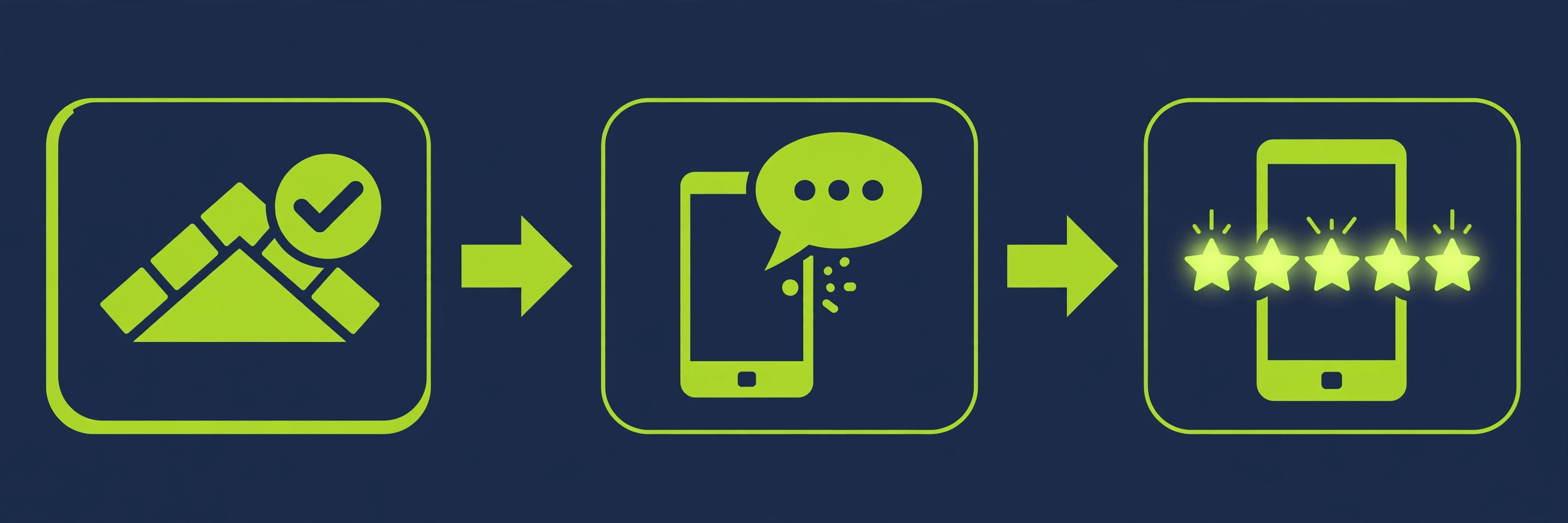
1. The trigger is the job status, not a person. The moment a job is marked complete — walkthrough signed, final payment collected, crew off site — the review text fires automatically. Not Friday. Not when the office catches up. The send is chained to the event, so volume cannot break it. 2. The text goes out the same day, ideally within an hour. Timing is everything in storm season. Podium’s research on review requests found that text-based requests complete up to 15x better than email-based ones, and the Mobile Marketing Association reports a 98 percent SMS open rate with 90 percent opened within three minutes (via Sakari’s benchmarks). The text arrives while the finished roof is still the biggest thing on the homeowner’s mind — especially right after a storm, when roof conversations dominate the neighborhood. 3. One person owns the replies. Volume breaks the ask and the inbox — replies come fast after a storm run, including complaints. Assign one person (not “the office”) to own every review-text reply within business hours: respond warmly, route problems to the production manager. 4. End-of-week reconciliation. Every Friday during storm season, pull two lists: jobs completed, review texts sent. They must match, job for job. Fifteen minutes catches the broken links — the text system that paused, the job marked complete in the wrong system.
The template stays the same whether it is storm week or October: first name, the specific work done, one honest-feedback ask, one link to the Google review page.
What Do You Do When the Storm Jobs Are Rushed and Sloppy?
Let us be honest about storm season. Crews are working six-day weeks. The new hires are green. Somewhere in May, a crew misses a cleanup, a gutter gets dented, a pipe boot gets the wrong color. Storm volume produces your most grateful customers and your most justified complaints at the same time.
The rule does not change: you ask everyone. Every job. No filtering.
This is the rule that protects you. Review gating — asking only the customers you expect to praise you — is explicitly prohibited by Google’s review policies. The FTC’s Consumer Review Rule (16 CFR Part 465, effective October 2024) separately prohibits suppressing negative reviews based on sentiment, with penalties exceeding $50,000 per violation. During storm season the temptation to quietly skip the rough jobs is strongest, and that is exactly when skipping is a violation — a platform rule and federal law at once.
But there is a better business reason than compliance. The storm customer whose cleanup was sloppy has two paths. Path one: nobody asks, the frustration boils, and in two weeks you find a 1-star review describing the nails in the driveway. Path two: they get the same polite text as everyone else, they reply “honestly the cleanup wasn’t great,” and your office has a live problem to fix within hours. You roll the magnet truck back out, the customer feels heard, and the complaint never becomes a public review.
The post-job text is a sentiment radar, not just a review funnel. During storm season, when mistakes spike, the radar is worth more than the reviews. Roofers who text every customer get fewer public complaints because they intercept the complaints while they are still text messages.
One practical note for storm crews: the estimator or project manager sets this up at the walkthrough. “I will send you a quick text tonight with a link — if you had a good experience we’d love your honest feedback.” Same for the smooth jobs and the rough ones.
How Do You Turn Storm Reviews Into Next-Season Estimates?
Reviews do not just sell today’s jobs. They compound into next season’s pipeline.
Storm-season reviews carry the keywords homeowners actually search. A review mentioning “hail damage,” “insurance claim,” and “the adjuster process” matches the exact phrases the next storm’s homeowners will type into Google when their own shingles land in the yard.
The recency engine does the rest. When hurricane season rolls around on the Gulf Coast or the spring hail belt fires up across Texas and Oklahoma, your profile shows dozens of reviews from this season or last season — both inside the 90-day window BrightLocal’s 2026 survey says roughly 74 of 100 consumers trust. The competitor’s profile shows a 4.8 average and a newest review from November. Same rating, wildly different credibility. Freshness is the tiebreaker, and storm season is where freshness comes from.
There is also the fall push. Homeowners who survived the spring storm without visible damage often discover the leak in October, when the first hard fall rain finds the bruised shingles. They search, they see your profile thick with spring storm reviews, and the story writes itself: this company was the one everyone called last season.

How Do You Keep Review Velocity Alive After Storm Season Ends?
Storm season ends every year. The temptation is to let the review system go quiet with it. Do not. The off-season is where most roofers hand back everything they built.
First, keep the machine running at low volume. Two to four reviews a month keeps your profile inside the 90-day trust window. It does not take storm volume — it takes a system that does not care what season it is.
Second, use the slow months for review reactivation. The past-customer list you ignored all summer is a goldmine now. A roof-age check-in text to customers whose installs are five to eight years old — “a quick inspection before the next storm season” — books maintenance inspections, and satisfied maintenance customers are review sources too. Reviews from maintenance visits keep the profile alive when replacement volume dips.
Third, plan the surge before it happens. When spring hail patterns start appearing on the forecast or hurricane advisories begin, confirm the system is live: the trigger is firing, the template is current, someone owns the replies, the Friday reconciliation is on the calendar. The roofer who enters April with the system already running captures the first week’s reviews; the roofer who sets it up after the first hail event loses the best reviews of the season.
The pattern is simple. Storm season makes reviews. The system captures them. The off-season sustains the velocity. A roofing company that runs all three never has a stale profile.
Bottom Line
Storm season is the highest-leverage review window a roofing company gets. The jobs are already happening, the gratitude is already there, and reviews posted during storm weeks sell the very next storm’s jobs — all while the recency window that roughly 74 of 100 consumers trust (BrightLocal 2026) is wide open. The capture system is unglamorous: job marked complete, review text out the same day, every customer asked equally, replies owned, weekly reconciliation.
That is exactly the kind of system RepuPilot sets up for roofing companies: the post-job review text fires automatically the moment a job completes — during the storm-season surge and the quiet months — every customer gets asked with no filtering, unhappy replies land with a human before they become public reviews, and the steady velocity of fresh Google reviews keeps winning the next estimate long after the storm clouds clear.
Frequently Asked Questions
Should I ask insurance-claim customers for reviews, or just retail jobs?
Ask both, equally. Filtering by job type sits uncomfortably close to review gating, which Google prohibits and which the FTC’s Consumer Review Rule (16 CFR Part 465) treats as deceptive — and gating claim jobs would be strategically backwards. Claim customers are often your most relieved customers: the claim was approved, the deductible handled, the roof is new. Their reviews are specific and exactly what other storm customers trust.
What if a storm customer leaves a bad review because their insurance claim was denied?
A denied claim is the number-one source of storm-season reviews that feel unfair. Respond publicly and calmly, and separate what you control from what you do not: “We are sorry the claim did not go through — the adjuster’s coverage decision is outside our control, and we are happy to walk through your options.” Never argue claim details in a public reply.
How fast should the review text go out during storm season?
Same day, ideally within an hour of the final walkthrough. SMS open rates sit near 98 percent, with 90 percent opened within three minutes of delivery (Sakari’s benchmarks), so the text lands while the finished roof is still the household’s main topic. By the weekend, it is not.
Can I ask customers to mention the storm or the insurance process in their review?
Do not script it. Asking a customer to write specific things in their review — or fishing for a specific sentiment — is exactly what Google’s review policies and the FTC’s rule prohibit. Keep the ask open-ended: “we would appreciate your honest feedback.” Storm customers write about the storm on their own.
My crews are finishing 40 jobs a week — how do I make sure nobody gets missed?
Tie the send to the job status, not to a person’s memory: the review text fires automatically when the job is marked complete. Then run a Friday reconciliation during storm season — completed jobs against texts sent, matched job for job, fifteen minutes. Assign one person to own every reply. Volume breaks manual systems; it cannot break a trigger plus a reconciliation.
Do storm-season reviews actually show up when neighbors search for a roofer?
Yes, and recency is the reason. BrightLocal’s 2026 survey found roughly 74 of 100 consumers only trust reviews written in the last three months, and Google’s local results favor profiles with steady recent reviews. A profile showing reviews dated this week, mentioning this storm, reads as the company working right now — which is a stronger story than an older 4.8-star profile.
Is it legal to text every storm customer and ask for a review?
Yes, with three guardrails. First, consent: a customer who gave you their mobile number for estimates and job updates has given prior express consent for transactional follow-ups — include your business name and honor every STOP reply immediately. Second, review rules: ask every customer equally, since selective asking is review gating, prohibited by Google and the FTC’s Consumer Review Rule (16 CFR Part 465, effective October 2024). Third, incentives: never offer discounts or gift cards for a review. Violations of the FTC rule carry penalties exceeding $50,000 per violation.