
The simple email that turns your install history into booked inspections — the exact template, the 3-touch sequence, and the inspection-to-replacement pipeline.
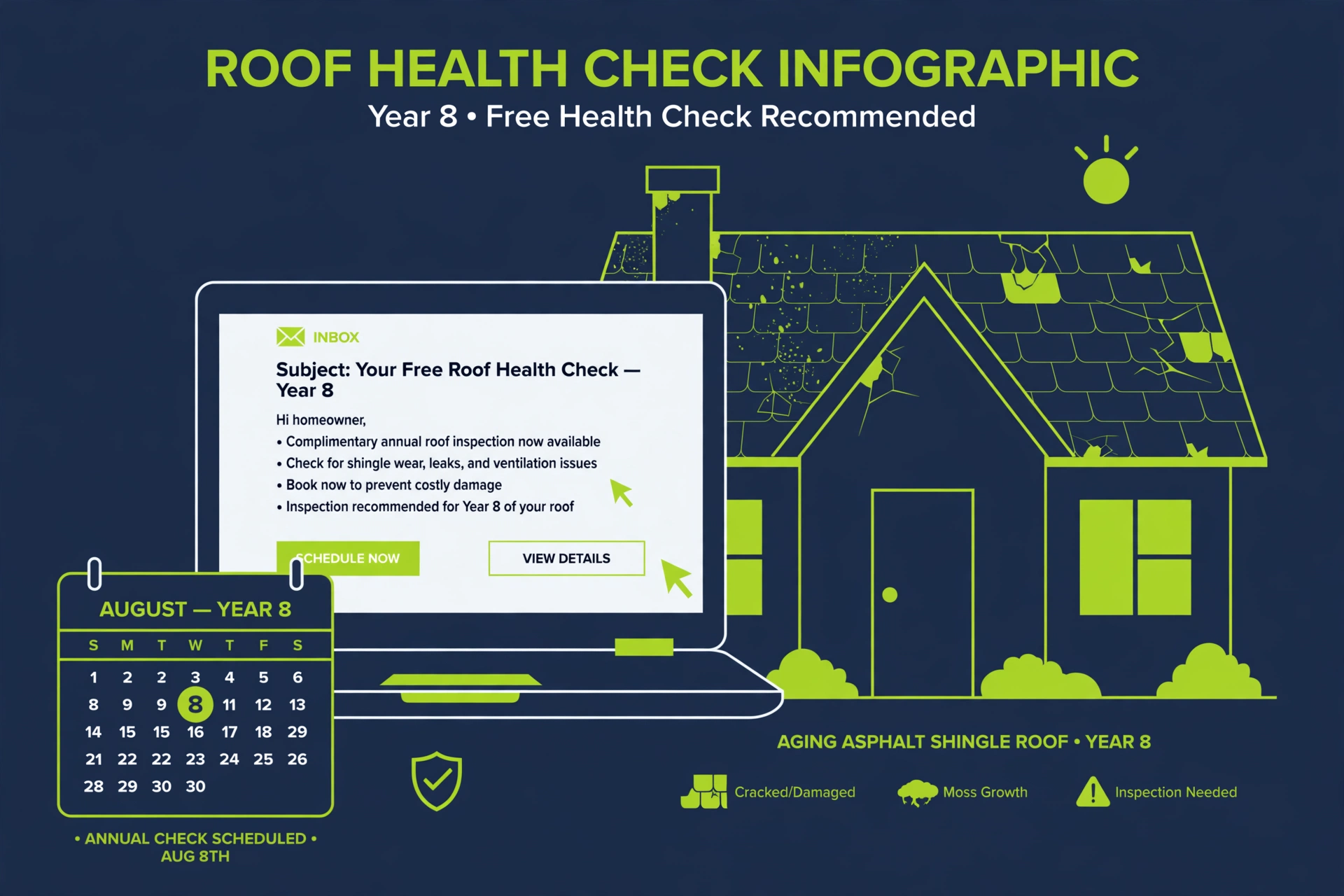
A roof-age email is a short, personal message you send to homeowners whose roofs you installed 7 to 10 years ago, offering a free roof health check. It works because an 8-year-old asphalt shingle roof sits in the inspection sweet spot: old enough that small maintenance issues start showing up, young enough that the homeowner still remembers exactly who put it on — you. Pull install dates from your CRM, segment the list by roof age, and run a three-touch sequence of email, email, text. The inspections book themselves.
Quick Answer:
The roof-age email offers a free inspection to past customers whose roofs are 7–10 years old. Segment your CRM by install year, then send a three-touch sequence: a personal email, a reminder a week later, and a text to close the loop. Asphalt shingle roofs last 15–30 years per manufacturers GAF and Owens Corning, so year eight is the sweet spot — early enough that you own the relationship, late enough that the roof has something worth checking.
Why Is an 8-Year-Old Roof the Sweet Spot for an Inspection?
Start with the product math. Manufacturers GAF and Owens Corning put the service life of a typical asphalt shingle roof at roughly 15 to 30 years — at year eight the roof is a third to halfway through that life. This is exactly when the first age-related issues appear: granules collecting in the gutters, rubber pipe boots cracking in the sun, sealant drying out around flashings, a few shingles lifted by last spring’s wind event. These are maintenance jobs — billable work that takes a crew an hour or two.
Now the homeowner psychology at year eight. Eight years sits inside living memory: the homeowner remembers the crew, the estimator’s name, the check they wrote. But they are not shopping for a replacement yet, which means no competitors are circling them with quotes. Compare that to year three — nothing to inspect, and the email feels random — or year fourteen, when the replacement conversation has already started and you are one of five quotes.
And here is your unfair advantage: you installed that roof, and you have the install date in your files. No competitor knows that roof turned eight this year. Nobody else can send this email. The roof-age email converts a filing-cabinet fact — the install date — into booked inspection appointments.
Which Segment of Your Customer List Should You Email First?
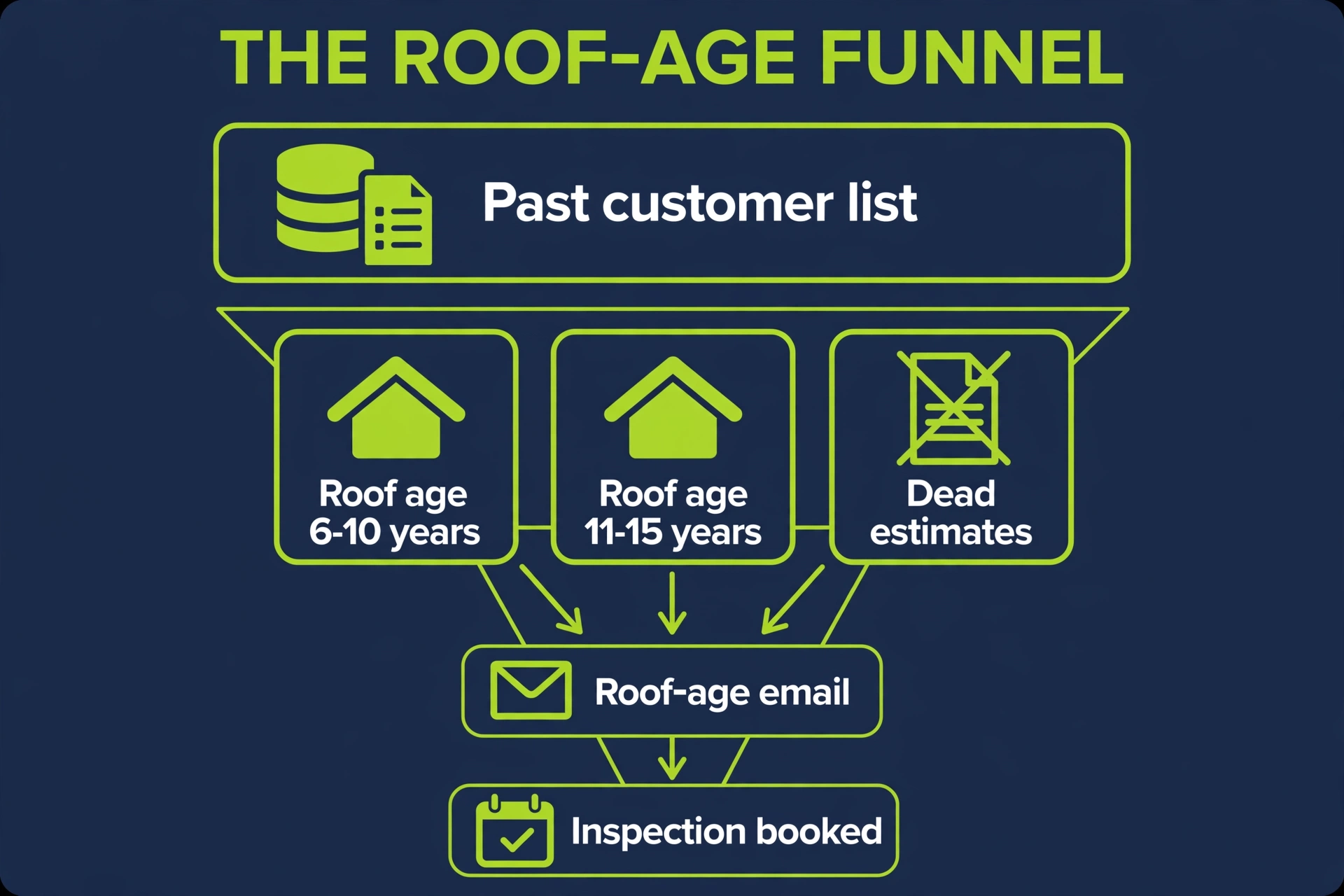
Export five fields from your CRM: homeowner name, email, mobile number, address, install date, plus roof type if you have it. Sort by install year and split into three tiers.
Tier 1 — 7 to 10 years old — is the email-first segment. This is the sweet spot crew: the homeowner remembers you, the roof has something worth checking, and nobody else is marketing to them yet. Start every roof-age campaign here.
Tier 2 — 11 to 14 years old — is the pre-replacement segment. Repair urgency is higher, but some homeowners have already started getting quotes, so the message shifts from “health check” to “time to start planning.” Run it as a separate sequence so the messaging stays honest.
Tier 3 — 4 to 6 years old — is the maintenance-and-goodwill segment: the real payoff is reviews, referrals, and staying top of mind. Do this tier after Tier 1, never before it.
One exclusion rule: any customer with an unresolved complaint, callback, or warranty dispute stays out of the campaign entirely. That homeowner needs a personal win-back call from you first, not a mass email. Also keep opted-out contacts out — no list is worth a spam complaint.
What Should the Roof-Age Email Actually Say?
Short. Personal. One offer, one button. Here is the template:
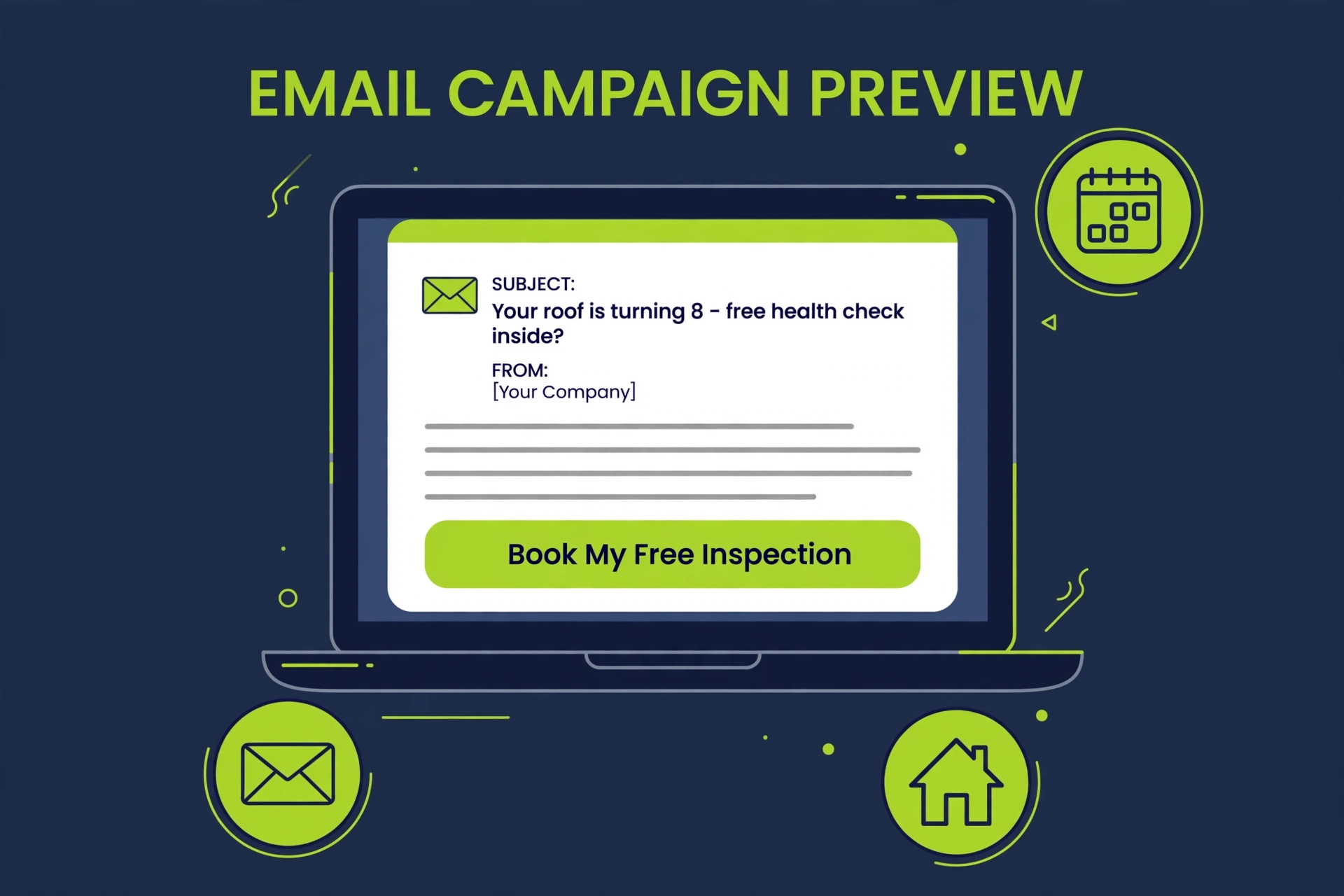
> Subject: Your roof turned [X] this year — free health check, [First Name]? > > Hi [First Name], this is [Your Name] with [Company Name]. We installed your roof back in [Install Year], and it has been doing its job for [X] years now. > > Once a roof hits the [X]-year mark, we offer every past customer a free roof health check — about 20 minutes on the roof, photos of anything we spot, zero sales pressure. Want me to send our tech by next week? > > — [Your Name], [Company Name] > > [Book My Free Roof Health Check]
Every line earns its place. The first name plus company name matters because the number they saved in their phone might just say “roof guy.” Naming the install year proves this is not a blast — you remember their roof specifically. “Twenty minutes” keeps the commitment small. “Photos of anything we spot” promises proof, not a pitch. “Zero sales pressure” disarms the one fear that kills inspection offers: the homeowner assuming a free inspection is a trap to sell them a roof they do not need.
Critical discipline: do not mention replacement anywhere in this email. The moment the word “replacement” appears, the homeowner reads it as a sales pitch and the trust evaporates. That conversation happens on the roof, face to face, with photos — not in the email.
Skip the PDF brochure, the company history paragraph, and the services list — if the email takes longer than 45 seconds to read, it is too long.
How Many Touchpoints Before You Give Up?
Three. A roof-age campaign is a three-touch sequence, and then you stop for the quarter.
Touch 1, Day 1: the email above.
Touch 2, Day 7: the same offer with a different angle — the reminder leads with what the roof has lived through since install year: hail seasons, heat cycles, that windstorm two summers back. Subject: “Quick question about your [Install Year] roof.” Same one-button ask.
Touch 3, Day 14: a text message. Short, from the same number that handled their job communications:
> Hi [First Name], [Your Name] with [Company Name] — sent you an email about a free health check for your [Install Year] roof. Still open if you want it. Want me to book it?
The text is the closer, and the numbers explain why. Text messages are opened roughly 98 percent of the time, per the Mobile Marketing Association, while email open rates sit in the 20s to low 30s percent range per general email marketing benchmarks (Campaign Monitor, Mailchimp). A meaningful share of your list never sees either email. Podium’s research found text-based requests see completion rates up to 15x greater than email-based ones — the text catches the people the emails missed.
After touch three, stop — no fourth email, no voicemail drop, no postcard. Cadence discipline is what separates reactivation from spam. Run the campaign again in six to twelve months; every roof on the list is older by then, which makes the offer more relevant.
What Do You Do With the Replies?
Answer fast. A reactivation reply is a warm lead who said yes to you by name — treat it like one. The five-minute rule applies here exactly as it does to new leads: respond within minutes, not hours, and a human being does the responding, not an autoresponder. Book the inspection within 48 hours, and hold dedicated inspection slots on the calendar during your slow months so you can offer times immediately.
Every inspection ends in one of three outcomes, and all three pay.
Outcome A: the roof needs repair now. Pipe boots, a few storm-lifted shingles, flashing reseal — the classic year-eight findings. That is a few hundred to a couple thousand dollars of billable work this week, on a roof you already know.
Outcome B: the roof is healthy. Document it with photos and a one-page report, then make your three asks: a Google review, a referral (“know anyone whose roof is around the same age?”), and a spot on your watch list for a re-check in two to three years.
Outcome C: the roof is aging fast. Photo-document everything, tell the homeowner honestly that the roof is entering the back half of its life, and put them on a 12-month watch list. This is your future replacement, pre-sold — the homeowner now has your photos, your honest assessment, and your name when the time comes.
None of the three is wasted. The campaign pays for itself on Outcome A alone; B and C are the pipeline.
How Do Inspections Turn Into Replacements 2–5 Years Later?
A roof replacement runs $8,000 to $20,000 or more, per Angi and HomeAdvisor cost data. That is why this pipeline matters more than the repair tickets.
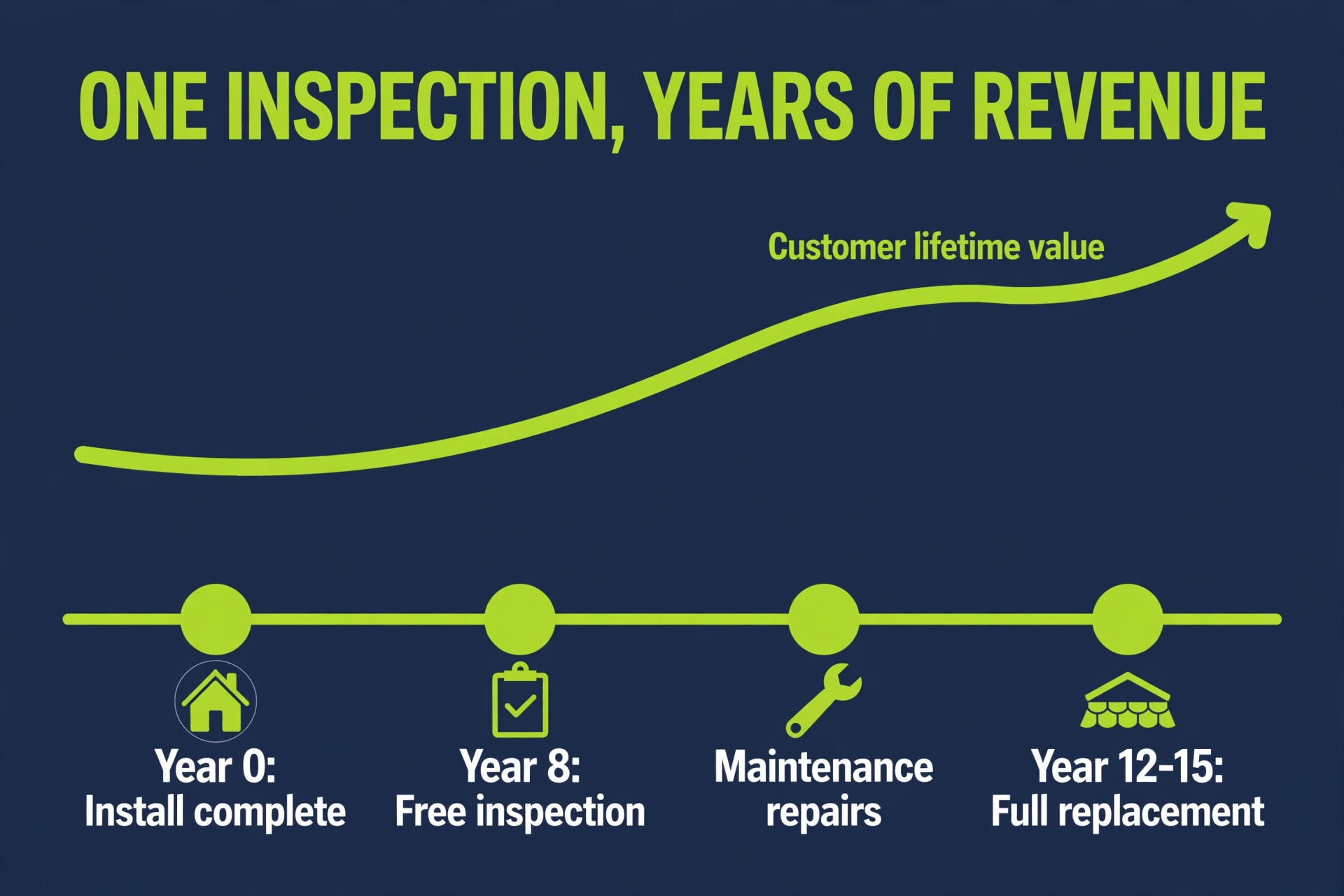
Here is the mechanism. At year eight you inspected and photographed their roof. At year twelve or fourteen, when a storm tears shingles or the adjuster says it is time, the homeowner does not Google “roofers near me” — they call the company that already knows their roof. You become the incumbent, and incumbents win because there is no shopping process to lose.
Now compare the cost of this pipeline to buying the same inspections as leads. Exclusive roofing leads run $200 to $500 or more each, per Modernize and Angi lead-cost benchmarks. A reactivation email costs essentially nothing beyond your CRM and the hour it takes to build the segment.
Illustrative example, not a market stat: 500 Tier-1 past customers. A 10 percent response rate gives you 50 inspections. Say 40 percent need repair work averaging $1,200 — that is 20 jobs and $24,000 in near-term revenue. The other 60 percent — 30 homeowners — join the watch list. Over the next five years, a third of them move to replacement: 10 replacements at a $15,000 average ticket is $150,000 of future pipeline. All from a list you already own.
Two seasonal windows make this campaign hit hardest. Run it in the slow months — January through March, when install crews have gaps — to keep the schedule full. Run it again ahead of storm season, April and May: pre-season inspections catch wind-lifted shingles before they become leaks, and every leak you prevent on a past customer’s roof is loyalty you cannot buy.
Bottom Line
The roof-age email is the cheapest marketing a roofer can run: you already own the list, you already earned the trust, and the calendar does the targeting — install year is the segment. Send the three-touch sequence, answer replies within minutes, and let every inspection fall into one of three outcomes: repair now, review and referral, or the watch list. Run it in the slow months and ahead of storm season, and you will never stare at an empty inspection calendar again.
This is exactly the kind of system RepuPilot helps roofing companies run: your customer database organized by roof age, the reactivation sequence firing on schedule, and every reply routed to your team in minutes so no past customer ever drifts to a competitor. The list is already yours — the revenue is just waiting to be reactivated.
Frequently Asked Questions
What exactly is a roof-age email?
A roof-age email is a short, personal message sent to a past customer whose roof you installed several years ago — typically 7 to 10 — offering a free roof health check. It uses the install date you already have on file to time the outreach for the moment the roof is old enough to need checking and the homeowner still remembers who installed it.
I don’t have install dates in my CRM. Can I still run this?
Yes, but rebuilding the dates is the first job. Pull them from signed contracts, invoices, or job folders, and cross-check with county permit records where available. Segment by your best-known year — even an approximate year beats no segmentation. Going forward, make install date a required field on every job record.
Is it legal to email past customers? What about spam rules?
Emailing customers you have done business with is the safest form of commercial email under the CAN-SPAM Act, but the rules still apply: use an honest subject line, identify your business and include a valid physical address, give a clear one-click opt-out, and honor every opt-out promptly. Never buy a list for this. For the Day-14 text, keep it to customers who gave you their number during the job relationship, include your business name, and honor every STOP reply immediately.
How often can I re-email the same homeowner about this?
One three-touch campaign per quarter at most, then rest that homeowner until the next cycle. More than that trains past customers to ignore you — including texts they actually need, like crew arrival updates. Every roof gets older between cycles, so the offer is more relevant each time.
Should the inspection really be free?
Yes. The inspection is your lead generation, not your product. “Free inspection” is the standard offer homeowners expect from roofers, and charging for it would kill response. The inspection pays for itself through Outcome A repairs, and the real money is the watch-list replacements two to five years out.
What if the inspection finds nothing wrong?
That is still a win. Hand the homeowner dated photos and a one-page report proving their roof is healthy — that documentation has real value to them at resale or insurance renewal time. Then make your three asks: a Google review, a referral, and permission to re-check in two to three years. A healthy roof at year eight becomes your replacement job at year fourteen.
How far back should I go — what about 15-year-old roofs?
Treat 13-to-16-year-old roofs as a separate campaign, not part of the roof-age email sequence. The message shifts from maintenance to planning: your roof is entering its final third, so it is time to talk about what the next few years look like. The inspection offer still works, but the honest framing is replacement planning, and mixing it into the 8-year health-check sequence muddies both messages.