
The exact rating math, the dollar math, and the reply playbook that contains the damage.
A single 1-star review can drag a roofer’s Google rating from 4.7 to 4.6 overnight, and that tenth of a star can be worth $6,000 to $10,800 a year in foregone revenue for a $1.2M roofing company. The damage is not just the average. It is the homeowners who see that fresh red star at the top of your profile and quietly pick your competitor instead.
Quick Answer:
A roofer at 4.7 with 60 reviews who gets one 1-star drops to a displayed 4.6. Harvard research ties each full star to 5-9% of revenue for independent businesses, and restoring the true 4.7 takes 13 new five-star reviews. A fast reply cuts the damage: 45% of consumers are more likely to visit a business that responds to negative reviews.
How does one 1-star review change your Google rating?
Let us walk through the exact arithmetic, because most owners have never seen it done step by step.
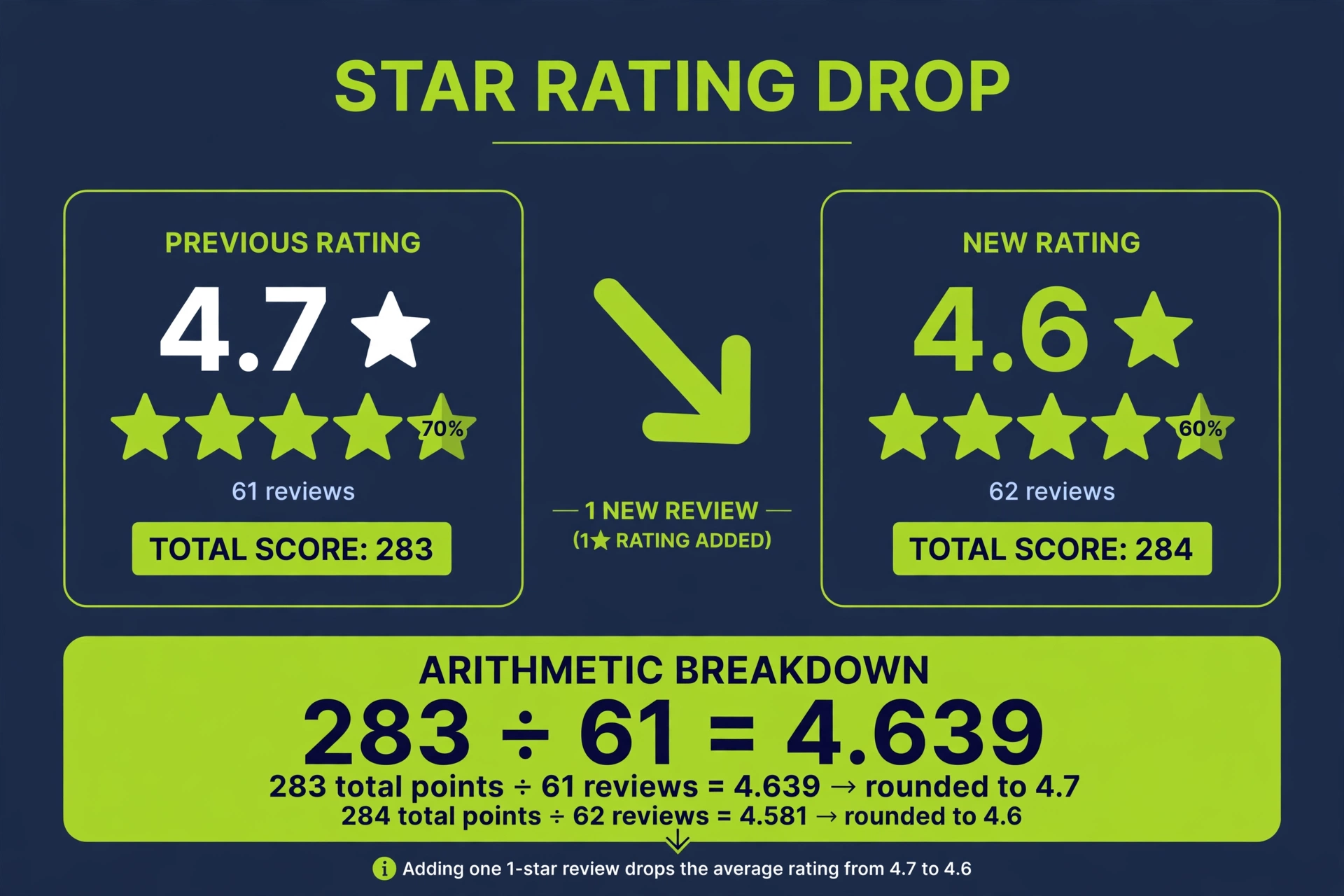
Say your company sits at 4.7 stars across 60 Google reviews, which is 282 total stars. One angry homeowner leaves a 1-star. Your new total is 283 stars across 61 reviews. Divide 283 by 61 and you get 4.639, and Google displays one decimal, so your profile now reads 4.6.
One review. One tenth of a star gone from the number every homeowner sees first.
This is why review count is armor. The company with 200 reviews barely flinches at a 1-star. The company with 40 reviews loses its badge, and every five-star you collect now is padding for the bad day that eventually comes.
Try it with your own numbers below. Plug in your current rating, your review count, and one hypothetical 1-star, and see exactly where your profile would land.
Review Gap Calculator
See what your Google rating gap is costing your roofing company, in real dollars.
Enter your numbers
See your result
Estimate based on a simple rule: every 0.1 star below 4.5 costs about 3% of ready to buy homeowners, who call the higher rated roofer instead. Your real number depends on your market. The fix is a steady flow of new reviews, every single month.
Close the gap
RepuPilot roofers close this gap with automatic review requests after every job, replies handled for them, and a shield that catches unhappy customers before they post.
See How RepuPilot Closes Your GapWhat does a 0.1-star drop actually cost a roofing company?
Here is where most owners stop at “it stinks” instead of pricing it. Harvard Business School professor Michael Luca studied Yelp ratings against real restaurant revenue data and found that a one-star increase in rating leads to a 5 to 9 percent increase in revenue, driven by independent businesses. Roofing companies are independent local businesses, the exact type the study says is most affected.
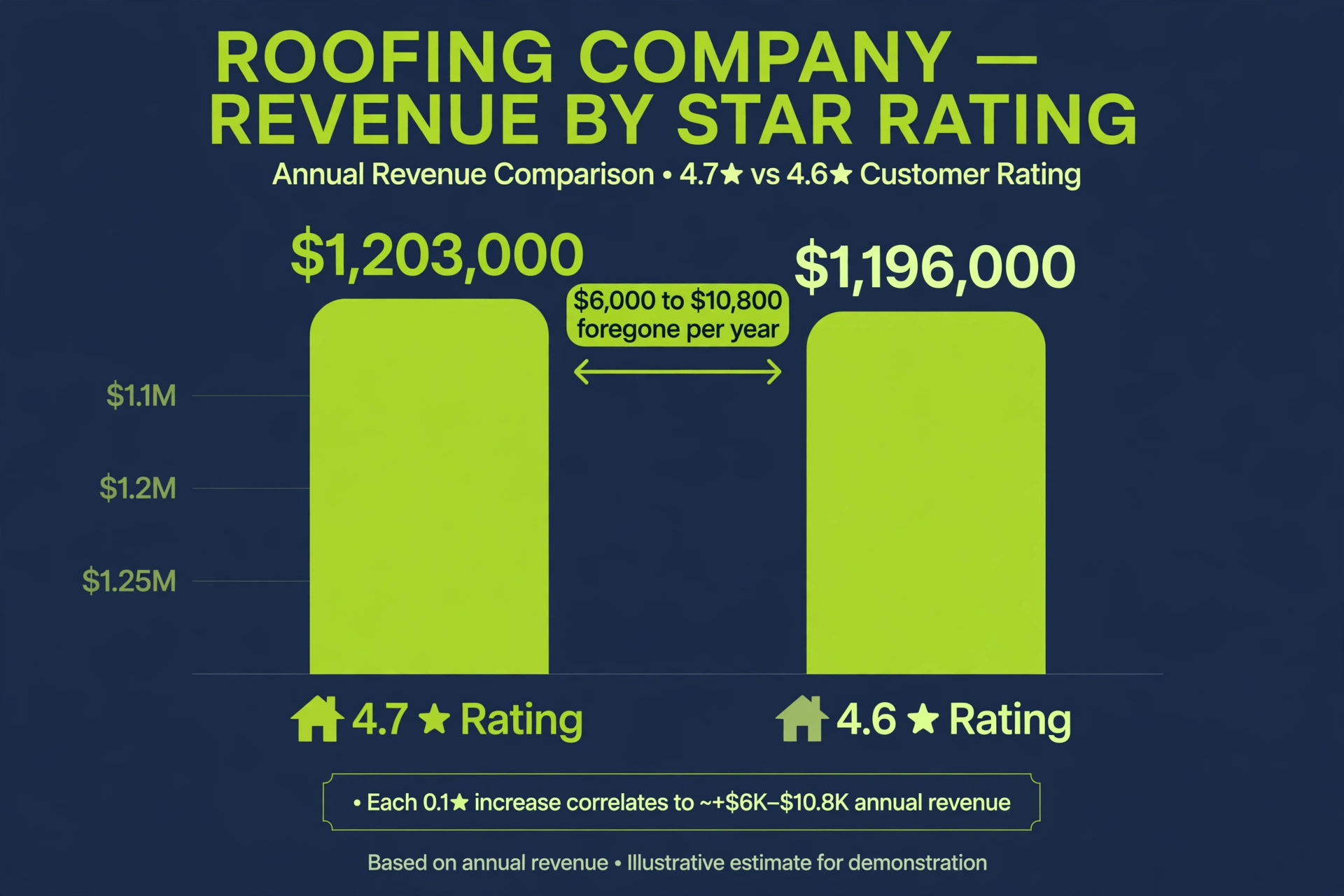
Now do the extrapolation, and I will label the assumptions so you can check me. A full star is worth 5 to 9 percent of revenue (Luca), so a 0.1-star drop is roughly 0.5 to 0.9 percent. Take a roofing company doing $1.2 million a year: $1,200,000 times 0.005 equals $6,000, and times 0.009 equals $10,800. A smaller company at $800,000 faces $4,000 to $7,200.
That is the illustrative extrapolation, and it is conservative: roofing jobs are ten to twenty times bigger than a restaurant check, so the swing per lost homeowner is enormous. A quick job-math check, same illustrative label: 40 estimates a month at a 25 percent close rate is 10 jobs at $11,500 average, or $115,000 a month in signed work. If the fresh 1-star sitting at the top of your profile deters just 5 percent of would-be callers, that is 2 fewer estimates a month, or 6 jobs a year. Six jobs at $11,500 is $69,000 a year in quoted revenue that never enters your pipeline, and at 30 percent gross margin about $20,700 of margin gone, every year, from one review left unanswered.
Run your own numbers in the free Revenue Leak Calculator at https://repupilot.7coxmos.com/ and see what your version of this leak looks like with your real revenue and job values.
Why does one bad review outweigh ten good ones in a homeowner’s mind?
Psychologists call it negativity bias, and review data confirms it behaves exactly the way you fear. BrightLocal’s 2026 survey found that 77% of consumers are put off by negative reviews, while ReviewTrackers reports that 94% of consumers said a single negative review convinced them to avoid a business at some point.
Think about it from the homeowner’s side. A roof replacement is a $10,000 to $20,000 decision, usually made under stress: a leak, storm damage, an insurance claim with a clock on it. That homeowner is not reading your 60 five-star reviews one by one. They scan the average, then click the lowest ratings to see what went wrong. Your ten best reviews are wallpaper. Your one bad review is the evidence they came looking for.
Three structural reasons make a single 1-star disproportionately powerful in roofing:
* Recency bias. BrightLocal 2026 found that 74% of consumers only care about reviews written in the last three months. A fresh 1-star reads as your current reality; your older five-stars read as history.
* The inspection effect. Roofing buyers look for reasons to disqualify, not qualify. When three roofers quote within a few thousand of each other, the homeowner breaks the tie on trust, and one detailed complaint about a leak never fixed breaks it against you.
* The AI summary effect. 45% of consumers now use AI tools for local recommendations (BrightLocal 2026). Those tools read your reviews and summarize them, so a vivid 1-star complaint becomes part of the answer to “should I hire this roofer?”
The 0.1-star drop is only half the story. The visible complaint, read by the most motivated buyers at the most decisive moment, is the other half.
How many 5-star reviews does it take to recover?
This is the part that surprises owners, because the recovery math has two answers and they are very different.
Stay with our example: you are at 283 stars across 61 reviews, a true average of 4.639, displayed as 4.6. You want your 4.7 back.
To get your displayed 4.7 badge back, you need your average at 4.65 or higher, because that is where Google rounds up to 4.7. Each new five-star review adds 5 stars and one review to the denominator. With 2 new five-star reviews: 293 total stars divided by 63 reviews equals 4.651, which displays as 4.7. Two reviews. That is fast.
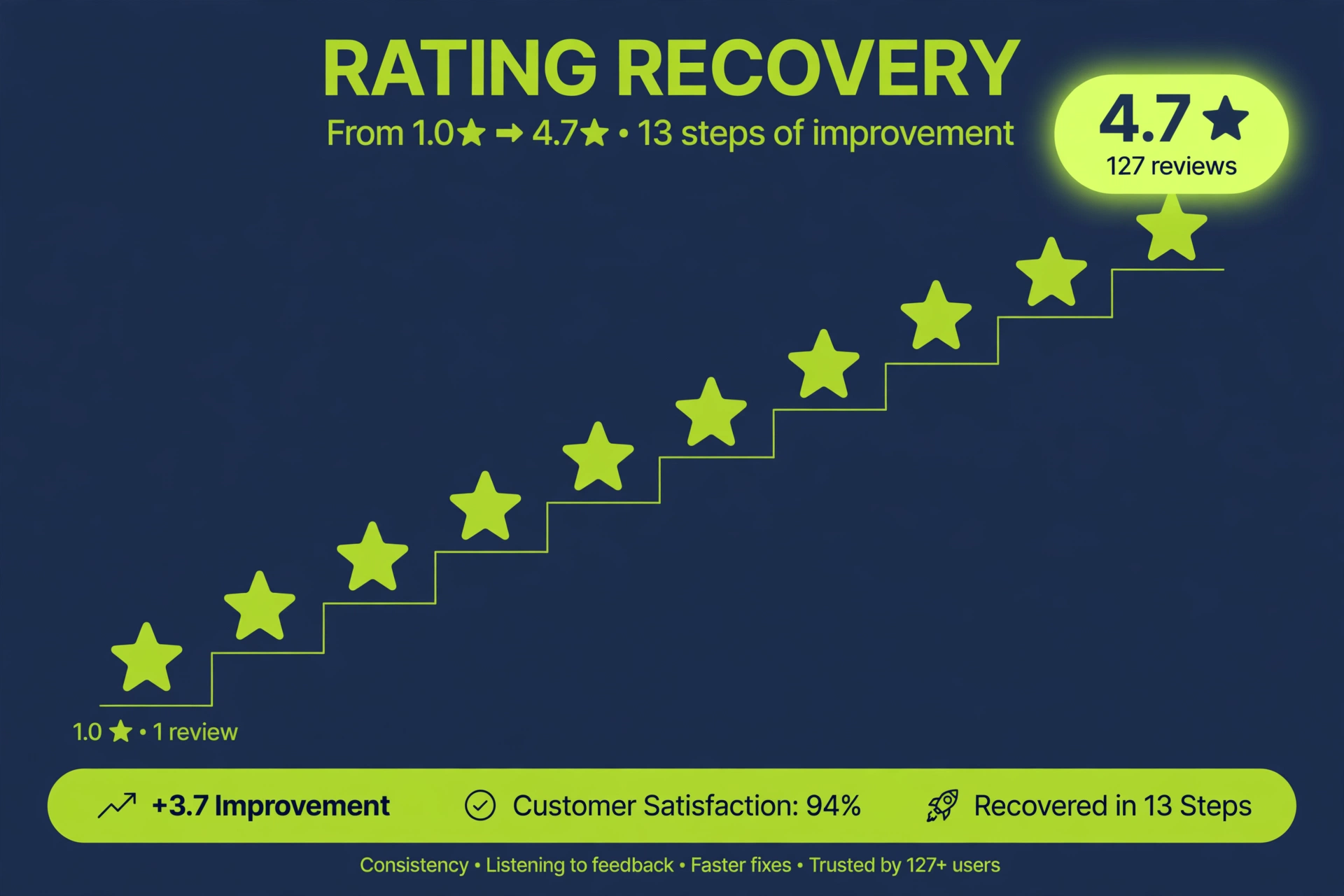
To get your true 4.7 average back, the math is harder. Solve for the number of five-star reviews n where (283 + 5n) divided by (61 + n) reaches 4.7. Try n equals 12: 343 divided by 73 equals 4.6986, which is still short. Try n equals 13: 348 divided by 74 equals 4.7027. Thirteen new five-star reviews to truly erase one 1-star.
Thirteen to one. That ratio is the real price of a bad review, and it is why review velocity is a revenue asset. A company collecting 5 reviews a month recovers in under three months. A company collecting one review a quarter sits at 4.6 for more than three years, paying that $6,000 to $10,800 a year the entire time.
Two more facts sharpen the point. BrightLocal 2026 found that 47% of consumers will not use a business with fewer than 20 reviews, and 32% look specifically for reviews written in the last two weeks. Recovery is not just about the average climbing. It is about fresh five-stars burying the complaint under recent proof that your company is doing good work right now.
Why does your reply matter more than the review itself?
Here is the part of this post that actually saves you money, because the rating math is what happened and the reply is what you control.
The review is one person’s complaint. Your reply is your public character witness, read by every future homeowner who opens your profile. ReviewTrackers found that 45% of consumers are more likely to visit a business that responds to negative reviews, and BrightLocal’s 2026 survey found that 80% are more likely to use a business that replies to all of its reviews. Roughly 9 in 10 consumers read the replies at all, and an unanswered 1-star tells them you did not notice or do not care.
Speed multiplies the effect. ReviewTrackers reports that 53% of consumers expect a response to a negative review within seven days, and Nation’s Restaurant News found that responding within 24 hours gives you a 33% higher probability of the reviewer coming back and upgrading their rating by as much as three stars. A fast reply can literally raise the star.
There is also a revenue angle to replying in general. Womply’s data, compiled by G2, found that businesses that respond to at least 25% of their reviews earn 35% more revenue on average. You do not need to reply to everything perfectly. You need a habit.
What should your reply actually say?
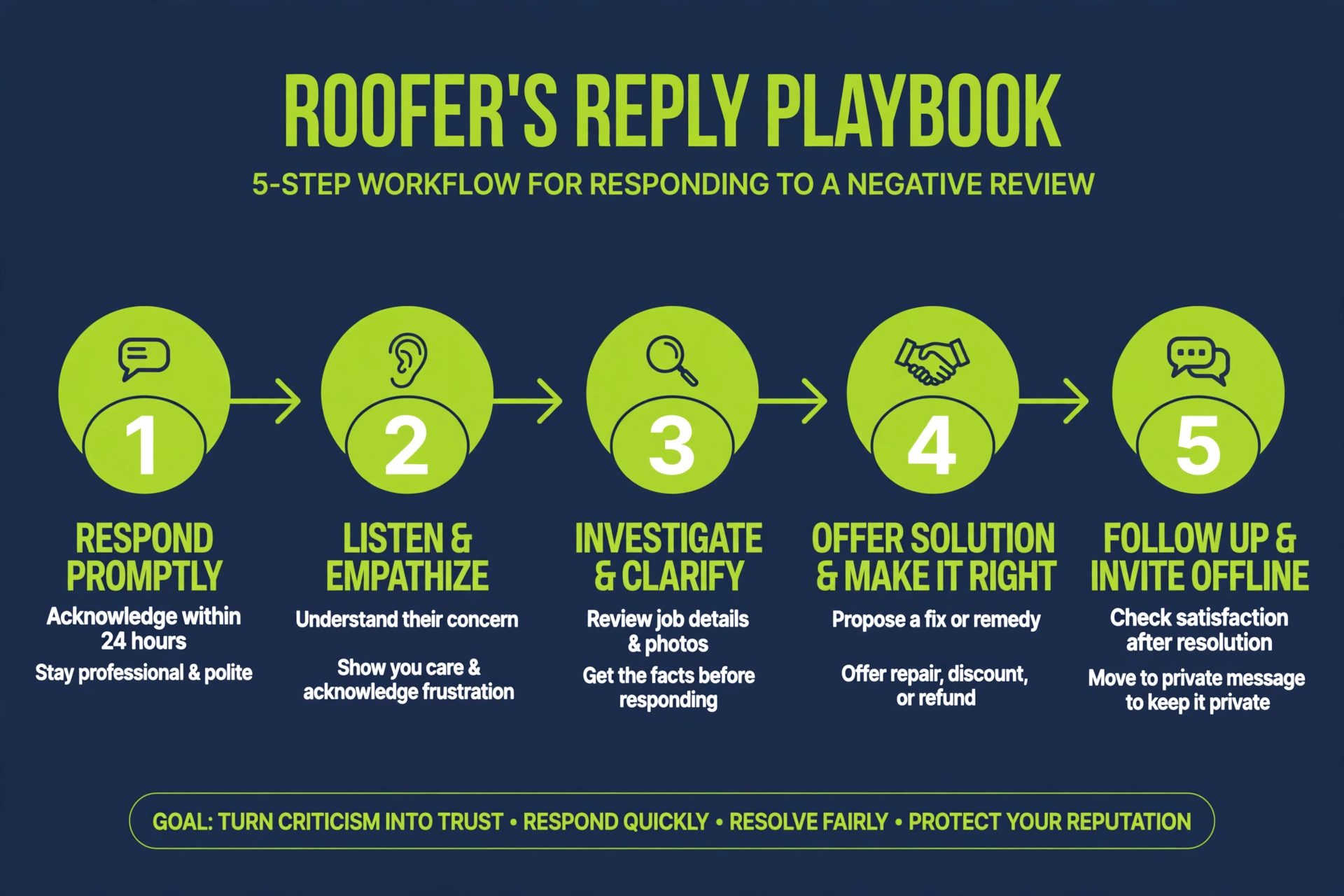
After years of watching what works on roofing profiles, the replies that contain the damage all follow the same five-part structure. Use it like a checklist, in your own words every time. BrightLocal 2026 found that generic or copy-paste replies put off 50% of consumers.
1. Name what they experienced, specifically. “I understand how frustrating a leak after a new roof must be” beats “we take all feedback seriously.” Specificity proves you read it.
2. Apologize for the experience, not the facts. “I am sorry this is how your project went” does not admit fault you do not believe you owe. Future homeowners read for tone, not legal liability.
3. Give one honest fact, without arguing. If the crew returned twice, say so in one sentence. Never debate the reviewer’s version in public. Every future reader will side with the homeowner.
4. Take it offline with a real path. “Please call me directly at [your number], this is [your name], the owner” is the single most powerful line in a review reply. It shows ownership and gives future readers proof a real person is accountable.
5. Invite the resolution publicly. “If we get this resolved, I would appreciate you updating your review” is fair and professional, and it works often enough that the 24-hour response stat above exists.
What not to do: never accuse the reviewer of lying, never mention lawyers or policies, never offer a refund or discount in the public reply (negotiate that privately, or every future complainer will expect one), and never ignore it hoping it fades. It does not fade. It sits at the top of your profile until thirteen five-stars bury it.
The deeper point is the system. If one 1-star takes thirteen five-stars to erase, the company that asks every happy customer for a review never has a crisis. The company that never asks turns every bad day into a three-year penalty.
Bottom Line
One bad review is a priced event, not a vibe. It moved your displayed rating from 4.7 to 4.6, it costs something like $6,000 to $10,800 a year in foregone revenue on a $1.2M book until you recover, and it takes thirteen new five-stars to truly erase. But the reply is where you win back the strangers reading it, sometimes win back the reviewer, and prove to every future homeowner that a real owner stands behind the work.
This is the kind of leak RepuPilot was built to plug: the quiet revenue damage hiding in your review profile, priced honestly, with the review flow and reply habits that keep a single bad day from becoming a three-year tax. Run your own numbers in the free Revenue Leak Calculator at https://repupilot.7coxmos.com/ and find out exactly what your rating is costing you. Then go reply to that 1-star today, within 24 hours, like the math depends on it. It does.
FAQs
Can I get a 1-star review removed from my Google profile? Only if it violates Google’s review policies, such as fake content, conflicts of interest, or offensive language. You can flag it from your Google Business Profile, but Google rarely removes reviews that are simply negative. Plan as if it stays, and put your energy into the reply and the reviews that bury it.
How fast should I reply to a 1-star review? Within 24 hours. ReviewTrackers reports that 53% of consumers expect a response within seven days, but Nation’s Restaurant News found that replying within 24 hours gives you a 33% higher probability of the reviewer returning to upgrade their rating.
Should I offer a refund or discount in my public reply? No. Keep the public reply to acknowledgment, one honest fact, and an invitation to talk directly, then negotiate any refund privately. Offering money publicly trains every future complainer to expect the same treatment.
Does replying actually bring customers back? Beyond the 33% upgrade finding, ReviewTrackers found 45% of consumers are more likely to visit a business that responds to negative reviews, and BrightLocal 2026 found 80% are more likely to use a business that replies to all of its reviews.
Will one 1-star review hurt my Google ranking? The rating is one of several review signals Google weighs for the local map pack. One 1-star will not sink a strong profile overnight, but a lower displayed average reduces clicks, and fewer clicks is exactly how a ranking slide starts. The click loss is the mechanism, not a penalty.
How many 5-star reviews does it take to recover from one 1-star? It depends on your review count, but for a roofer at 4.7 with 60 reviews, the worked math in this post shows 2 new five-stars restore the displayed 4.7 badge and 13 restore the true 4.7 average. Smaller profiles need more. Steady review velocity is the cheapest insurance you own.
What if the 1-star review is fake or from a competitor? Flag it through your Google Business Profile and document why it violates policy. While you wait, still reply calmly and factually, because the flag may take weeks and homeowners read the profile in the meantime. A composed reply to a suspicious review reassures readers more than silence.
Should I reply to old 1-star reviews I never answered? Yes, if they are still visible near the top of your profile. A late, genuine reply still shows future readers that an owner is paying attention. Keep it short, give the direct phone number, and fix the system so the next one gets answered within 24 hours.