Every roofer gets one eventually. The 1-star review that makes your stomach drop. Maybe the complaint is fair. Maybe it is exaggerated. Maybe the person was never your customer at all. But it is sitting on your Google profile, and every homeowner who considers you will read it.
Here is the direct answer: responding to negative Google reviews protects a roofer's reputation because future customers judge your response more than the complaint. Research shows 80% of consumers are more likely to use a business that responds to all of its reviews, while 42% are unlikely to use one that ignores reviews entirely (BrightLocal, 2026). A calm, specific, professional reply to a bad review often sells more roofs than the 5-star reviews around it.
Quick Answer
Respond to every negative Google review within a week: thank the reviewer by name, acknowledge the specific issue without arguing or admitting fault, state what you will do, and move the conversation to a phone call. 80% of consumers are more likely to use a business that responds to all reviews (BrightLocal, 2026).
Why Does Your Response Matter More Than the Bad Review?
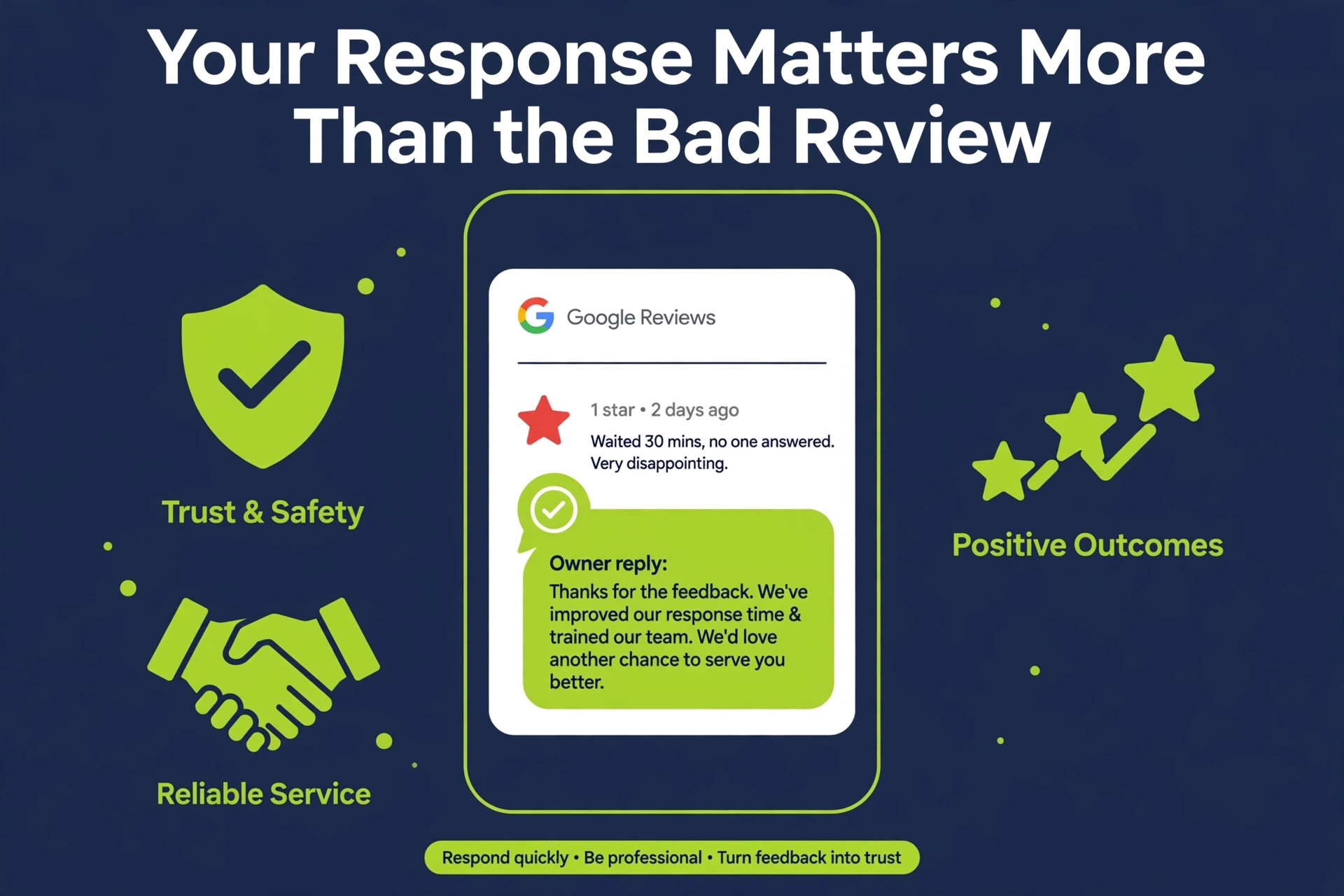
Here is the part most roofers miss: the negative review is not written for you. It is written for the next homeowner. And that homeowner is watching how you handle it.
When someone reads a 1-star review that says "they left nails all over my driveway," they do not just absorb the complaint. They scroll down to see what the company said. No response reads as guilt or indifference. A defensive response reads as a company that argues with customers. A calm, specific, accountable response reads as a company that stands behind its work. That third version can actually win you the job, because the homeowner thinks: "If something goes wrong with my roof, this is how they will treat me."
The research is blunt. 89% of consumers expect business owners to respond to reviews (BrightLocal, 2026). 80% are more likely to use a business that responds to all of them. 42% are unlikely to use a business that ignores reviews entirely. And here is the trap: 50% say generic, templated responses make them unlikely to choose the business. A copy-paste "We value your feedback" reply is almost as bad as silence. The homeowner can smell it.
There is also a ranking angle. Google itself recommends responding to reviews, saying it signals an active, engaged business. Businesses that consistently respond see measurable improvement in local visibility. And there is a compounding benefit: businesses that respond to reviews earn about 12% more reviews overall and carry an average rating 0.12 stars higher (ReviewTrackers, 2026). Responding does not just fix the bad review. It lifts the whole profile.
What Are the Golden Rules Before You Type a Word?
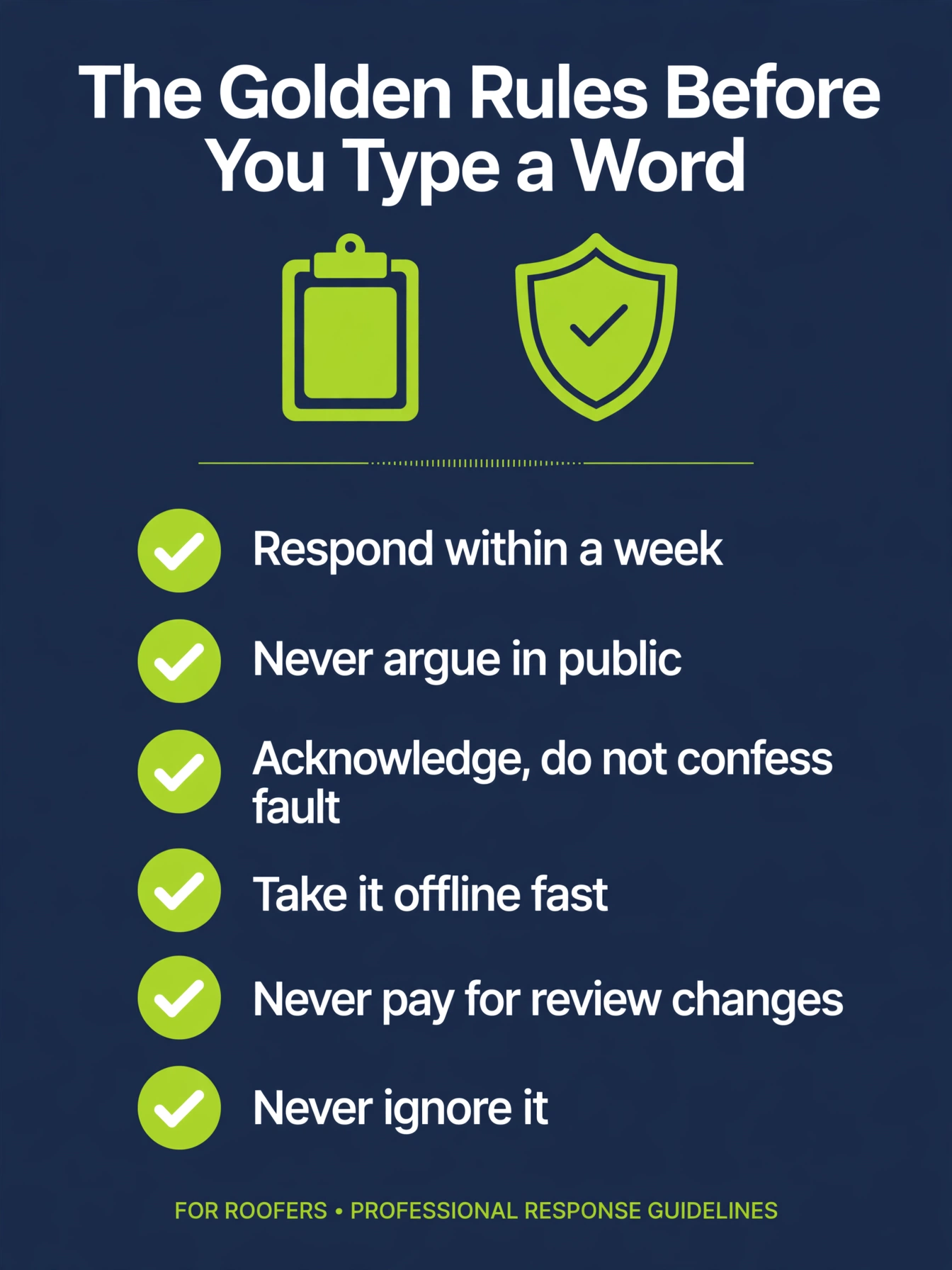
Before you touch a single template, lock in these rules. They apply to every negative review response, every time.
Rule 1: Wait, then respond within a week. Never reply while you are angry. Sleep on it if you need to. But do not let it sit for a month either: 19% of consumers expect a same-day response and 81% expect one within a week (BrightLocal, 2026). Fast and calm beats slow and perfect.
Rule 2: Never argue in public. You will never win an argument on your Google profile. Even if the reviewer is wrong about the shingle warranty or the timeline, the profile is not a courtroom. The homeowner reading the exchange is the jury, and they always side against the company that fights.
Rule 3: Never admit legal liability. Saying "we installed the flashing wrong and it caused the leak" is honest, but it is also a written admission on a public platform. Acknowledge the experience ("I understand how frustrating a leak is") without confessing fault. Let any real dispute be handled by phone or in person.
Rule 4: Take it offline fast. Every response should end with a name, a phone number, and an invitation to talk. Public thread: two messages maximum, yours and maybe one follow-up. Everything substantive happens on the phone.
Rule 5: Never offer payment or discounts for review changes. Google prohibits incentivized reviews. Offering a homeowner money or a free repair in exchange for editing a review can get the review removed and your profile flagged. Fix the problem because it is the right thing, not as a trade.
Rule 6: Do not ignore it. Around 75% of businesses never respond to negative reviews (industry data widely cited in 2026 review-management research). Simply showing up, thoughtfully, puts you ahead of three quarters of your competition.
How Do You Respond to a Legitimate Complaint?
This is the most common case: a real customer, a real problem. A callback that took too long. A cleanup that missed nails. A leak after a repair. The homeowner is angry, and some of it is fair.
The formula: Name + empathy + specific acknowledgment + what you are doing + offline contact. Here is a template roofers can adapt:
Hi [Name], thank you for letting us know, and I am sorry about [the specific issue, e.g., the nails left in your driveway after our crew finished]. That is not the standard we hold our crews to. Our production manager is reviewing this with the team today, and I would like to make this right personally. Please call me at [phone number] and ask for [your name] so we can take care of it right away.
Why this works: it uses the homeowner's name, it names the specific issue (which proves you actually read the review and know the job), it shows a concrete action, and it moves the conversation to the phone. Future customers reading this see accountability, not excuses.
Do not relitigate the facts, and do not grovel: one sincere apology is enough.
After you resolve the issue on the phone and the customer is genuinely satisfied, you can post a short public follow-up: "Glad we got this sorted for you, [Name]. Thanks for giving us the chance to make it right." If the customer voluntarily updates or removes the review, that is their choice. Never ask them to.
What If the Review Is Fake or From Someone Who Was Never Your Customer?
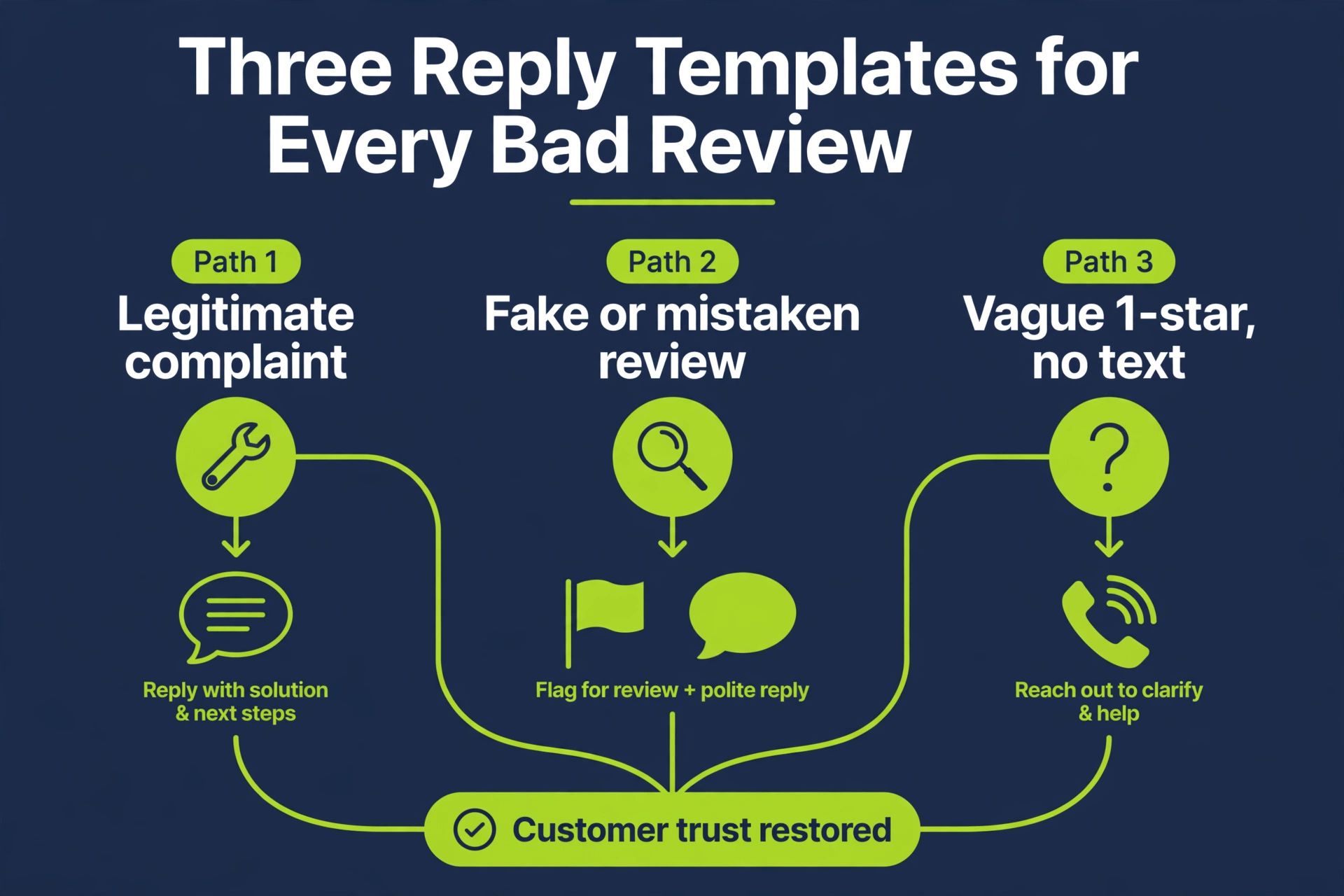
This happens more than roofers expect. A competitor's friend. A confused homeowner who mixed you up with another company. A tenant complaining about a landlord's roofer. Google's policy allows you to flag reviews that violate its rules, including fake engagement and reviews from non-customers.
First, do not accuse the reviewer publicly of lying. Even when you are sure, a public accusation looks terrible to the next homeowner. Instead, respond with calm specificity that exposes the gap:
Hi [Name], we take every review seriously, but we cannot find any record of work at your address or under your name. It is possible this review was meant for a different company. Please call us at [phone number] so we can look into this together. If you did use a different roofer, we would appreciate you moving the review to the right business.
This does two things. It signals to future readers that the review may not be legitimate, and it gives the reviewer a graceful exit. Many fake or mistaken reviews get deleted or edited after a response like this.
Second, flag the review in your Google Business Profile. Click the three dots on the review, report it, and select the violation type (fake engagement or conflict of interest). Google's review moderation is slow and inconsistent, so do not count on removal. The public response is your real defense; the flag is a bonus.
One caution: only flag reviews that genuinely appear fake or mistaken. Flagging every negative review trains Google to ignore your flags and wastes your time.
What About the Vague 1-Star Review With No Text?
The star-only review is the most annoying kind. No explanation. No details. Just a 1 sitting on your profile, dragging your average down, and you have no idea what happened.
Respond anyway. The response is short and it is mostly for the audience:
Hi [Name], we are sorry to see the 1-star rating, but without details we are not sure what went wrong. We would genuinely like to fix it. Please call [your name] at [phone number] so we can find out what happened and make it right.
Most of the time you will never hear from them. That is fine. The response still does its job: it shows every future homeowner that you care enough to chase down even an anonymous complaint. An unanswered star-only review looks like you do not care. A answered one looks like a company that takes every signal seriously.
If the reviewer does call, treat it like any legitimate complaint and follow the template above.
How Do You Reply to Positive Reviews Without Sounding Robotic?
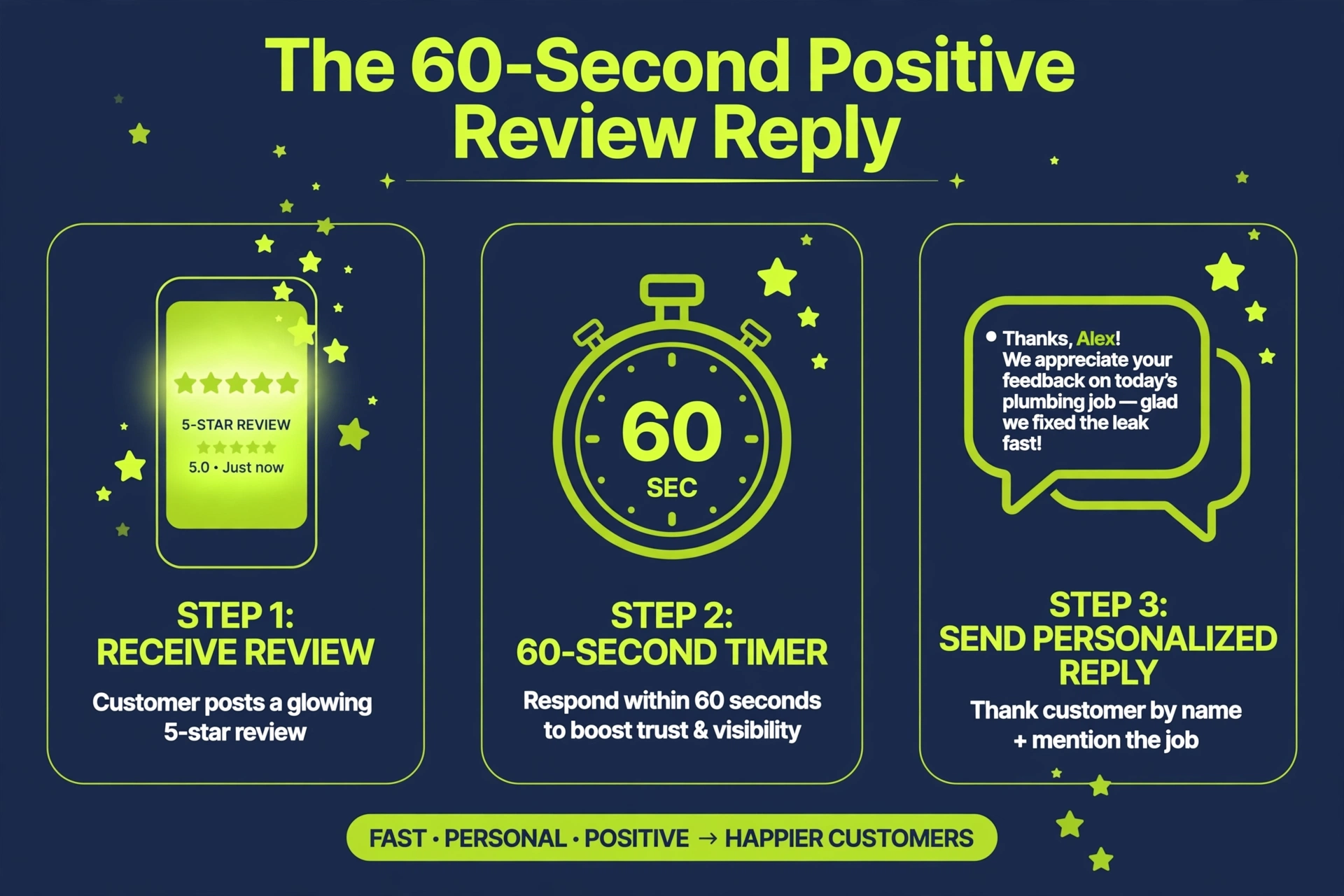
This is the part roofers skip, and it is a mistake. 80% of consumers are more likely to use a business that responds to all reviews, and that includes the 5-star ones (BrightLocal, 2026). Reply to everything: answering only negative reviews looks defensive, while answering all of them looks engaged.
The 60-second positive reply formula: name + specific detail from their review + genuine thanks + one line about the job. Example:
Thanks, [Name]! Glad the new architectural shingles came out looking sharp. It was a pleasure working on your home, and we appreciate you trusting us with the roof.
That took 30 seconds. It references the actual job (architectural shingles), which proves it is not a template. Compare that to "Thank you for your 5-star review! We appreciate your business." The second version is what 50% of consumers say puts them off (BrightLocal, 2026).
Make it a system, not a mood. Whoever checks the company email each morning also checks the Google profile and replies to anything new. Positive replies take under a minute. Negative replies take five minutes of thought. Total weekly time: under 30 minutes for most roofing companies. Or automate the draft and approve it with one tap. The key is that every review gets a human-sounding response from someone who knows the job.
What Should You Never Do in a Review Response?
A quick blacklist, because these mistakes are common and costly:
Bottom Line
A negative review is not a reputation disaster. An unanswered negative review is. The homeowner reading your profile is not looking for a roofer with zero complaints. They are looking for a roofer who handles complaints like a professional. Every response you write is a public demonstration of how you treat customers when things go wrong, which is exactly what a homeowner spending $10,000 on a roof needs to see.
The roofers who win on reputation are not the ones who never get bad reviews. They are the ones with a system: every review answered within a week, every complaint taken offline and resolved, every positive review acknowledged by name. It takes 30 minutes a week and it compounds.
This is the part of reputation management that most roofing companies never systematize, which is exactly why it is an advantage for the ones who do. RepuPilot keeps every review answered for roofing companies: instant alerts when a review lands, professional draft replies that reference the actual job, and one-tap approval so nothing ever sits unanswered. The review itself you cannot control. The response, and everything it earns you, is entirely in your hands.
Frequently Asked Questions
Should roofers respond to every Google review?
Yes, positive and negative. 80% of consumers are more likely to use a business that responds to all of its reviews, and 42% are unlikely to use one that ignores reviews (BrightLocal, 2026). Responding to everything signals an engaged, accountable company.
How fast should a roofer respond to a negative review?
Within a week at the latest. 19% of consumers expect a same-day response and 81% expect a response within a week (BrightLocal, 2026). Never reply while angry, but do not let it sit for weeks either.
What is the best template for responding to a negative roofing review?
Thank the reviewer by name, acknowledge the specific issue without arguing or admitting legal fault, state what you are doing about it, and move the conversation to a phone call with your name and number. Keep the public thread to one or two messages.
Can roofers get fake Google reviews removed?
You can flag reviews that violate Google's policies (fake engagement, non-customer reviews) from your Google Business Profile, but moderation is slow and removal is not guaranteed. Always post a calm public response first: it is your real defense, and it exposes the gap for future readers even if the review stays up.
Should you offer a discount to get a negative review removed?
No. Google prohibits incentivized reviews, and offering payment or free work in exchange for editing a review can get your profile flagged. Fix legitimate problems because it is the right thing to do, and let the customer decide on their own whether to update the review.
How do you respond to a 1-star review with no text?
Post a short public reply asking what went wrong and inviting a phone call with your name and number. You may never hear back, but the response shows future homeowners you chase down every complaint. An unanswered star-only review looks like indifference.
Do review responses help a roofer's Google ranking?
Yes. Google recommends responding to reviews as a signal of an active, engaged business, and businesses that respond consistently see better local visibility. Businesses that respond to reviews also earn about 12% more reviews and carry a 0.12-star higher average rating (ReviewTrackers, 2026).