
You have 187 Google reviews and a 4.8 average. Your competitor has 94 reviews and a 4.6. And he is outranking you in the map pack. How? Look at the dates. His last review came in yesterday. Yours came in four months ago. Google does not rank your past. It ranks your present.
Here is the direct answer: review velocity — the steady flow of new reviews per month — matters more than your total review count for local rankings. Industry analyses put review signals at roughly 20 to 25% of map pack ranking weight, with velocity and recency carrying the heaviest share, and 74% of consumers only trust reviews written in the last three months (BrightLocal, 2026). A roofer pulling 4 to 10 new reviews every month will outrank a roofer sitting on a large but frozen total.
Quick Answer
A roofing company needs roughly 4 to 10 new Google reviews per month, with 3 to 5 as the practical floor. Steady velocity beats total count: 74% of consumers only trust reviews from the last three months (BrightLocal, 2026), and fresh-review flow lifts rankings within 30 to 60 days.
What Is Review Velocity, and Why Does Google Care About It?
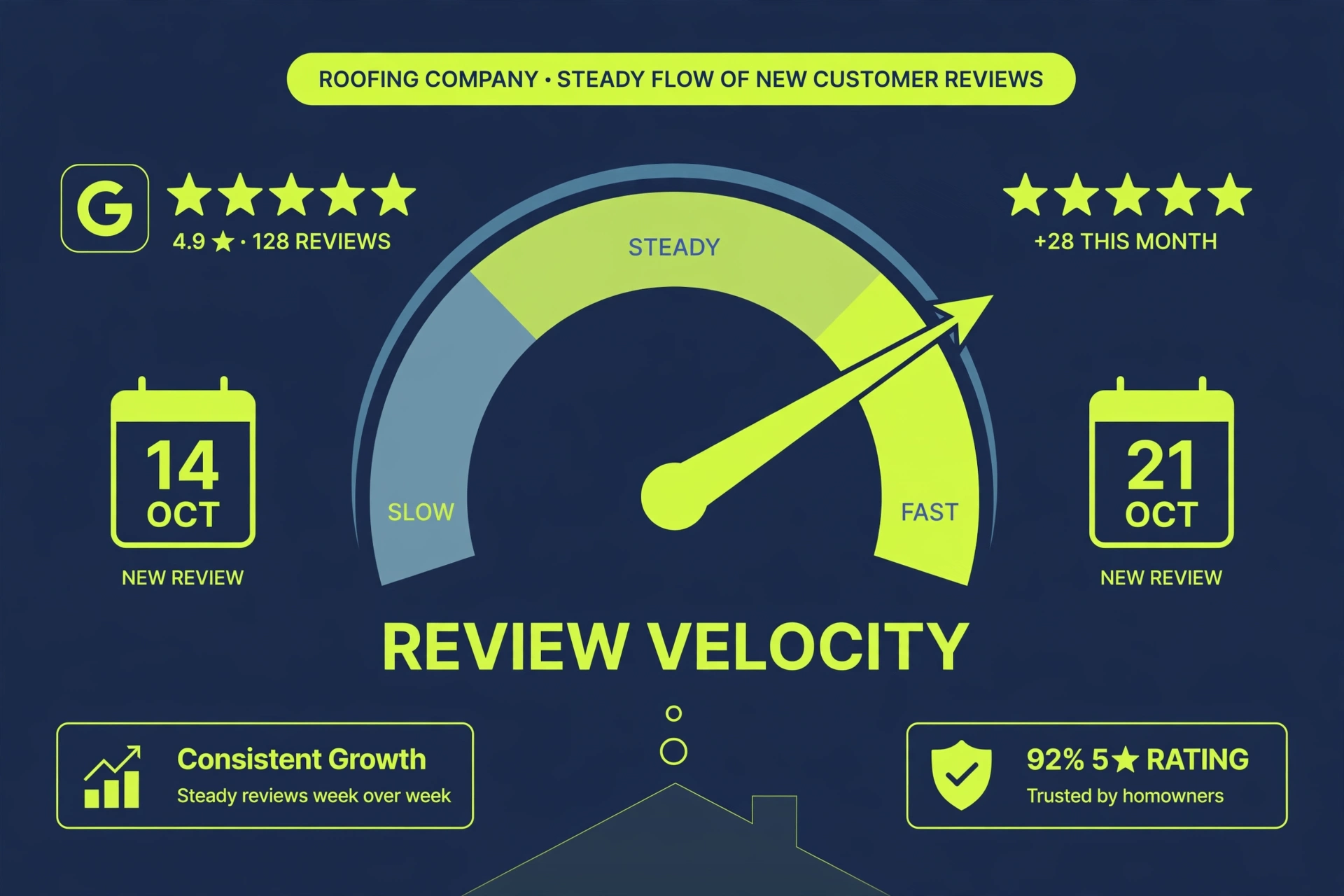
Review velocity is simply the rate at which new reviews land on your Google Business Profile: how many per week, per month, sustained over time. Google's local algorithm treats it as a freshness and trust signal. A business earning new reviews every week looks alive, active, and currently trusted by real customers. A business whose reviews stopped six months ago looks dormant, and Google has no current proof that the quality is still there.
Velocity works on two fronts. On the ranking side, it feeds the prominence factor Google uses to order map pack results. On the conversion side, fresh reviews are what the homeowner actually reads — when 74% of consumers ignore anything older than three months, your 2024 reviews are decoration and your 2026 reviews are the product page.
How Many Reviews Per Month Does a Roofer Actually Need?
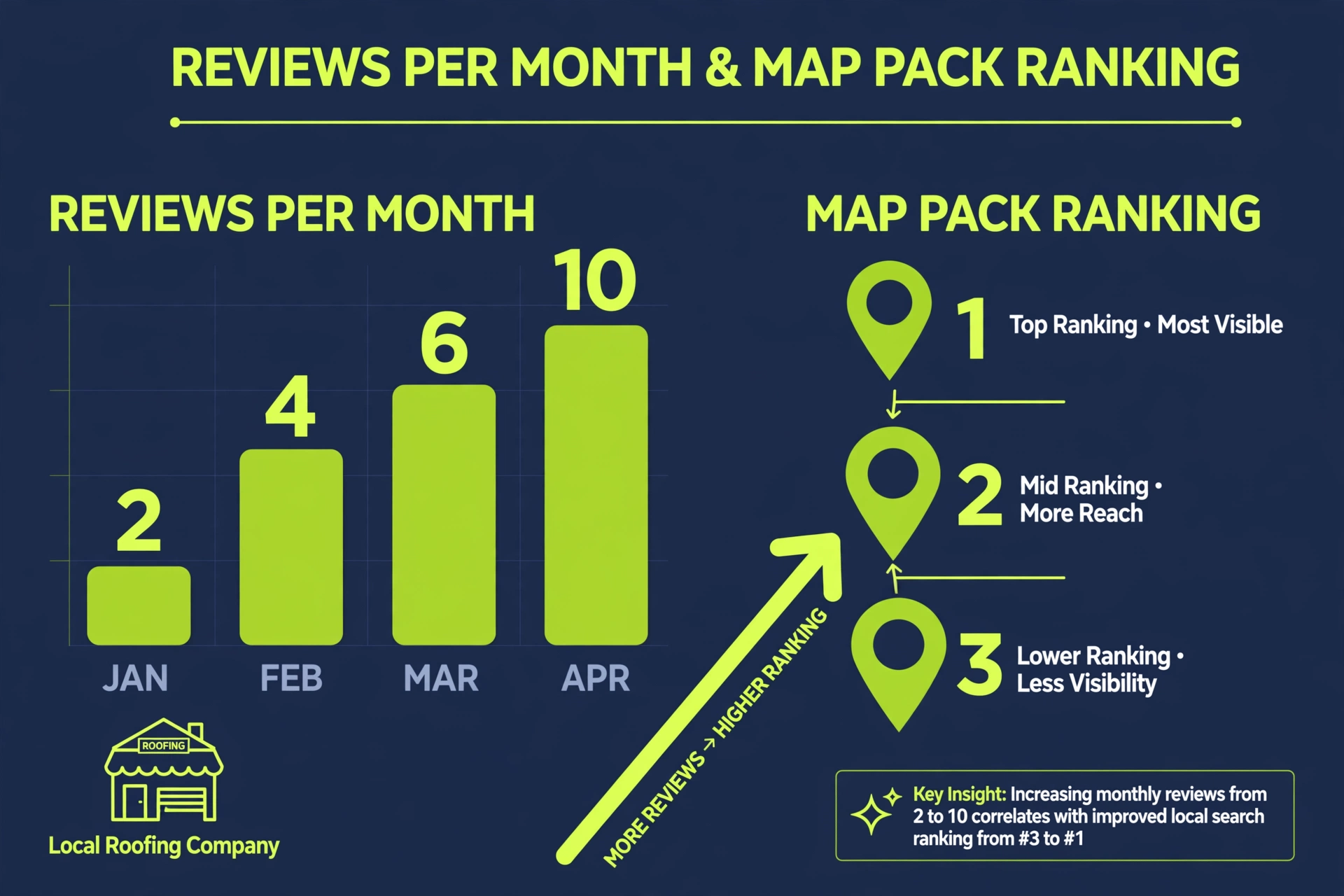
There is no number Google publishes, but the industry benchmarks converge into a useful range:
Translate that to a roofing operation. A residential roofer doing 12 to 15 jobs a month who asks every customer for a review and converts 35 to 40% of asks into reviews produces 4 to 6 reviews monthly. That puts you squarely in the competitive range with no heroics — just a system that asks, every job, every time.
The honest truth: the right number is relative. If your top three competitors each add 2 reviews a month, you adding 6 will separate you within two quarters. Velocity is a race, not a test score — the number that matters is "more, and more consistently, than the guys you are trying to outrank."
And one more benchmark worth knowing: businesses that start generating regular fresh reviews see ranking improvements within 30 to 60 days (BrightLocal data reported by ReviewDriver). This is not a twelve-month SEO project. It is a two-month compounding habit.
Why Does a Steady Drip Beat a Big Burst of Reviews?
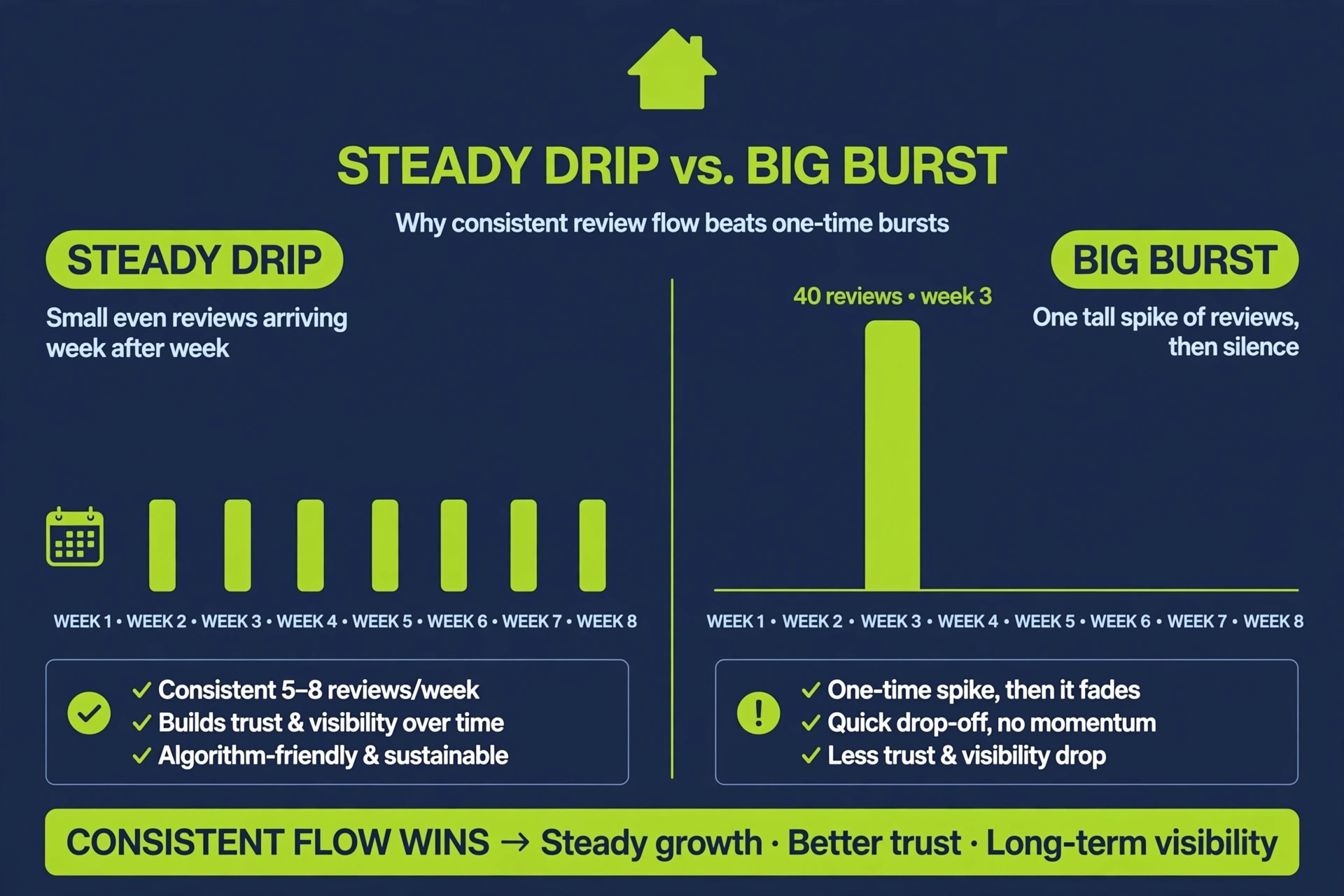
Every roofer knows a guy who did this: got excited about reviews in March, asked twenty customers at once, collected 30 reviews in a week, then forgot about it for eight months. His profile has a spike and a flatline. Google reads that pattern exactly the way it looks — unnatural.
A steady drip of 1 to 2 reviews per week beats a 30-review burst for three reasons:
Reason 1: It looks real. Reviews arriving in unnatural spikes can trip authenticity filters. Google analyzes review timing patterns to separate authentic feedback from manipulation (ReviewDriver, 2026 analysis). A burst after months of silence is the pattern paid-review schemes produce. A steady flow is the pattern real businesses produce. You never want your profile to resemble the second kind.
Reason 2: It keeps you current. Thirty reviews in March are stale by July. The homeowner reading your profile in July sees nothing recent and moves on. Six reviews a month means there are always reviews from the last two weeks — and 32% of consumers specifically look for reviews from the last two weeks (BrightLocal, 2026). The drip always has something fresh. The burst has nothing fresh most of the year.
Reason 3: It compounds in rankings. Each new review is fresh content on your profile — indexable, keyword-bearing, recency-stamped. Owner responses add even more fresh content. A business adding reviews weekly is feeding Google new relevance signals weekly. The burst business feeds Google once and then goes quiet for eight months. Ranking is a moving calculation, and the drip keeps moving with it.
The operational takeaway: never batch your review asks. Ask after every single job, within 24 hours, by text. The system should be boring and relentless — that is the whole point.
What Happens When Your Review Flow Stops Completely?
It decays. Slowly, then visibly. Here is the honest timeline of a stalled review profile:
Months 1 to 2: Nothing dramatic. Rankings hold on momentum. You might not notice anything at all, which is why most roofers do not notice until month five.
Months 3 to 4: Recency starts working against you. 74% of consumers now distrust everything on your profile because all of it is older than three months. Click-through from the map pack softens. Competitors with fresh reviews start passing you on the freshness signals.
Months 5 to 8: The ranking slide becomes visible. Your competitors kept adding 4 to 6 reviews a month. Over six months that is 24 to 36 fresh reviews each while you added zero. The velocity gap is now a volume gap too, and it is growing every week. Meanwhile every new review your competitors earn contains keywords — "roof replacement," "storm damage," your city name — that Google scans for relevance. Their profiles are getting more relevant to search queries while yours sits frozen.
Month 9 and beyond: You are now the profile with the impressive total and the dead feed. Homeowners assume you went out of business, changed ownership, or stopped caring. The competitor with half your total reviews but six from this month looks like the active, thriving choice. Because he is.
The cruelest part: restarting is harder than never stopping. Google rewards consistency, and a business restarting after a long stall has to rebuild the trust pattern from scratch. The roofer who never stopped just keeps compounding.
How Do You Build a Review System That Never Stalls?
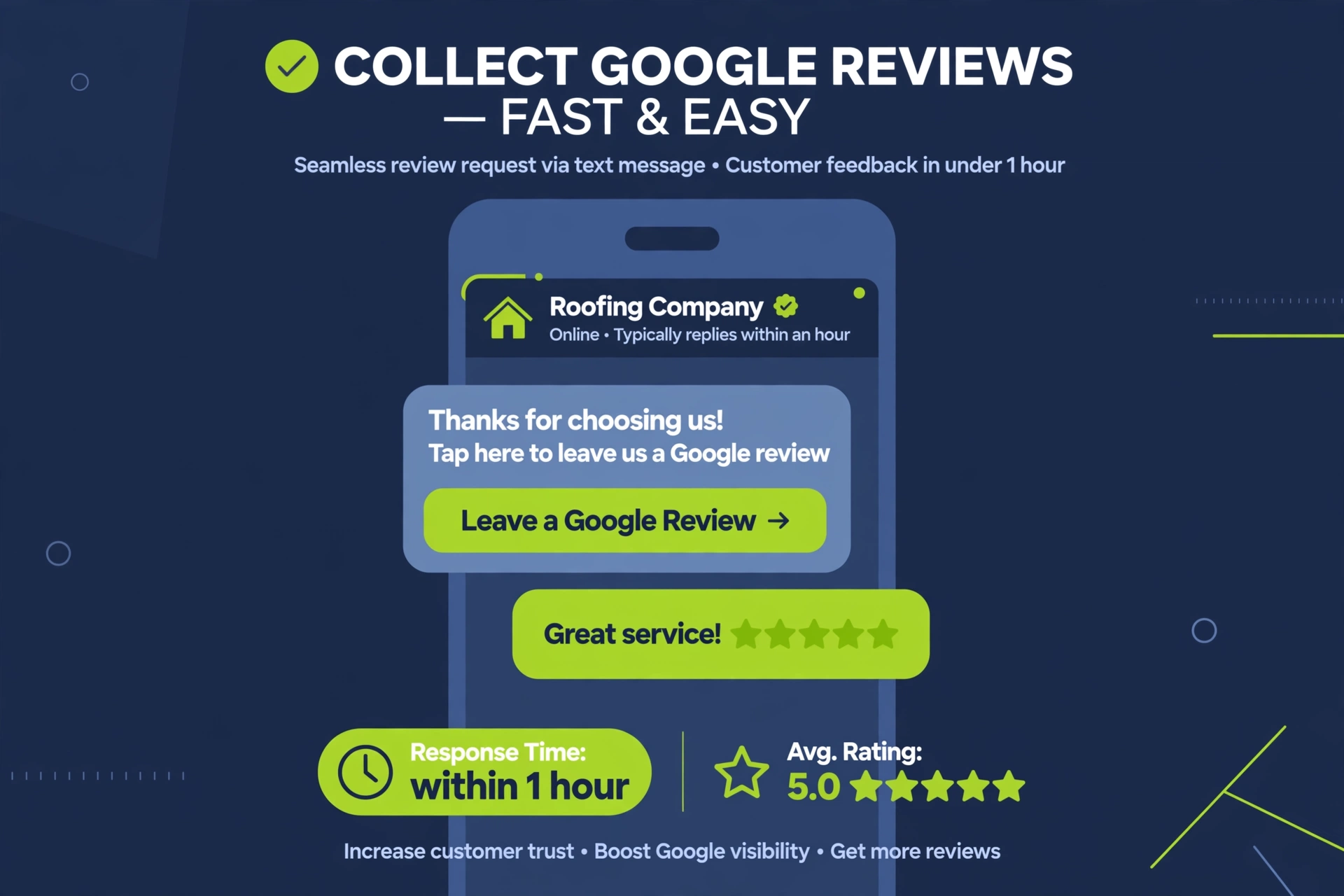
Velocity dies when review generation depends on someone remembering to ask. The crew is tired after a tear-off. The office is juggling permits. Nobody asks. The system has to run without human memory.
Step 1: Trigger the ask automatically at job completion. The moment the final walkthrough is signed off and the invoice is paid, the customer gets a text with a one-tap Google review link. Not tomorrow. Not "when the office gets to it." Within the hour, while the new roof is still the thing they are happiest about. Texts get opened; emails get buried. This single step is responsible for most of the velocity gap between roofers.
Step 2: Send exactly one follow-up. If the customer does not review within 3 to 5 days, send one polite follow-up text. Not three. Not a phone call. One nudge. This typically converts another chunk of the non-responders without annoying anyone.
Step 3: Respond to every review within a week. Responding correlates with up to 18% more revenue and about 12% more reviews earned, and 89% of consumers expect a response within a week (BrightLocal, 2026). Owner replies also add fresh, indexable content to your profile — every response is a small ranking deposit.
Step 4: Cover the slow months deliberately. Roofing has natural quiet periods. That is exactly when most profiles stall and exactly when a few proactive asks separate you. After every repair, every inspection, every maintenance visit — ask. A repair customer can leave a review just like a replacement customer. The slow season is when your competitors stall, which makes it the cheapest time to gain ground.
Step 5: Track it like a KPI. One number on the dashboard: new Google reviews this month. Target 6. If you are at 2 by the 15th, the ask stopped going out. Velocity problems are almost always system problems, not customer problems — customers are happy to review, they just need to be asked.
One rule on top of everything: never buy reviews, never pay for reviews, never selectively ask only happy customers in a way that filters out honest feedback. Google's policies treat manipulation seriously, and review spikes from paid sources are exactly the unnatural patterns that get profiles filtered. Real jobs, real asks, real reviews. The honest system is also the fastest system, because it is the only one that survives.
How Fast Will You See Rankings Move Once Velocity Picks Up?
Faster than most roofers expect, slower than they hope. Here is the realistic curve:
Weeks 1 to 4: Trust signals start accumulating. Your profile shows reviews from this month, and click-through and call volume often improve before rankings do — the conversion side of velocity moves first.
Days 30 to 60: This is the window BrightLocal's data points to for ranking improvements from fresh review activity. If you go from zero to 6 reviews a month and hold it, expect to see movement in the map pack within two months. Not from position 9 to position 1 — but from the edge of the pack into it, or from 3 to 2.
Months 3 to 6: Compounding kicks in. You now have 18 to 36 recent reviews. Your competitors who stalled are visibly stale next to you. The gap that took them years to build through total count, you are closing through recency. This is also when the keyword content in your fresh reviews — "hail damage repair," "new roof," your service cities — starts stacking relevance signals.
Month 12: A roofer who held 6 reviews a month for a year has 72 new reviews, all recent and keyword-rich. In most mid-size markets, that is the profile sitting at the top of the map pack.
The math only works if the velocity holds. Start and stop, and you reset the clock. The roofer who treats review generation like showing up to the job site — every day, no excuses — wins. It is that simple, and that hard.
Bottom Line
Your total review count is your history. Your review velocity is your pulse. Google ranks the pulse, homeowners trust the pulse, and the competitor adding six reviews a month is beating your 200-review profile on the only metric that moves: right now.
The fix is not complicated. Ask every customer, by text, within an hour of the final walkthrough. Follow up once. Respond to everything within a week. Track the monthly number like it is revenue — because it turns into revenue. Four to ten reviews a month, every month, and the map pack takes care of itself.
This is exactly the machine RepuPilot runs for roofing companies: every finished job triggers a review request at the right moment, every review gets a response on time, and your velocity never stalls — even in the slow months when your competitors go quiet. The roofers holding the top of the map pack are not luckier than you. Their system just never stops asking.
Frequently Asked Questions
How many Google reviews per month does a roofer need to rank well?
Aim for 4 to 10 new reviews per month in competitive markets, with 3 to 5 as the practical floor. Businesses receiving regular fresh reviews see ranking improvements within 30 to 60 days (BrightLocal). Consistency matters more than hitting a specific number — 6 reviews a month for six straight months beats 40 reviews in one week followed by silence.
Does review velocity matter more than total review count?
For rankings, velocity and recency now carry more weight than raw volume. A competitor with 60 total reviews and 6 new ones this month will typically outrank a business with 200 total reviews and none in the last six months. Total count still matters for homeowner trust, but it is velocity that moves the map pack.
What is a good review velocity for a roofing company specifically?
A residential roofer doing 12 to 15 jobs a month who asks every customer and converts 35 to 40% of asks into reviews produces 4 to 6 reviews monthly — right in the competitive range. Larger operations and storm-chasing crews in active markets should target 8 to 12 per month to stay ahead of competitors who are also generating reviews.
Can getting too many reviews too fast hurt my rankings?
Yes, if the pattern looks unnatural. Review spikes after months of silence can trip authenticity filters, since that is the pattern paid-review schemes produce. Build velocity gradually — a natural ramp of a few reviews per week is safe; 40 reviews in two days after a year of silence is a red flag.
Do review responses affect review velocity or rankings?
Responses do not create velocity directly, but businesses that respond to all reviews earn about 12% more reviews and carry ratings about 0.12 stars higher, and 89% of consumers expect a response within a week (BrightLocal, 2026). Owner replies also add fresh, indexable content to the profile.
Why did my rankings drop even though my review count is high?
Almost always recency. If your last review is months old, 74% of consumers distrust your profile and Google's freshness signals have decayed. Competitors adding new reviews monthly have been compounding velocity while you stood still. Restart the ask-after-every-job system and expect movement within 30 to 60 days.
Should roofers ask for reviews after repairs and inspections, not just replacements?
Absolutely — and this is how you cover the slow months. A repair customer or inspection customer can leave a review just like a replacement customer. Every completed service is a review opportunity. Roofers who only ask after full replacements leave most of their velocity on the table.