
You have 400 past customers sitting in your CRM. You paid for every one of them — the ads, the estimates, the gas, the crew days. Right now they are worth exactly zero, because you never talk to them. Meanwhile you spend $200 a lead to find strangers who trust you less than the people you already roofed.
Here is the direct answer: a roofer's past-customer database is typically the highest-ROI marketing asset in the business. Email marketing returns an average of $36 for every $1 spent (Litmus, 2025 survey of roughly 500 marketers), and the UK Data and Marketing Association's 2026 tracker puts it at about 41 pounds back per pound spent. Past customers already trust you, already know your work, and are surrounded by neighbors who need roofs — a systematic reactivation campaign turns that dormant list into inspections, replacements, and referrals at a fraction of new-lead cost.
Quick Answer
A roofer's past-customer list is the cheapest revenue source in the business: email returns about $36 per $1 spent (Litmus, 2025), and past customers convert far better than cold leads. Roof-age reminders, dead-estimate follow-up, and seasonal check-ins can pull 6 figures a year from a list most roofers ignore.
How Much Is Your Past-Customer List Actually Worth?
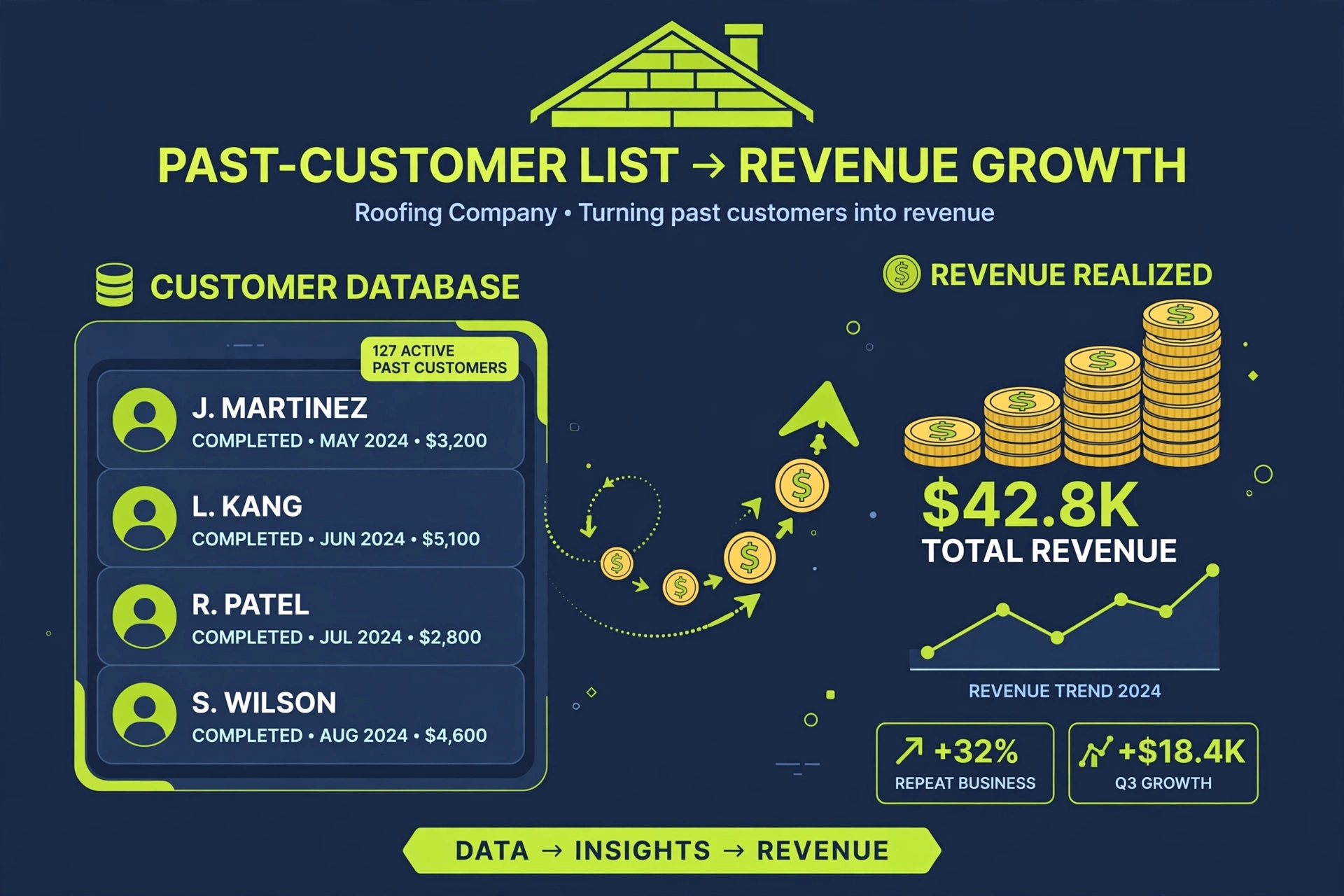
Do the illustrative math on a typical residential roofer's database — conservative, labeled assumptions:
Run that twice a year — a spring storm-season push and a fall pre-winter push — and the same list produces roughly $144,000 a year. Add referral spillover (past customers who forward your email to a neighbor) and dead-estimate recovery on top, and six figures is not optimistic. It is what the math says when you actually work the list.
Now compare that to buying the same revenue from cold leads. At $200 per lead and a 10% lead-to-job close rate, each job costs $2,000 in lead spend. Eight jobs cost $16,000 in leads. The reactivation campaign cost an email platform subscription and an afternoon. The margin difference is the entire game.
And the channel math backs this up. Litmus's 2025 survey of roughly 500 marketers found email returns $36 for every $1 spent. The DMA's Marketer Email Tracker 2026 found about 41 pounds back per pound. Klaviyo's 2026 benchmarks found automated flows generated nearly 41% of email revenue from just 5.3% of sends. Owned-audience email is the highest-return channel in marketing — and roofers own an audience they never email.
Why Do Roofers Ignore the Cheapest Leads They Own?
Because the list feels like the past, and marketing feels like it should be about the future. The marketing budget goes to Google Ads, lead brokers, and door hangers, while the CRM gathers digital dust. Three specific reasons the list stays dormant:
Reason 1: Nobody owns it. The list lives in the CRM, but no person or system is responsible for mailing it. Marketing is "whoever has time," which means nobody.
Reason 2: Roofers think past customers do not need roofs. The logic goes: I just roofed them, they are done for 20 years. Wrong on two counts. First, the customer's neighbors, family, and coworkers need roofs right now — past customers are your best referral source, but only if you remind them you exist. Second, roofs need inspections, maintenance, gutter work, and storm-damage checks long before replacement. A customer from 6 years ago is a prime inspection candidate today.
Reason 3: Fear of being annoying. You are emailing people who invited you onto their roof and paid you five figures. A useful seasonal email twice a month is not spam — it is a contractor staying in touch. The bar for "annoying" is far higher than roofers think, and the cost of silence is far higher than one unsubscribe.
What Is the Roof-Age Email, and Why Does It Book Inspections?
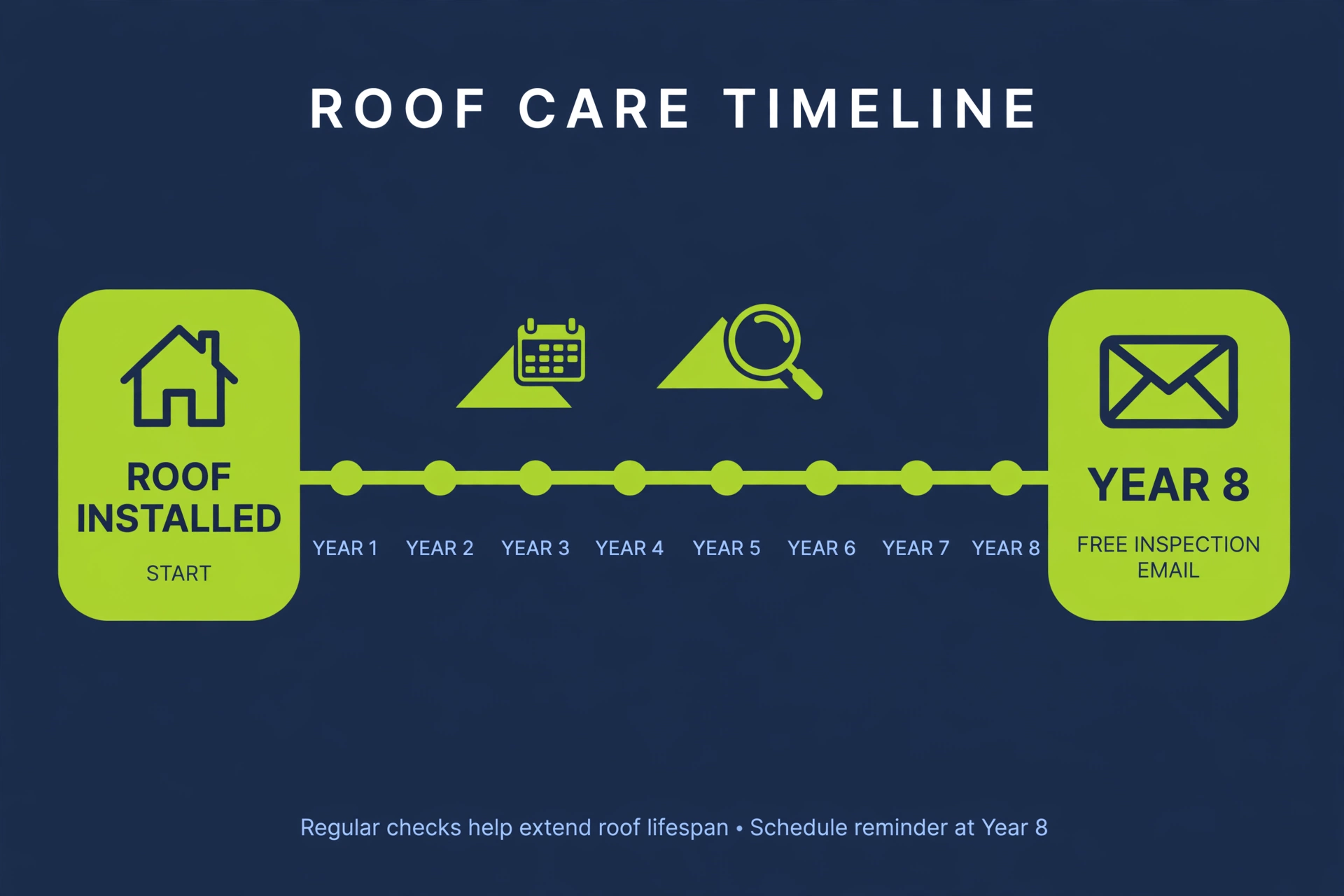
The roof-age email is the single highest-converting reactivation message in roofing, and almost nobody sends it. The concept is simple: when a roof you installed hits 8 to 10 years old, email that customer with a free inspection offer.
Why it works:
The roof is entering its middle age. Most asphalt shingle roofs carry 20- to 30-year manufacturer warranties, but real-world wear — granule loss, sealant aging, flashing fatigue, storm micro-damage — starts showing in years 8 to 12. The homeowner does not know this. They assume the roof is fine because it is not leaking. Your email teaches them otherwise, and positions the inspection as free expertise, not a sales pitch.
The timing feels personal, not promotional. "Hi Mike, we installed your roof in 2017 — it has been 9 years, and this is right when we recommend a free checkup" reads like a contractor who keeps records and cares about his work. Because it is. Compare that to a generic "10% off roofing!" blast. One builds the relationship. The other trains customers to wait for discounts.
Inspections convert. A free inspection puts your rep on the roof, in front of the homeowner, with photos of actual wear. A meaningful share of inspections surface real issues — storm damage that qualifies for an insurance claim, failing flashing, ventilation problems — and a share of those become jobs. Even inspections that find nothing build the relationship that produces the referral and the eventual replacement.
How to run it: pull install dates from your CRM, segment customers by install year, and send the roof-age email on the anniversary — automated, so it fires every month to whichever customers cross the 8-year mark. One email, once a year per customer, timed to the roof's actual age. It is the closest thing to free money in roofing marketing.
How Do You Win Back Dead Estimates With a 5-Touch Sequence?
Every roofer has a graveyard of estimates that went nowhere. You measured, you quoted, they said "we'll think about it," and then silence. Most roofers write these off. That is a mistake — the estimate is the warmest lead in your business that did not buy, and warm leads close on follow-up.
The truth every veteran roofer knows: most lost estimates were not lost on price. They were lost on timing — a spouse who needed convincing, a competing quote that fell through, life getting busy. A homeowner who got your estimate 90 days ago is not a cold lead. They are a warm lead with an expired timeline.
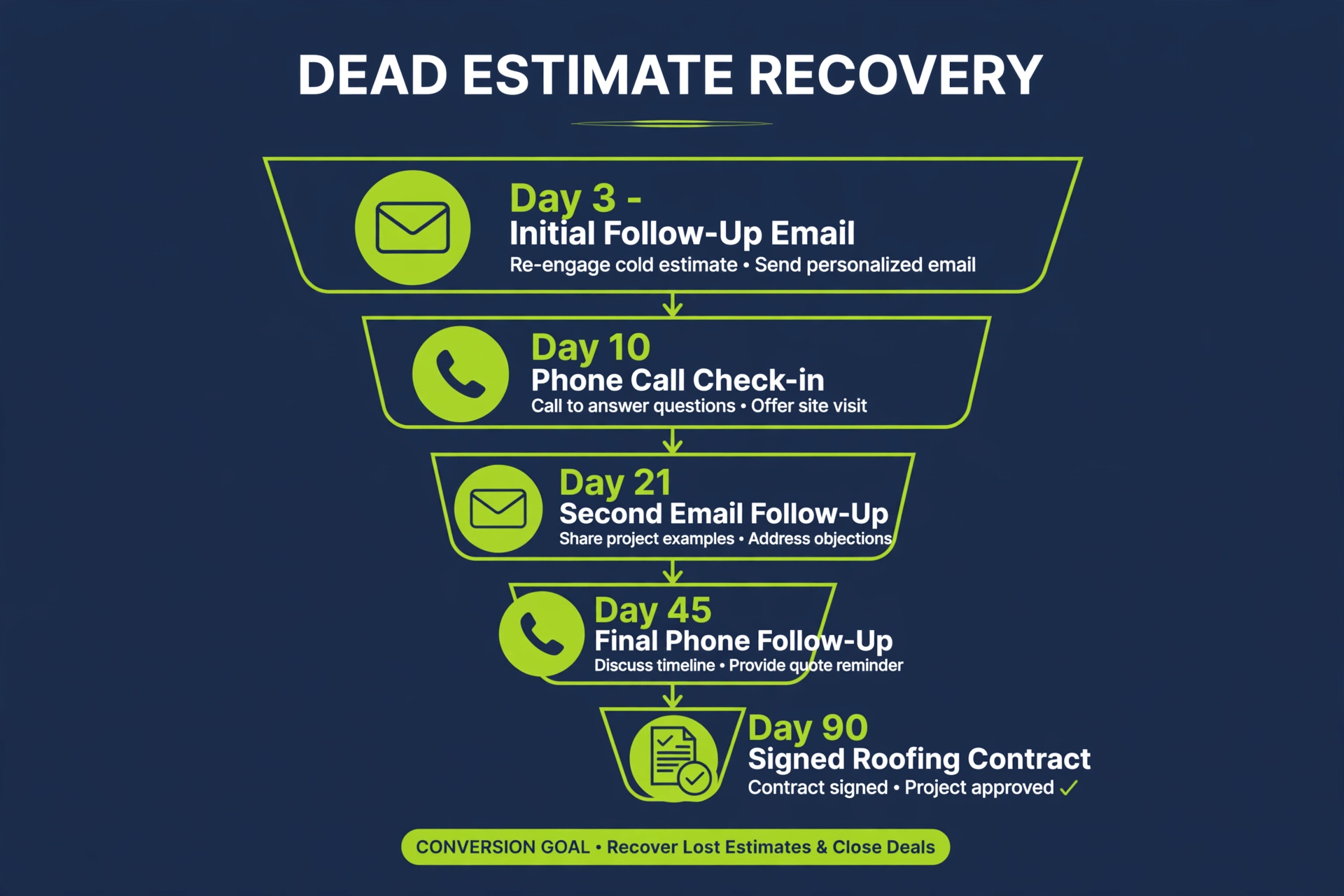
The 5-touch reactivation sequence for dead estimates:
Touch 1 (day 3 after the estimate): The thank-you text. "Thanks for having us out Tuesday — your estimate is attached. Any questions, just reply here." Short, helpful, no pressure. This alone recovers the estimates that were simply waiting on a nudge.
Touch 2 (day 10): The helpful check-in. "Quick question — did you end up going with another company, or is the project still on hold?" A direct question forces a reply; you will be surprised how many say "still deciding."
Touch 3 (day 21): The value add. Send something useful: a short guide to comparing roofing quotes, or photos from a recent similar job in their neighborhood. Expertise on display, no discounting.
Touch 4 (day 45): The seasonal trigger. "Storm season is coming up — want us to do a free pre-storm check on the areas we quoted?" Tie the follow-up to a real calendar event. Urgency that is honest, not manufactured.
Touch 5 (day 90): The breakup email. "Hey, I am going to close out your estimate file — should I keep it open or archive it?" The breakup email pulls replies because it creates a real deadline. Some will say archive it; some will say wait, we are ready now. Both answers are useful.
Run this as an automated sequence for every estimate that goes cold, and the graveyard starts producing. Even a 10% recovery rate on dead estimates is found revenue — jobs you already paid to quote, closing at zero additional lead cost.
What Should You Send Past Customers in the Slow Season?
The slow season is when reactivation pays twice: it fills the schedule when new leads dry up, and competitors go silent, so your emails get noticed. Four campaign types that work:
Pre-storm inspection offers. Before hail or hurricane season, offer past customers a free pre-storm roof check. Position it as documentation: photos of the roof's current condition make any future insurance claim dramatically easier. Homeowners understand this immediately.
Post-storm damage check-ins. After a major weather event, email customers in affected zip codes offering free storm-damage inspections that week. This is service, not sales — damage is real, it is time-sensitive for insurance, and you are the contractor they already trust.
Seasonal maintenance reminders. Gutters, flashing, attic ventilation, ice dam prevention — the unglamorous work that prevents the expensive work. A fall email about gutter cleaning and roof checks before winter books maintenance visits and surfaces bigger issues.
The referral ask, done right. Lead with value — the seasonal tip first — then close with one line: "If a neighbor mentions roof trouble, we would be grateful for the introduction." Past customers refer when reminded, not when pressured. A 500-customer list where each knows 10 homeowners is a 5,000-person warm audience.
Send twice a month in season, once a month off season. Every email teaches something small about roofs and ends with one clear next step. That is the whole content strategy.
How Do You Run Your First Reactivation Campaign Without Being Spammy?
Start small, start clean, and let the results argue for expansion:
Week 1: Clean the list. Export past customers from the CRM. Remove duplicates, bad emails, and anyone who asked not to be contacted. Segment into three buckets: last 2 years (hot), 3 to 6 years (warm), 7+ years (roof-age candidates).
Week 2: Send the re-introduction. One email to the whole list: who you are, and what is in it for them — free inspection reminders, storm-season alerts, priority scheduling for past customers. Set the expectation of useful monthly contact. Give an easy unsubscribe; the people who stay are your engaged core.
Week 3: Launch the roof-age segment. Pull every customer whose install is 8+ years old and send the roof-age inspection email. This is your highest-converting send — track replies and booked inspections separately.
Week 4: Start the dead-estimate sequence. Take estimates from the last 6 months that went cold and enroll them in the 5-touch sequence. Short, direct, helpful.
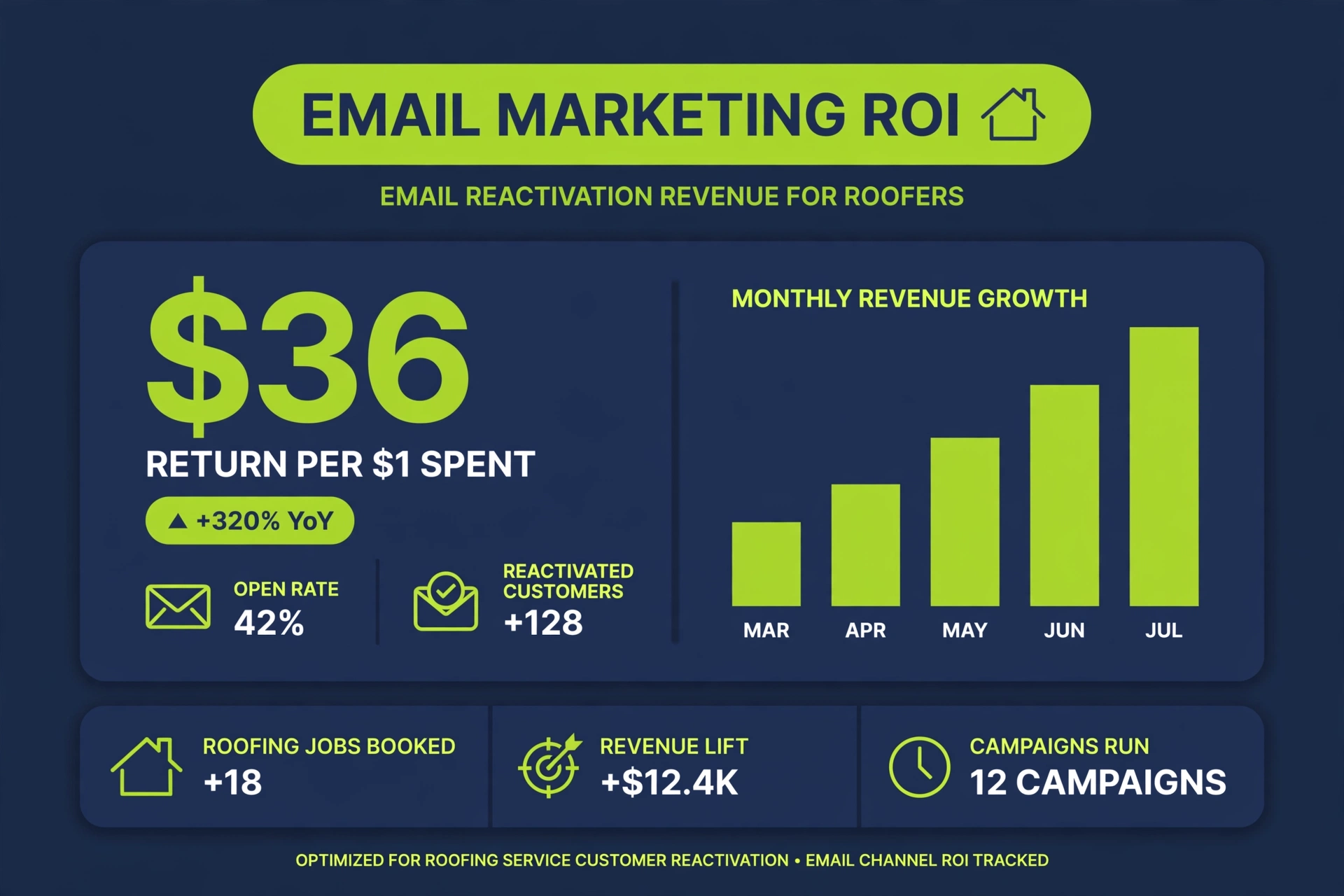
Then measure two numbers: revenue attributed to reactivation sends, and cost. The cost is an email platform (tens of dollars a month) plus a few hours. The revenue is five to six figures a year. When the ratio is 100-to-1, "is this spammy" stops being the question.
One compliance note that matters: only email customers you have a real business relationship with, include your business name and address, and honor unsubscribes immediately. Past-customer email is the most compliant marketing you can do — these are people who paid you — but keep it clean anyway. Trust is the asset. Do not spend it carelessly.
Bottom Line
You already paid for these customers. The ads, the estimates, the crew days — that money is spent. Every month you do not email them, you are choosing to buy their replacements from Google at $200 a lead instead of talking to them for pennies.
The reactivation playbook is not complicated: roof-age emails on install anniversaries, a 5-touch sequence for dead estimates, useful seasonal check-ins, and a referral ask that follows value. Twice a month in season, once a month off. A list of 500 past customers turns into the highest-ROI marketing channel in your business — $36 back for every $1 spent, per Litmus, with your warmest possible audience.
This is exactly what RepuPilot's database reactivation is built to run for roofing companies: your past-customer list segmented automatically, roof-age reminders firing on install anniversaries, dead estimates getting their follow-up sequence without anyone remembering to send it. The roofers with full schedules in the slow months are not better at buying leads. They just never let a customer go quiet.
Frequently Asked Questions
What is database reactivation in roofing?
Systematically marketing to past customers and old estimates to generate new inspections, jobs, and referrals. The core plays: roof-age anniversary emails, dead-estimate follow-up sequences, seasonal maintenance reminders, post-storm check-ins — all to people who already trust your work.
How much revenue can a roofer generate from past customers?
Illustrative math for a 500-customer list: a 5% response rate yields 25 conversations; at a 30% close rate that is 7 to 8 jobs. At $9,600 average job value, one campaign wave is roughly $72,000 — six figures a year across two seasonal waves, before referrals.
What is the ROI of email marketing for contractors?
Email returns an average of $36 for every $1 spent (Litmus, 2025 survey of roughly 500 marketers), and the UK DMA's 2026 tracker found about 41 pounds per pound spent. For roofers emailing past customers — a warm, owned audience — returns skew higher: no trust-building cost, no per-lead media spend.
What is the roof-age email?
An email sent when a customer's installed roof hits 8 to 10 years old, offering a free inspection. Roofs show real wear — granule loss, aging sealant, flashing fatigue — in years 8 to 12, and the anniversary timing makes the message feel personal. It is the highest-converting single reactivation message in roofing.
How many times should you follow up on a dead roofing estimate?
Five touches over 90 days: thank-you text at day 3, direct check-in at day 10, value-add at day 21, seasonal trigger at day 45, breakup email at day 90. Most lost estimates were lost on timing, not price — the sequence catches homeowners when timing turns right.
Is it legal to email past roofing customers?
Marketing to customers you have a genuine business relationship with is the most compliant email you can send. Still follow the basics: identify your business, include a physical address, make unsubscribing easy, honor opt-outs immediately. Never buy third-party lists.
How often should a roofer email past customers?
Twice a month during active season, once a month in the slow season. Every email should teach something small about roofs and end with one clear next step — an inspection offer, a seasonal reminder, a referral ask.