
Most roofers ask "how many reviews should I have?" The question that decides who gets the estimate calls is "how many does the top roofer in MY zip code have?" There is a specific number that wins each market. Know it, close the gap, keep the velocity, take the top spot.
Here is the direct answer: the review threshold is roughly 1.25 to 1.5 times the Google review count of the roofer at the top of the map pack, paired with a 4.6+ star rating. In most suburban roofing markets that means 80 to 250 reviews. The number is always relative to your competitors, never fixed — and once you know yours, you can plan exactly how many months of review generation stand between you and #1.
Quick Answer:
A roofer dominates a zip code at about 1.25 to 1.5 times the Google review count of the current map-pack leader, with a 4.6+ star rating. Since 97% of consumers read reviews and 68% require four or more stars (BrightLocal, 2026), the roofer who leads on both count and rating wins most estimate calls.
What Exactly Is the Review Threshold?
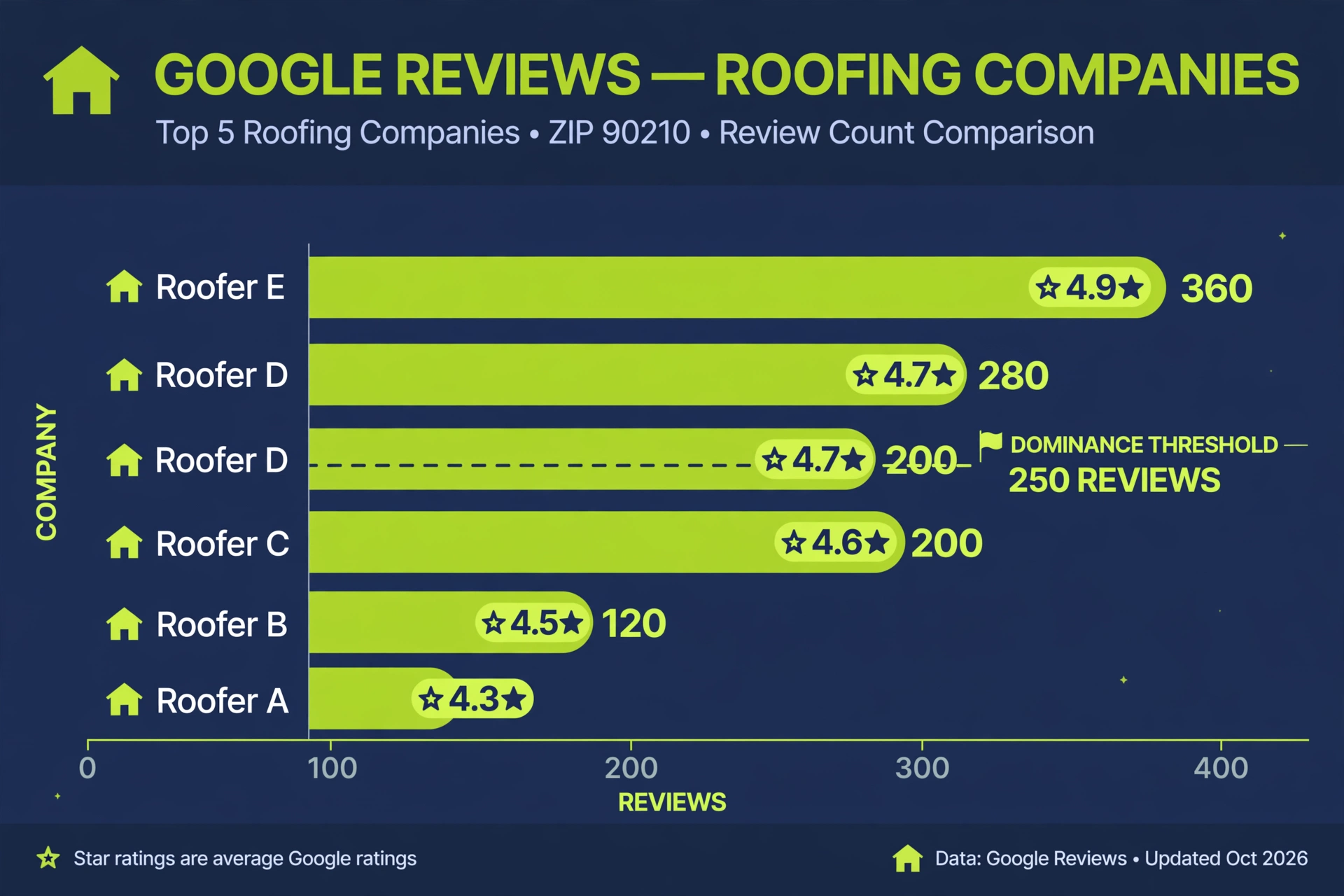
Think of your zip code as a mini-league. A homeowner searching "roof replacement near me" sees three roofers in the map pack and compares the profiles side by side: review count, star rating, recency. The roofer visibly ahead on all three does not just win a little more business — he wins the calls outright, because the comparison takes five seconds and the winner is obvious.
The threshold is the count at which that comparison stops being a contest — the number where a homeowner glances at three profiles and picks you without scrolling. Research keeps tightening what "good enough" looks like: 68% of consumers now require at least four stars, and 31% will only use businesses rated 4.5 stars or higher, up from 17% the year before (BrightLocal, 2026). Below 4.5 you lose nearly a third of the market on rating alone. But count is what creates separation. When one roofer has 187 reviews and the other two have 60, the homeowner reads the number: "hundreds of people in my area trusted this company with their roof." At a certain count, the review number stops being a statistic and becomes a verdict.
Why Do the Top Three Map Pack Roofers Win Almost All the Calls?
This is the math most owners never sit down to do. The map pack is a three-slot game, and the drop-off between position three and position four is a cliff, not a slope: most homeowners look at three or fewer options before calling. The fight is not "get as many reviews as possible." The fight is "have more, better, fresher reviews than the other two roofers in the pack."
The homeowner's brain runs a two-second sort: highest stars first, then highest count. Two roofers at 4.7 — the one with 214 reviews beats the one with 68, and the homeowner feels confident, because the crowd has spoken. That confidence is everything in roofing, where the average job is $9,609 for a standard replacement (HomeAdvisor, 2026) and insurance-claim replacements averaged $17,631 in 2025 (Verisk). Nobody gambles a ten-thousand-dollar roof job on the roofer with 14 reviews.
There is also a raw-trust floor under the whole market: 47% of consumers will not use a business with fewer than 20 reviews at all (BrightLocal, 2026). Below 20 you are filtered out entirely; above it you are in the conversation but losing to the roofer with 150.
How Do You Calculate Your Review Gap?
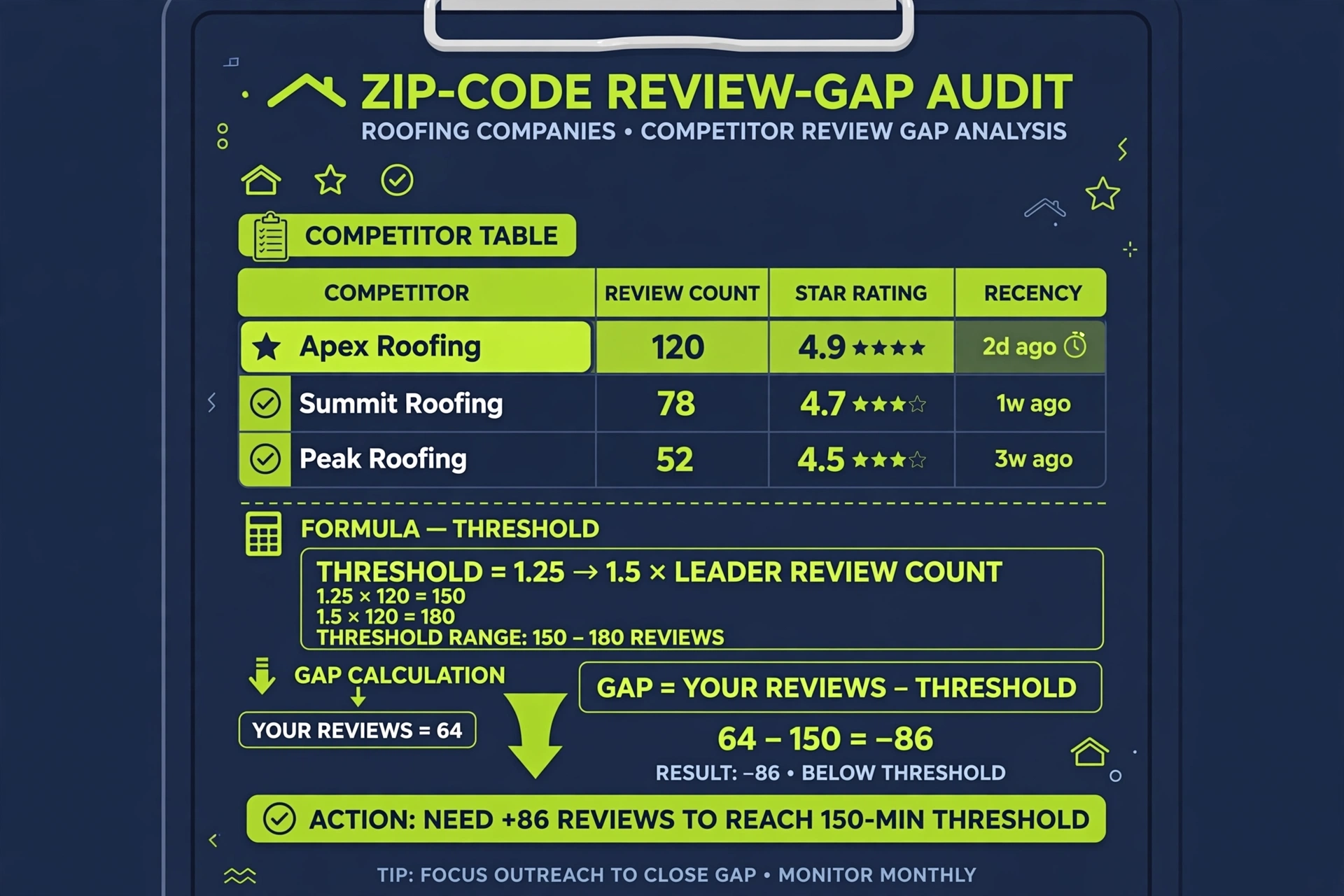
This is the part you can do this week, in about thirty minutes. It is a simple audit — the zip-code review-gap worksheet. No software needed, just Google Maps and a spreadsheet.
Step 1: Find your real competitors. Search the terms your customers actually use — "roof replacement near me," "roof repair [your zip]," "roofing company [your town]" — and write down the three to five roofers who appear in the map pack and organic results for your core zip. These are your league. Ignore the guys in the next county; you only need the profiles the homeowner sees next to yours.
Step 2: Record three numbers for each one. For every competitor profile, note: (a) total Google review count, (b) star rating, (c) date of the most recent review. The third number matters as much as the first two — a competitor with 300 reviews and nothing newer than five months has a frozen profile, and that is an opening.
Step 3: Find the leader and set the threshold. Take the highest review count among your three to five competitors. Your domination threshold is that count times 1.25 to 1.5, with a 4.6 minimum star rating. (Illustrative example: if the leader sits at 160 reviews, your threshold is 200 to 240 reviews at 4.6+ stars. The 1.25 to 1.5 multiplier is a competitive rule of thumb — the goal is a count that makes the comparison unmistakably yours, not a statistically derived figure.)
Why a multiplier instead of just matching the leader? Matching ties you, and ties go to the incumbent. A homeowner comparing two profiles at 160 reviews picks the one she has heard of. You need daylight between you and #2 — enough that the glance test ends the debate in your favor.
Step 4: Compute your gap. Subtract your current review count from the threshold. That number is your review gap — the single most important marketing number in your business, and most roofers have never calculated it.
What Does the Review Gap Actually Cost in Jobs?
Now the math that turns the gap from an ego metric into a revenue number. Run it with your own figures, but here is the shape of it using real industry inputs.
Start with the cost of the traffic you are losing. Roofing is the most expensive home-service category for paid search: the average roofing Google Ads cost per lead is $228.15 (LocaliQ, via Pipelineon, 2026). Shared-lead platforms sell roofing leads for $15 to $90 each but send the same lead to four or more roofers, with close rates typically running 5 to 15% (Pipelineon, 2026). Organic map-pack traffic from a top review profile costs you nothing per click. Every position you sit below the threshold leader is traffic you either lose outright or buy back at $228 a lead.
Now the illustrative example, inputs labeled. Suppose your zip generates 40 estimate requests a month through the map pack. The threshold leader takes roughly half — 20. You, sitting third with a thinner profile, take 8. That is 12 requests a month flowing to the roofer above you. At a $9,609 average replacement (HomeAdvisor, 2026) and a 30% estimate-to-job close rate, those 12 lost requests are about 3 jobs a month — $28,827 monthly, over $340,000 a year. And that is before storm season, when demand spikes and the top profile absorbs most of the surge.
The inputs are illustrative, the direction is unmistakable: the review gap is a jobs problem, priced in ten-thousand-dollar roof replacements. Review signals carry 16 to 20% of local pack ranking weight — more than backlinks (Whitespark, 2026) — and they are the one ranking factor you can manufacture, job by job. You cannot move your office closer to the searcher. You can out-review them.
What Is the 90-Day Sprint to Cross the Threshold?
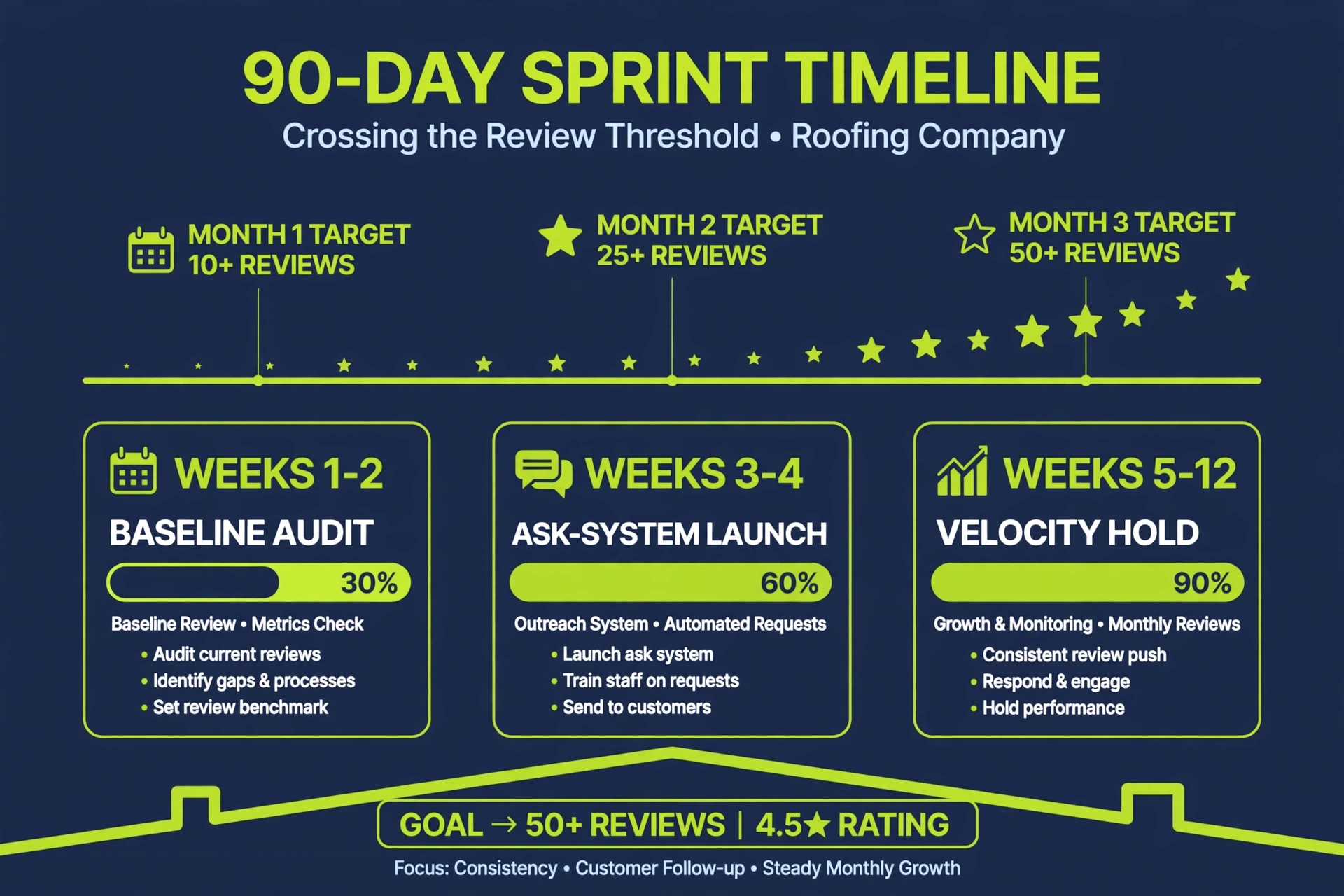
Knowing the threshold is half the work. The other half is closing the gap fast. Here is the 90-day sprint framework — a realistic, aggressive plan built for a working roofing company.
Weeks 1 to 2: Set the baseline and build the ask system. Run the gap audit, then install the review request flow: text the customer a one-tap Google review link within an hour of the final walkthrough. Review counts compound from ask volume, and most roofers' ask volume is near zero — this single step is the highest-leverage move in the sprint.
Set your sprint rate. Divide your gap by 3 for the monthly target. (Illustrative: a 120-review gap means 40 a month for three months — aggressive, but doable for a crew doing 20+ jobs a month with a systematic ask. If the target exceeds your job volume, extend honestly to six months.) The sprint runs on real jobs, never shortcuts: Google blocked or removed over 292 million policy-violating reviews in 2025, and the FTC's fake-review rule carries penalties up to $53,088 per violation (BrightLocal, 2026; FTC).
Mine the sources most roofers forget. This is how you hit sprint rates on real jobs: repairs and service calls (average $4,699 in 2025 — every one of those customers can leave a review), post-storm inspections, insurance claim jobs (average $17,631 in 2025, with severe hail hitting 20%+ of roofs in 16 states — Verisk), and slow-season maintenance like tune-ups and gutter cleanouts. The slow months are when competitors stall, which makes them the cheapest months to gain ground.
Weeks 5 to 12: Hold the rate and protect the rating. Velocity without rating is a trap — 31% of consumers now require 4.5+. Respond to every review within a week (89% expect a reply that fast; replying businesses earn about 12% more reviews — BrightLocal, 2026). One follow-up text for non-responders, three to five days after the first ask. Track one number: new reviews this month versus sprint target. A 200-review gap is not closed in 90 days — but it is cut in half, and a profile adding 30 to 40 reviews a month while competitors add 4 or 5 is visibly charging. Homeowners notice momentum. So does Google.
Does the Star Rating Matter as Much as the Review Count?
Short answer: rating gets you into the race, count wins it. They work as a sequence.
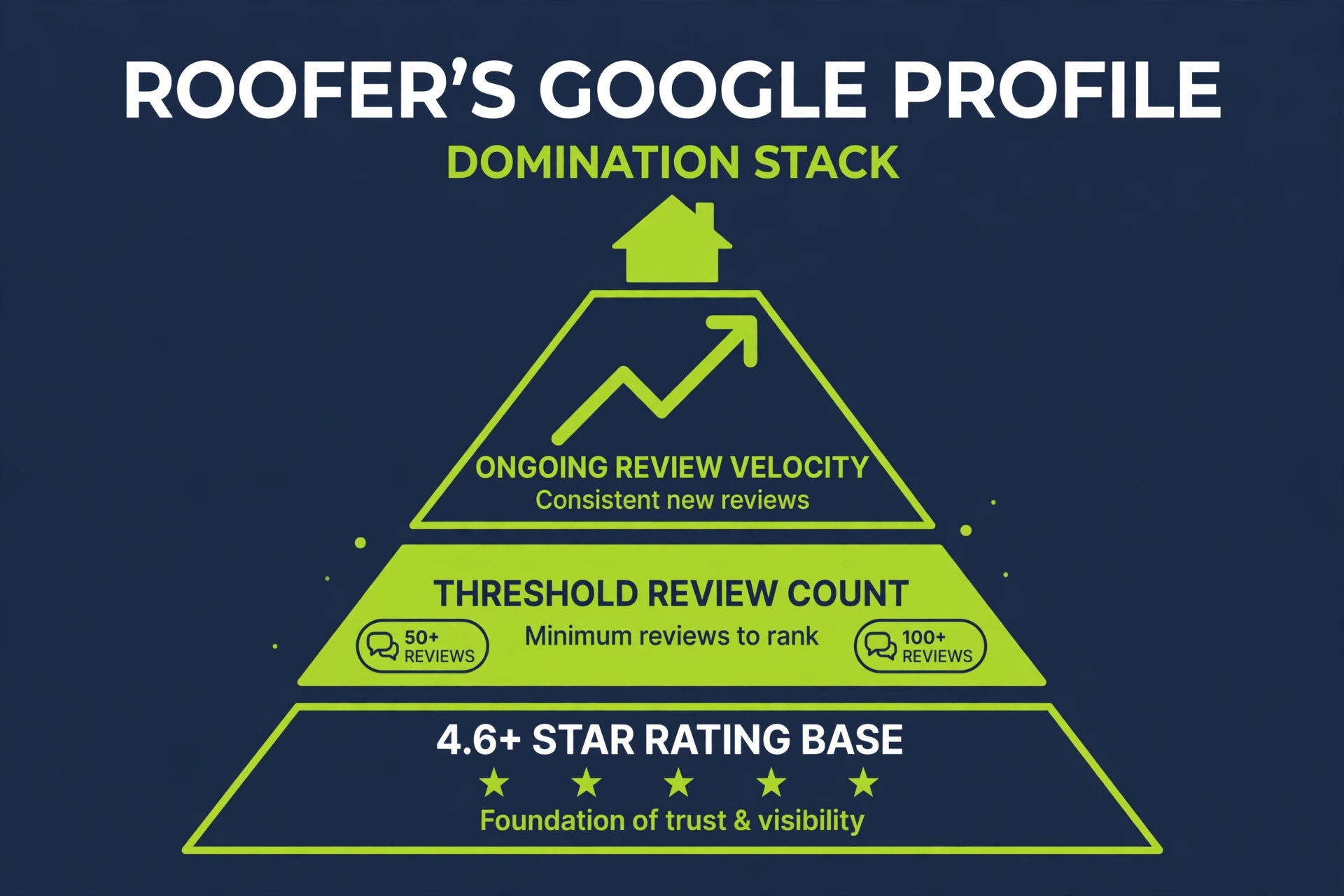
The rating is the gatekeeper. With 68% of consumers requiring four stars and 31% requiring 4.5+, a 4.3-star roofer with 300 reviews still loses comparisons to a 4.8-star roofer with 90 — the 4.3 fails the first filter before the count gets read. Businesses improving from 3.5 to 4.5 stars see roughly 18% more revenue (digitalapplied.com, 2026). Job one: hold 4.6 or better, always.
The threshold formula is count AND rating. Two 4.7 profiles side by side — the larger count wins in seconds. Either one alone is half a strategy.
There is one exception worth naming: the recency tiebreaker. When two roofers both hold 4.7 and similar counts, the profile with reviews from this week beats the one whose newest review is four months old. Fresh reviews are the product page; old reviews are the archive.
Bottom Line
The review threshold turns a vague marketing chore into a specific, winnable number. Audit your zip code, find the leader's count, multiply by 1.25 to 1.5, hold 4.6 stars, and you have a target. Divide the gap by your monthly job volume and you have a timeline. Run the cost math and you have the motivation — the gap is priced in ten-thousand-dollar jobs going to the roofer above you.
The roofers dominating their zip codes are not doing anything mysterious. They figured out the number, built the ask into every finished job, and never let the flow stop. Storm season will hand you the volume. The question is whether your review system is ready to convert it.
This is exactly what RepuPilot's Review Shield runs for roofing companies: the review-gap audit for every zip you serve, the automatic ask after every job so the count climbs without anyone remembering, rating protection so you never slip below the 4.6 gate, and steady velocity that keeps your profile the obvious choice — even in the slow season when everyone else goes quiet. The threshold is real. There is no rule that says it cannot be you.
Frequently Asked Questions
How many Google reviews does a roofer need to dominate a zip code?
There is no fixed number — the threshold is relative to your market. Use the rule of thumb: 1.25 to 1.5 times the review count of the current map-pack leader, with a 4.6+ star rating. In most suburban roofing markets that lands between 80 and 250 reviews. Run the gap audit in this post to find your exact number.
What star rating does a roofer need before review count matters?
4.6 stars is the practical gate. 68% of consumers require at least four stars and 31% require 4.5 or higher (BrightLocal, 2026). Fix a sub-4.5 rating before chasing count — 100 new reviews on a 4.2 profile still lose to a 4.8 profile with 90.
How long does it take to close a 100-review gap?
At 8 to 10 new reviews a month — achievable for a roofer doing 15 to 20 jobs a month with a systematic after-job ask — a 100-review gap closes in 10 to 12 months. An aggressive 90-day sprint can cut it in half before storm season. The honest answer depends on your job volume and whether the ask goes out after every job.
Should I count reviews on Facebook and Yelp toward the threshold?
Google is the comparison screen that matters — its share of review traffic was 71% in 2026 (BrightLocal, 2026), and the map pack cards are what the homeowner compares. But watch the trend: AI tools jumped from 6% to 45% as a source of local recommendations in one year (BrightLocal, 2026). Facebook reviews feed those AI answers, so ask on Google plus one secondary platform — just do not dilute the Google count chasing a dozen profiles.
What if the top roofer in my zip has 500 reviews?
A 500-review leader means a 625 to 750 threshold — a multi-year project at normal velocity, so do not sprint at it blindly. Flank him: dominate the lane where his profile is weakest (storm damage, a neighboring zip, insurance claims) and let recency do the rest. A 500-review profile with nothing new in three months is a fortress with the gate open.
Can buying reviews help me reach the threshold faster?
No — it is the fastest way to lose the profile entirely. Google blocked or removed over 292 million policy-violating reviews in 2025, and the FTC's fake-review rule carries penalties up to $53,088 per violation (BrightLocal, 2026; FTC). Spikes after silence also trip authenticity filters. The sprint in this post closes the gap on real jobs only, and it is the only method that survives.