
*A conservative annual-loss story, the word-for-word text-back script, and the after-hours emergency capture system.*
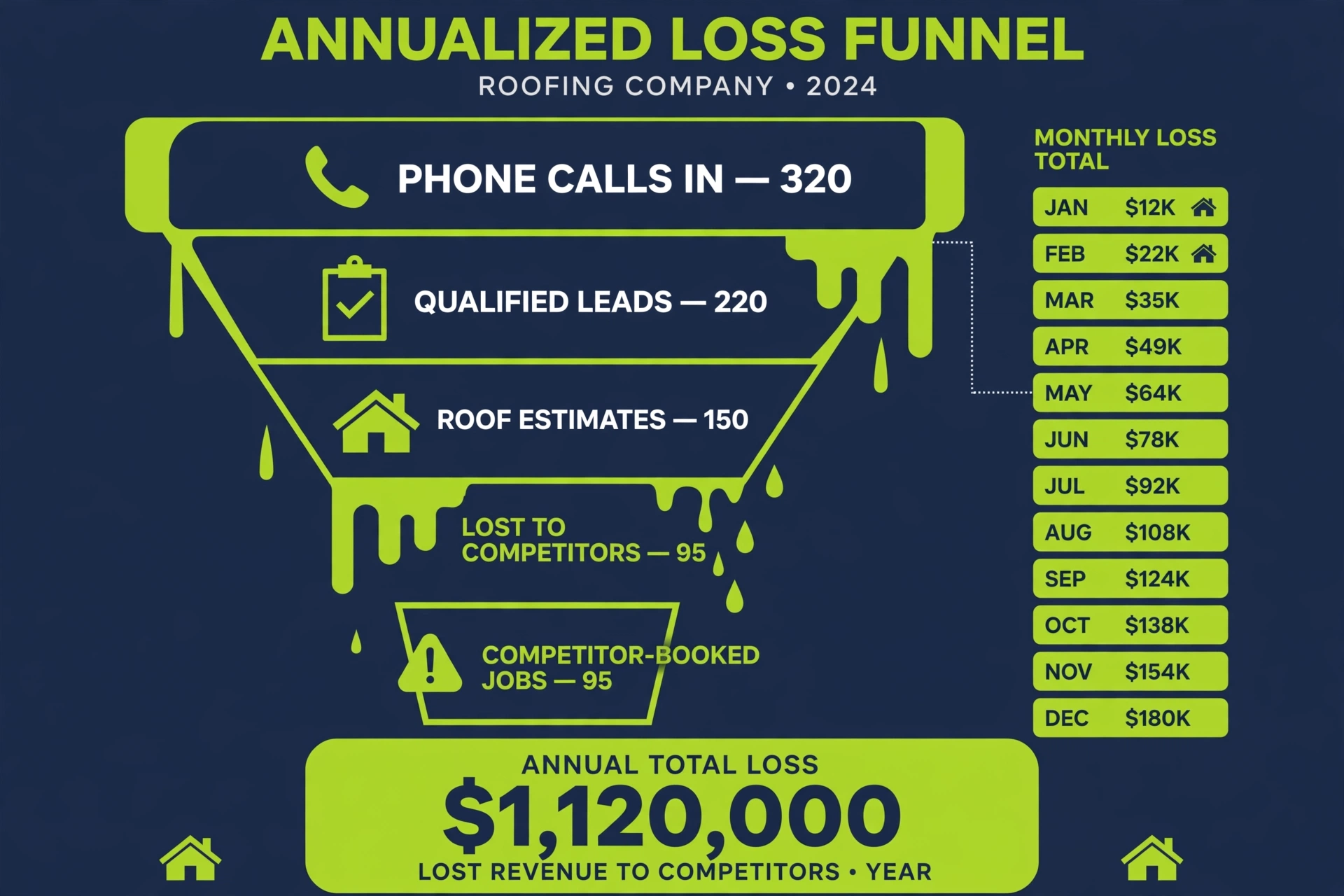
A roofing company that misses just one genuine lead call a month is quietly losing $36,000 a year — and that's the conservative floor (illustrative example: $10,000 average job value, 30% close rate). Small businesses miss anywhere from 25% to 62% of inbound calls (CallRail, 2025; 411 Locals, 2024), and 85% of missed callers never call back. The fix takes 60 seconds: an automatic text-back that reaches every missed caller before they dial the next roofer.
Quick Answer:
Roofers lose $30,000+ a year to unanswered calls — conservatively. One missed genuine lead a month, at a $10,000 average job value and a 30% close rate, equals $36,000 a year handed to competitors (illustrative). An automatic 60-second text-back recovers those callers by texting them while they're still deciding.
How Does One Missed Call a Month Become $36,000 a Year?
Nobody shows roofers the annual number, so let me run it as a story. The average roof replacement in the U.S. costs roughly $9,500 to $11,500 (Angi data; RoofGuides, 2026), with insurance-paid and premium-material jobs running $15,000 to $25,000. Even a repair ticket is $800 to $3,000, and plenty of repair calls convert into full replacements once you're on the roof.
Now the illustrative math, deliberately conservative:
You miss one genuine lead call per month — not per week. Twelve calls a year.
Average job value: $10,000 (low-middle of the real range).
Close rate on inbound leads: 30%.
12 missed leads × 30% × $10,000 = $36,000 a year.
That is the floor. Now consider what the data says actually happens: roughly 6 in 10 inbound calls to small businesses go unanswered (BrightLocal, 2024; 411 Locals, 2024), CallRail's 2025 platform data puts the unanswered share at 28%, and about half of inbound calls are genuine leads (getnextphone analysis of 1.45M calls, 2026). A roofer getting 30 calls a week who misses 28% is missing 8 to 9 calls a week — not one a month. At those volumes the annual loss is five to ten times the $36,000 floor. And 85% of missed callers never call back — but 62% immediately dial a competitor (futurocorp synthesis of 2026 missed-call data). That $36,000 didn't vanish into the air. It walked into someone else's estimate book.
Why Do Roofers Miss So Many Calls?
This isn't a discipline problem. It's structural — the roofing business model fights the phone.
Your crew is on the roof, not at a desk. Roofing is a field operation. The people who know roofing are on tear-offs, in attics, or driving between estimates. The phone rings at 10:40 AM while the whole crew is mid-install. A dental office has a front desk. You have a job site.
Storm season breaks normal volume. When hail hits, call volume spikes 5 to 10 times overnight. The calls you miss during a hail week are the highest-value calls of the year — insurance-paid replacements at $12,000 to $20,000.
After-hours is when emergencies call. Roof leaks don't respect business hours. An estimated 30 to 40% of missed business calls happen outside business hours (voiceanna operational analysis, 2026). The 2 AM "water is coming through the ceiling" call is the highest-intent call you'll ever get — and the most likely one to miss.
The callback comes too late. MIT/InsideSales research found the odds of contacting a lead drop 100-fold and qualification odds drop 21-fold when you wait 30 minutes instead of responding within 5 (2007 Lead Response Management Study). HBR's 2011 analysis of 2,241 U.S. companies found firms responding within an hour were nearly 7 times as likely to qualify a lead as firms that waited even an hour longer — and 23% never responded at all. In roofing, "I'll call them back tomorrow morning" is how you fund your competitor's truck payment.
Why Is Voicemail the Worst Safety Net in Roofing?
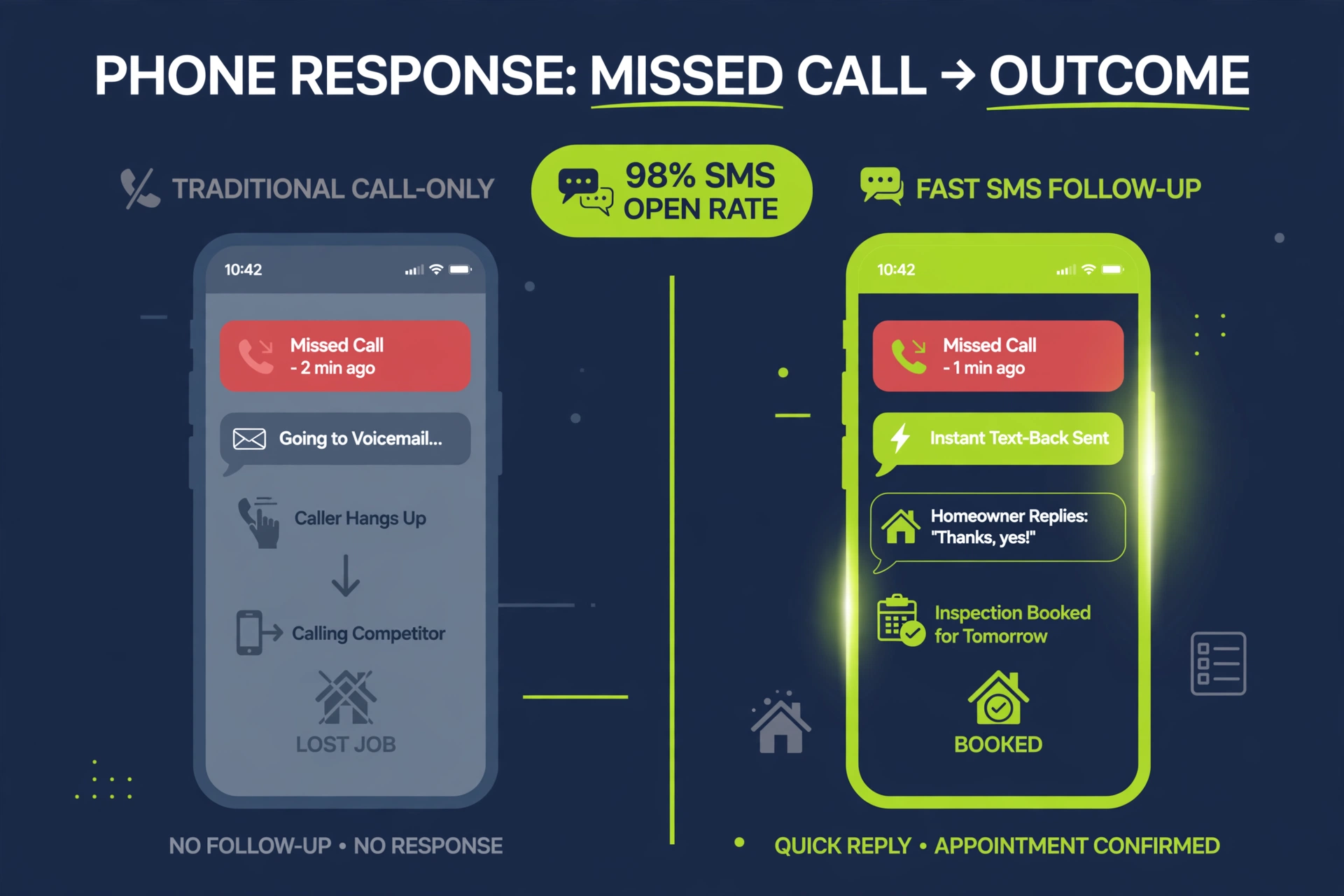
"They can just leave a message" is the most expensive sentence in the roofing industry. Fewer than 3% of callers routed to voicemail actually leave a message (Patient Prism analysis of 11.5M calls, 2025). Eight in ten callers who reach voicemail hang up without leaving one — most of your missed calls leave zero trace. No name, no number, no second chance.
Put yourself in the homeowner's shoes. It's 9 PM and there's a brown spot spreading across the bedroom ceiling. They called you because your Google profile looked good. Your voicemail picks up — they hang up mid-greeting and tap the next listing. A homeowner with an emergency was never going to leave a message.
CallRail's 2025 consumer survey found 78% of consumers have abandoned a business entirely after an unanswered call, and 82% would call a competitor when you don't pick up. Voicemail doesn't slow that process down — it confirms, in about six seconds, that you aren't there.
What Is the Exact 60-Second Text-Back Script?
When someone calls your business line and you don't answer, the system automatically texts them within 60 seconds. Here's the word-for-word script:
> Hey, this is Apex Roofing — sorry we missed your call! Is this about a leak, or are you looking for a replacement estimate? Reply with LEAK or ESTIMATE and we'll get you taken care of.
That's the whole thing. Here's why every element earns its place:
"Hey, this is Apex Roofing" — Identity first. The homeowner was looking at three roofer listings; this confirms which one is talking. Use your real company name.
"sorry we missed your call" — The apology costs nothing and buys everything. It signals accountability instead of automation.
"Is this about a leak, or are you looking for a replacement estimate?" — One qualifying question, not five. Questions get replies; statements don't.
"Reply with LEAK or ESTIMATE" — A stressed homeowner doesn't want to compose a message; they want to tap two letters. Keywords also route: LEAK flags urgent, ESTIMATE enters the normal pipeline.
Why text beats every other channel here: SMS has a 98% open rate, with 95% of messages read within three minutes of delivery (Subtext 2026 SMS Benchmark Report, 10 billion messages analyzed). The median consumer reads a text within 90 seconds (CTIA/Esendex benchmarks). Text is the only channel that reaches a stressed homeowner in the moment they're deciding.
Two variant scripts for your two hardest scenarios:
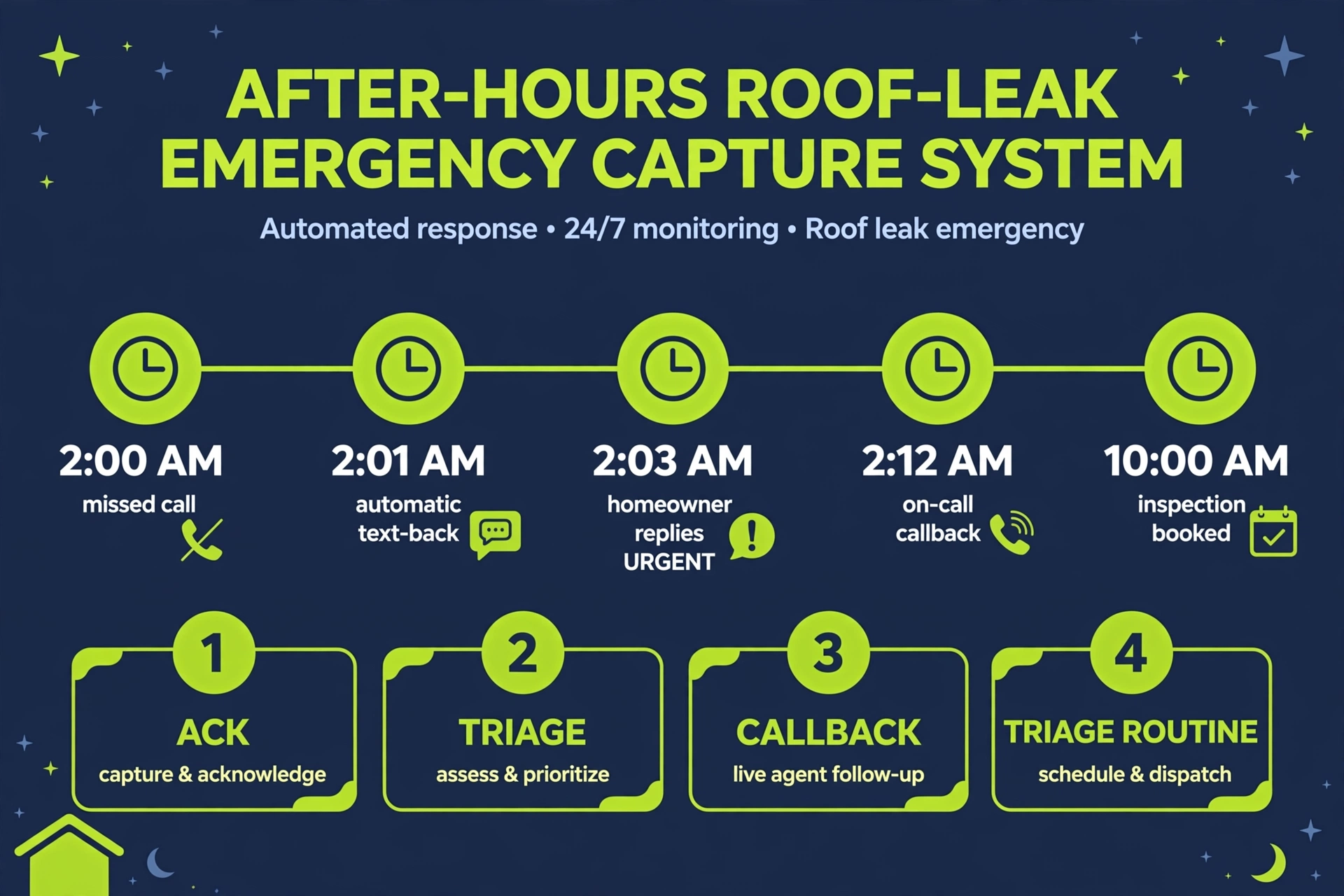
*After-hours:* > Hey, this is Apex Roofing — we're closed right now, but we got your call. If you have water coming in, reply URGENT and our on-call tech will call you back within 15 minutes. Otherwise reply MORNING and we'll call you first thing at 8 AM.
*Storm season surge:* > Hey, this is Apex Roofing — with the storm in the area our lines are slammed, but you're in our queue. Is there active leaking? Reply YES and you'll get priority scheduling.
Notice what none of these scripts do: they never say "we'll get back to you." They always offer a next action with a time attached. That's the difference between a text-back that converts and one that doesn't.
How Do You Capture the 2 AM Emergency Call?
The after-hours emergency call is the most valuable and most wasted call in roofing. Here's the full capture system — four layers, each one doing a job the others can't.
Layer 1: Instant acknowledgment (automatic, under 60 seconds). The after-hours script goes out immediately. Its job isn't to solve the problem — it's to stop the homeowner from dialing competitor number two. A homeowner who gets a text in 60 seconds feels heard; one who gets voicemail feels ignored.
Layer 2: Urgency triage (automatic keyword routing). The URGENT keyword is the hinge. When a homeowner replies URGENT, the system pushes a real alert to the on-call phone — not a quiet email. Non-urgent replies sit in a clean queue for the morning. Only true emergencies wake anyone up.
Layer 3: The on-call callback (human, within 15 minutes). The on-call tech — owner, lead tech, whoever holds the rotation — calls back within 15 minutes. The call has one job: tarp crew tonight or inspection tomorrow. Most 2 AM "emergencies" are containable until morning; the homeowner just needs a human to say what to do until you get there.
Layer 4: The morning triage routine (7:30 AM, every day). Someone works the overnight queue in this order: (1) URGENT replies that got a callback, confirmed into appointments; (2) URGENT replies that didn't, called first; (3) MORNING replies, in order received; (4) non-replies, one polite follow-up text. Ten minutes a day — nobody from last night is uncontacted by 9 AM. The homeowner who got a 60-second text at 2 AM and a human callback at 2:15 has an inspector coming at 10 AM. They're not calling your competitor; they're telling their neighbors about you.
When Does the Money Start Coming Back?
Owners want the timeline, so here it is — honest, no hype.
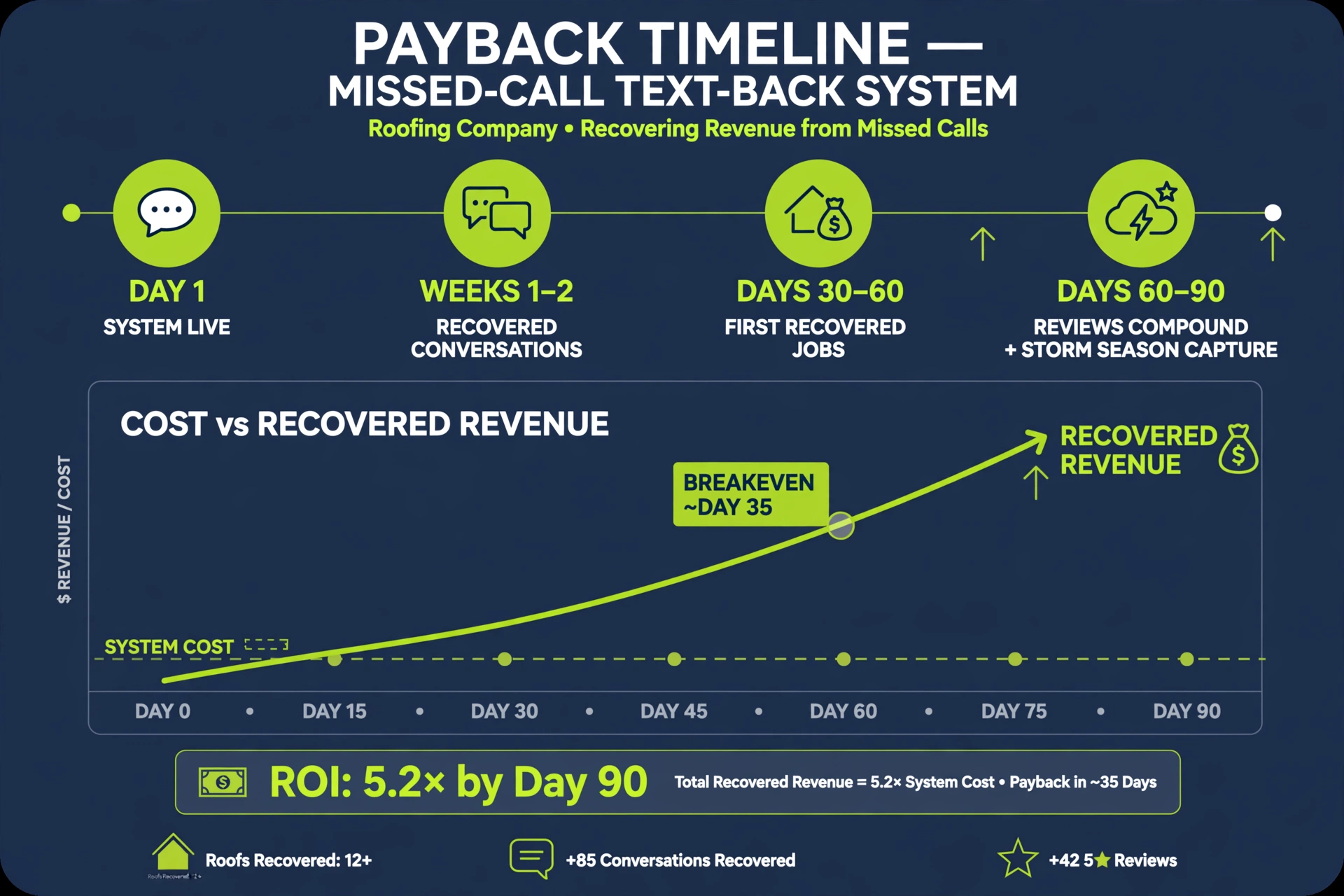
Day 1: The system goes live on your existing business number. Nothing changes about how you advertise — every missed call from this point forward gets the 60-second text.
Weeks 1 to 2: You'll notice it first in the conversations, not the revenue. Homeowners who would have vanished are now texting back. Miss 5 calls a week and convert 30 to 40% of texted callers into conversations, and that's 6 to 8 recovered conversations a week that used to be voicemail dead-ends.
Days 30 to 60: The first recovered jobs land. Illustrative math: 2 recovered conversations a week at a 25% close rate is roughly 2 booked jobs a month — $20,000 a month at a $10,000 average job. The system itself typically costs a few hundred dollars a month. One recovered job pays for the year.
Days 60 to 90: Compounding kicks in. Recovered customers leave reviews (they're disproportionately grateful — you answered when nobody else did). Those reviews lift your map presence, which drives more calls, which the system captures. Then storm season arrives, and the system handling 5 missed calls a week handles 50 — every one getting an instant response while competitors' voicemails fill up.
The uncomfortable truth: the $36,000-a-year floor assumes you miss one genuine lead a month. Most roofers miss that many in a week. The real question isn't whether the fix pays for itself — it's how long you want to keep donating five figures a year to the roofer down the street.
Bottom Line
Every unanswered call is a homeowner making a decision without you. In roofing — where a single job is worth five figures and emergencies don't keep office hours — that decision costs real money, every week, all year. The math says the floor is $36,000 a year. Your actual number is almost certainly higher, and it's been compounding quietly while you've been on roofs.
The fix isn't a bigger office staff or a fancier voicemail. It's 60 seconds: text every missed caller automatically, give them one question and one next step, and run a real after-hours triage for the emergencies. Roofers who do this don't have better crews or better ads. They just stopped letting the phone leak.
This is exactly the system RepuPilot sets up for roofing companies: missed-call text-back on your existing number, the after-hours emergency capture running 24/7, every conversation routed into booked inspections. The roofers who never lose a lead to voicemail aren't working harder than you — their phone just never goes unanswered.
Frequently Asked Questions
Will homeowners think the auto-text is a robot and ignore it?
Not if the script sounds like your shop. Homeowners ignore texts that read like marketing blasts; they reply to texts that read like the office picked up. Keep it short, keep your company name in it, and always end with a question or a next step.
What if the caller replies at 3 AM and nobody is awake to respond?
The system should send an immediate second acknowledgment: "Got it — our team will reach out first thing in the morning. If water is coming in right now, reply URGENT." That holds the homeowner through the night. Then your 7:30 AM triage routine works the queue in priority order. A homeowner who gets a 60-second auto-text and an 8 AM human callback is still yours.
Does this work with my existing business number, including a landline?
Yes — text-back runs on your current business line, the one on your trucks, website, and Google profile. Most landlines can be text-enabled without changing the number, so you don't reprint anything or update any listings.
How do I know if the text-back is actually working?
Track three numbers weekly: missed calls that received a text, reply rate to those texts, and inspections booked from text conversations. A healthy system shows 30 to 40% of texted callers engaging in conversation. If replies are low, the script is usually too long or missing the question. If conversations stall before booking, follow-up speed is the problem.
What about spam calls and wrong numbers?
They self-filter. A spam robocall doesn't reply to a text; a wrong number replies "wrong number" and you move on. Anyone who doesn't answer with LEAK, ESTIMATE, URGENT, or MORNING after two messages gets one polite closing text and drops out of the queue. Near-zero staff time on non-leads.
Who on my team handles the text conversations?
However you handle calls today, just faster. The auto-text buys you time; a human still runs the conversation. For most small roofers that's the owner or office manager checking the queue between jobs — a text takes 3 minutes versus 20 minutes of phone tag. The rule: every conversation gets a human reply within 15 minutes during business hours.
Can this replace my answering service?
For most roofers, yes — and it usually performs better. A typical answering service ($200–$500/month) takes messages and the homeowner still waits hours for your callback. By the HBR data, waiting even an hour makes you 7 times less likely to qualify the lead. Text-back reaches the homeowner in 60 seconds with a real conversation path. Many roofers keep the answering service for overflow and let text-back handle the first response — the moment that actually decides who gets the job.