
*The math on what one bad review costs a roofer, the 5-part reply template, and the 24-hour rule that turns complaints into future 5-star reviews.*
A single 1-star review costs a roofing company far more than one lost job: future homeowners read your reply more closely than the complaint, and Harvard research ties a one-star rating increase to 5 to 9 percent more revenue (Luca & Zervas, 2016). A calm, structured reply posted within 24 hours converts that angry review into public proof you stand behind your work.
Quick Answer:
A 1-star review is not a disaster, it is a stage. Homeowners expect complaints; what they judge is your response. Acknowledge the homeowner by name, take visible ownership, move the conversation offline with a real contact, and close with the standard future customers should expect. Reply within 24 hours and never argue.
Why Does One 1-Star Review Cost a Roofer Five Figures?
Roofing jobs are not impulse buys. A homeowner spending $10,000 to $25,000 on a roof replacement researches like they are hiring a surgeon, and your Google review profile is the first credential they check. The average U.S. replacement runs $9,500 to $11,500 (Angi; RoofGuides, 2026), insurance-paid jobs $15,000 to $25,000. That check size is why one bad review hits roofers harder than a pizza place.
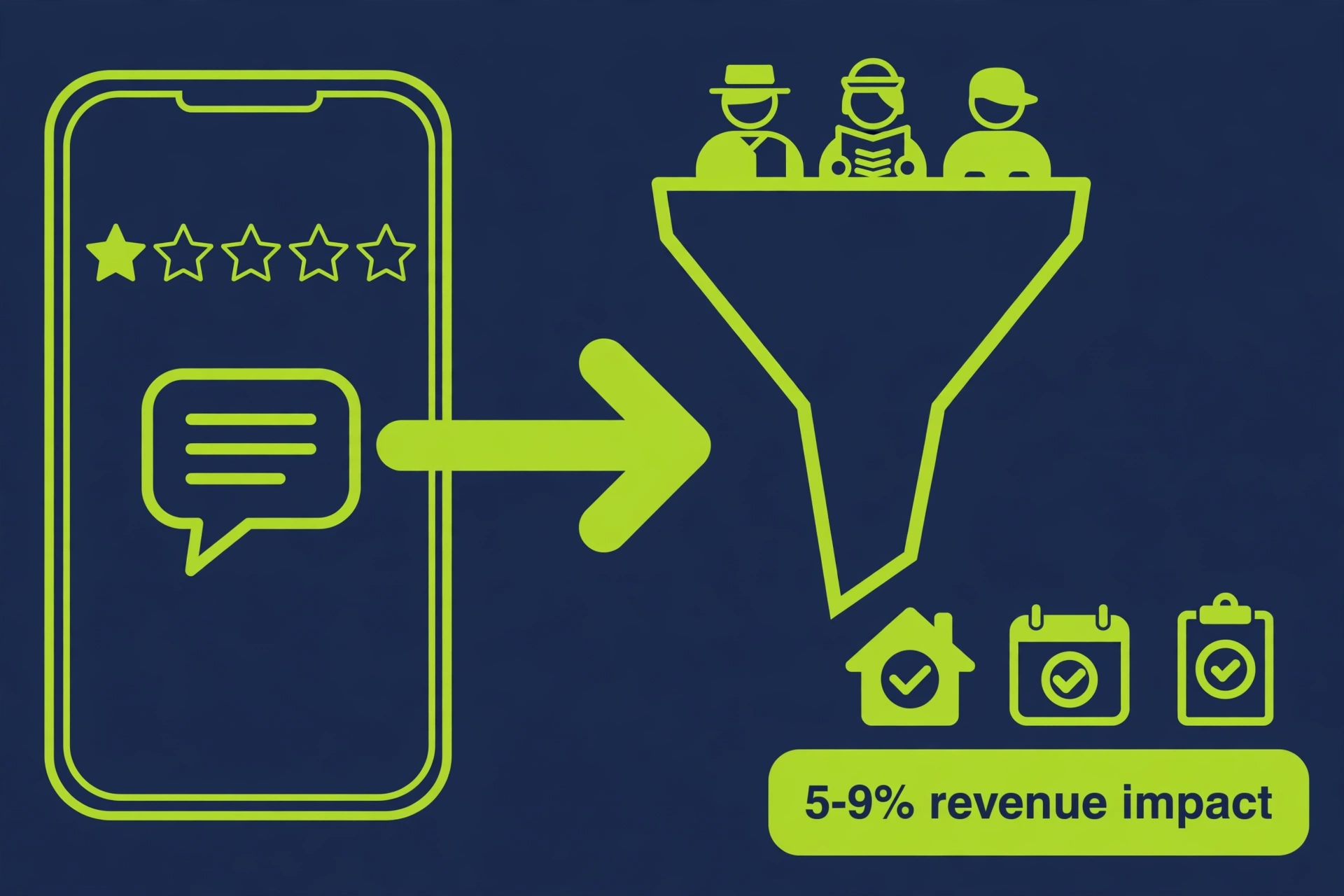
A Harvard Business School study found that a one-star increase in rating is associated with a 5 to 9 percent revenue increase for independent businesses (Luca & Zervas, 2016). Flip it: on $1.2 million in annual revenue, a star dragged down is $60,000 to $108,000 a year, lost to a number on a free listing. Consumers read an average of 10 reviews before trusting a business (BrightLocal, 2024), so your 1-star review sits inside a 10-review reading sample, and 94 percent of consumers say a review has convinced them to avoid a business (ReviewTrackers, 2021). One ugly, unanswered complaint ends the reading session and sends the homeowner back to the results, straight to your competitor.
Here is the part most roofers miss. The complaint is not the damage. The silence is the damage.
What Do Homeowners Actually Look For in Your 1-Star Replies?
Here is the uncomfortable truth: by the time a homeowner reads your 1-star review, they are not deciding whether the complaint is true. They are deciding what kind of company you are.
Every homeowner knows roofing jobs go sideways: a crew runs late, a shingle color looks different in daylight, a nail pops through a gutter. What terrifies a homeowner spending $12,000 is not that something might go wrong; it is that the company will vanish when it does. Your reply is the only place on your profile where they watch you handle a problem in real time.
ReviewTrackers found 45 percent of consumers are more likely to visit a business that responds to negative reviews (2021), and BrightLocal found 88 percent would use a business that responds to all reviews versus 47 percent for one that never responds (2024). The reply is not damage control; it is a sales page your best prospects are actively reading.
Think of it this way. The angry reviewer is your past. The homeowner reading your reply is your future. You are not writing to change the reviewer's mind, though that sometimes happens. You are writing for the dozen homeowners this month who will read that exchange and ask one question: "If something goes wrong on my roof, will this company pick up the phone?" Your reply is your answer, and "proof you care" is the buying criterion of a homeowner about to trust you with their most expensive exterior asset.
What Is the 5-Part Anatomy of a Reply That Wins the Next Customer?
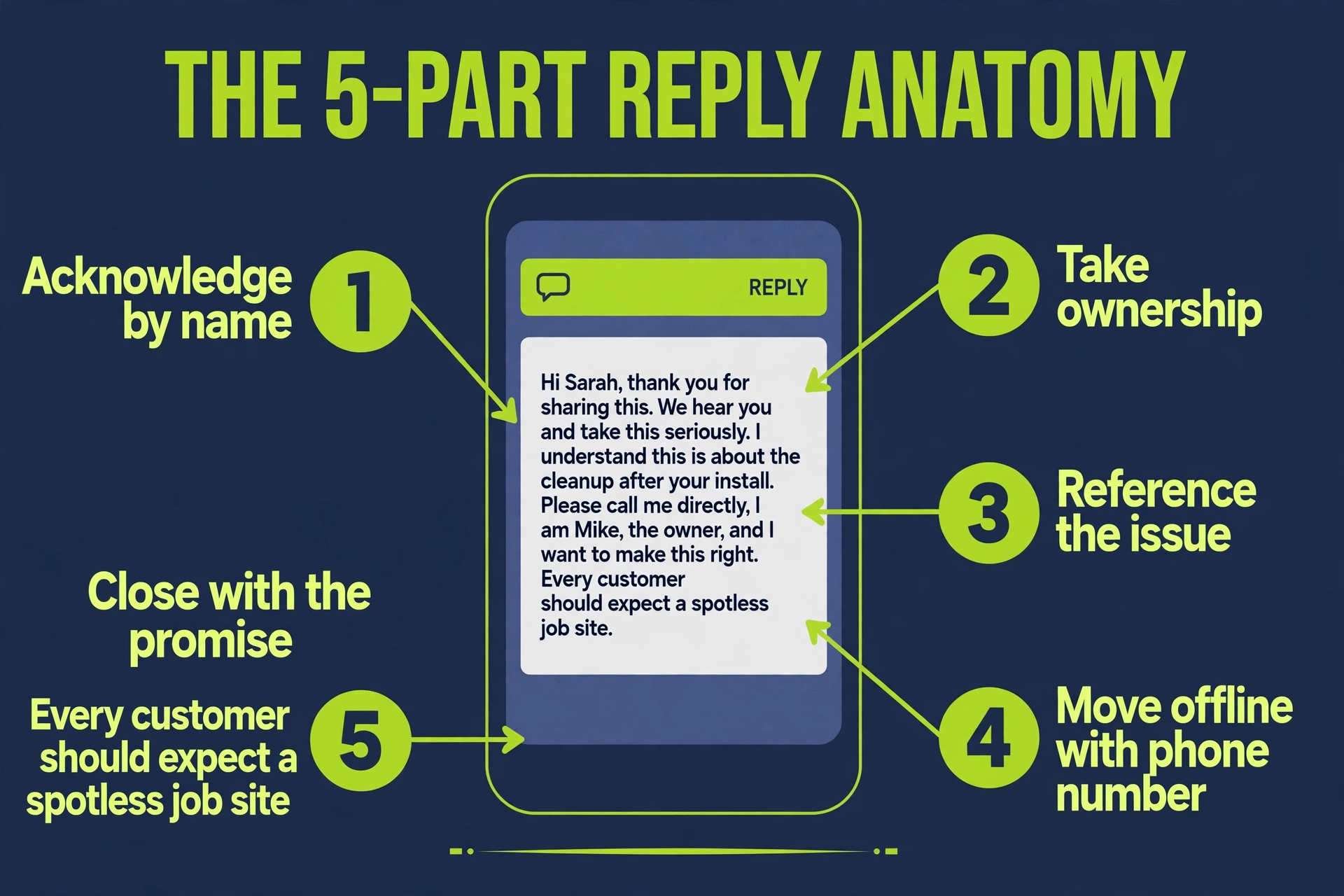
The reply that wins the next customer follows the same five parts every time, because future homeowners scan for the same five signals. Here is the anatomy, then the template.
Part 1: Name them and acknowledge the experience. "Hi [Name], thank you for taking the time to share this." It shows a human wrote this, not a template, and signals you know exactly which job this was. No name in the review? Use a neutral "Hi there" rather than guessing.
Part 2: Take visible ownership, without conceding legal ground. "We hear you, and we take feedback about our work seriously." You are not admitting the roof is defective; you are admitting their experience matters. Future homeowners want accountability, not a courtroom defense.
Part 3: Reference the specific issue briefly. "I understand this is about the cleanup after your installation last month." It proves you know the job and are not pasting a generic response. One clause is enough; never re-litigate the facts in public.
Part 4: Move it offline with a real name and a real number. "Please call me directly at [your number], I'm [Your Name], the owner. I want to make this right." The highest-leverage sentence in the reply: a public complaint reaches the owner directly, with a real number attached, not a screen to hide behind.
Part 5: Close with the promise future customers should expect. "Every customer of ours should expect a clean job site and a roof we'd put our own name on, and I want to get you there." You just stated your standard in front of every future homeowner reading the exchange.
The word-for-word template:
> Hi [Name], thank you for taking the time to share this. We hear you, and we take feedback about our work seriously. I understand this is about [specific issue, one clause]. Please call me directly at [your number], I'm [Your Name], the owner, and I want to make this right. Every customer of ours should expect [your standard, e.g. a spotless cleanup and a roof we'd put our own name on], and I want to get you there.
Sixty seconds to write. Says everything a future homeowner needs to hear.
Should You Ever Argue With a Bad Review?
No. Never. Not even when the reviewer is wrong, not even when you have photos, not even when the crew still talks about that job.
The argument has two audiences and both punish you for it. The angry reviewer escalates: they reply, their friends reply, and the exchange becomes a thread Google displays at the top of your reviews. Future homeowners do not read it as evidence about who is right; they read it as evidence about how you treat customers who disagree. The moment you argue, they file you under "will fight me if there's a problem" and move on.
Google's own guidance says responding to reviews improves visibility, and businesses that respond to more than 25 percent of reviews earn 35 percent more revenue (Womply, 2021). But public fights and accusatory language can get your reply removed and draw policy attention to the listing. The algorithm rewards the calm professional.
Every reply must read to your next $15,000 customer as proof you are safe to hire. If a sentence does not serve that reader, delete it.
How Fast Do You Need to Reply?
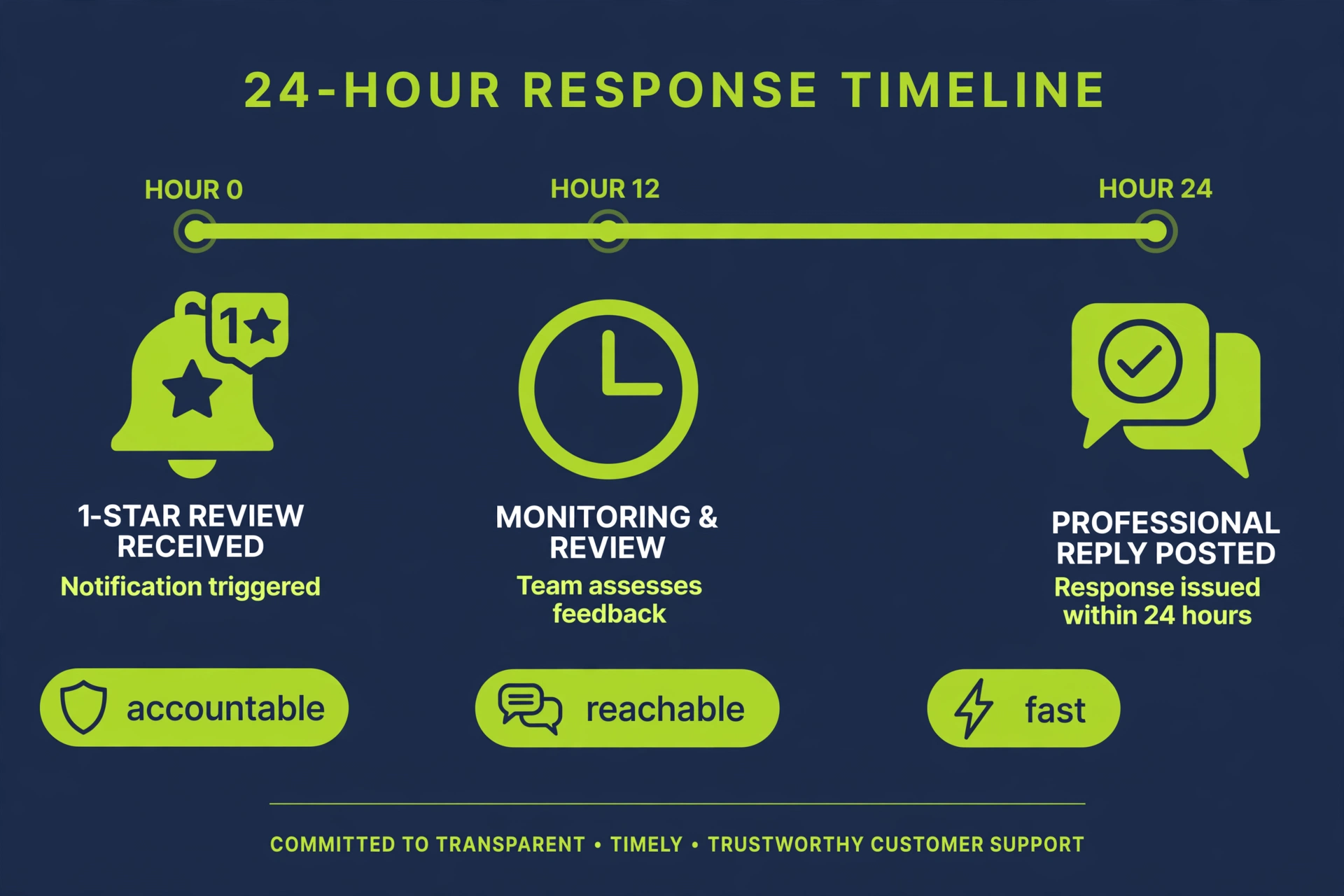
Within 24 hours. Every time. No exceptions for busy weeks, storm season, or installs running long.
Speed is itself the message. Google surfaces recent reviews prominently, so the hours after posting are when most homeowners read your reply. A reply within hours says "we monitor our work and we respond"; one three weeks later says "someone finally told the owner." Future homeowners notice timestamps.
In practice, one person owns review monitoring with the template on their phone: the office manager drafts within hours and the owner approves, or the owner posts directly between estimates. The rule fails when "someone should check reviews" is everyone's job, which means it is nobody's.
Reply before you resolve the issue. Homeowners understand a roof fix takes days; they do not understand silence taking days. Post the public reply on day one, handle the repair on your normal schedule. The reply cannot wait for the resolution.
What About a Review That Is a Lie?
Some 1-star reviews are not from customers at all: a competitor's friend, a homeowner who confused you with another company, a fake account that reviewed twelve businesses in three states this week. Arguing facts with a stranger helps no one, but ignoring it helps no one either.
Step one: still reply, briefly. "Hi there, we don't have a record of this job in our system. Please call me at [your number] so we can look into it, I'm [Your Name], the owner." Mistaken-identity reviewers often remove the review themselves; for fakes, your reply shows future readers the review does not match your records, without an accusation Google might penalize.
Step two: flag it through your Business Profile and document why (no customer record, reviewer hitting competitors across states). Google's review team is slow and inconsistent, so treat flagging as a background process, not a strategy.
Step three: never name the reviewer as fake in your public reply. "This review is fake" reads as defensive to future homeowners and gives Google no usable evidence. "We don't have a record of this job" states the fact and lets the reader draw the conclusion.
Remember the Spiegel Research Center finding: ratings between 4.0 and 4.7 see higher purchase likelihood than perfect 5.0s, because flawless scores trigger skepticism. A few well-handled 1-star reviews make your 4.6 more believable than a competitor's suspicious 5.0. The handled complaint is a trust asset; the perfect profile is a trust question.
How Do 1-Star Replies Turn Into Future 5-Star Reviews?
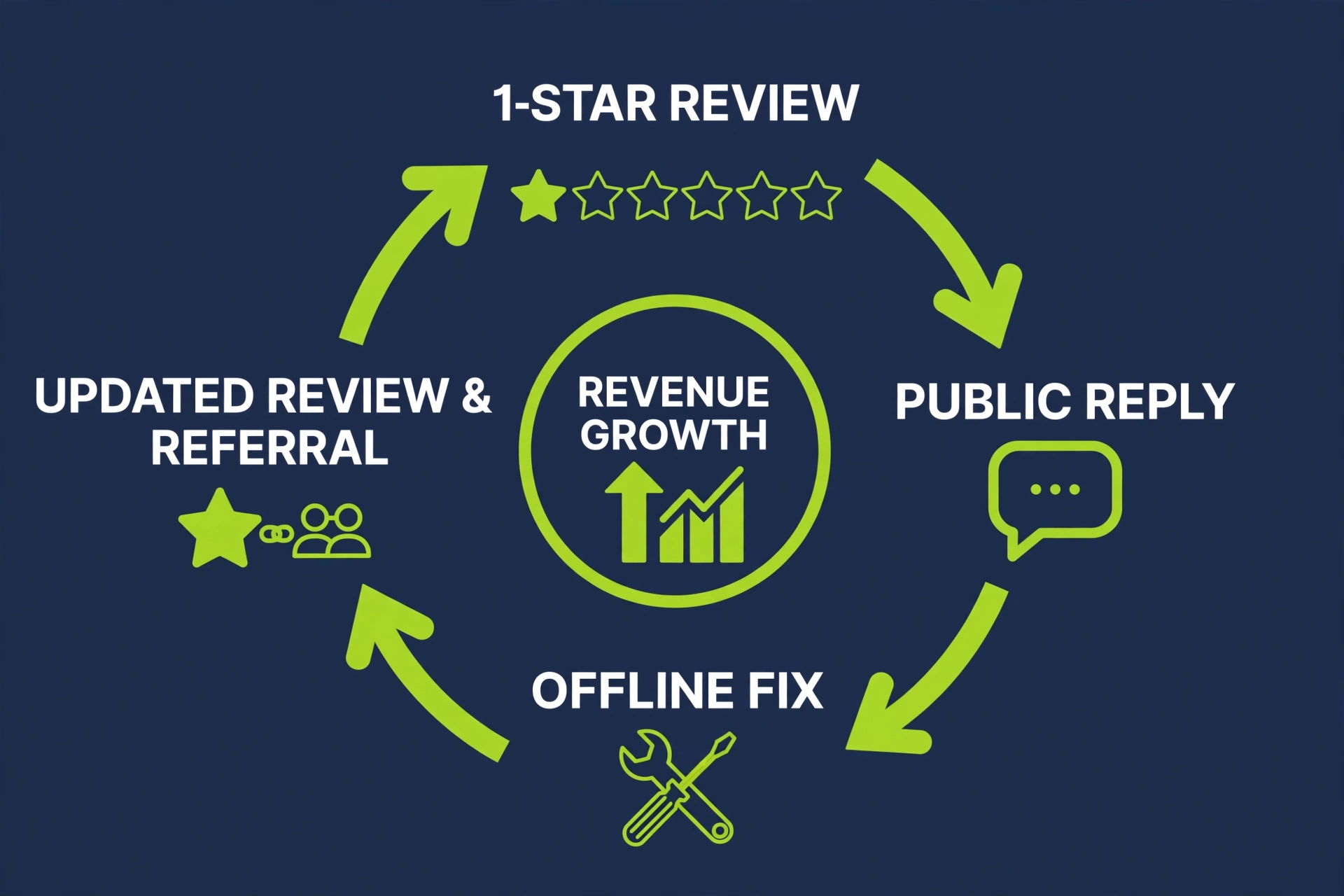
The homeowner who posted the 1-star review is not gone. In roofing, a customer who watched you fix a problem becomes more loyal than one who never had a problem, because they have seen your character under pressure. Service research calls this the service recovery paradox; roofers live it: the repaired customer is the one who refers three neighbors.
The mechanism is the five-part reply. You moved it offline, the owner called, the issue got fixed. Now the homeowner has a new story: "They messed up the cleanup, but the owner called me personally and they came back the next day." That story becomes an updated review and, frequently, a referral. Homeowners trust a roofer who has been tested.
Businesses with 82 or more reviews earn 54 percent more in annual revenue than average (Womply, 2021). Every converted 1-star feeds two pipelines: the updated review strengthens the rating, and the impressed homeowner becomes a reviewer and referrer. The complaint that cost you sleep becomes the story your future customers tell each other.
Bottom Line
A 1-star review is a public interview for your next dozen jobs. Homeowners are not asking whether you are perfect; they are asking whether you are accountable, reachable, and fast. Name the homeowner, own the experience, move it offline with your real number, post within 24 hours. That is the playbook, worth five figures a year.
This is exactly what RepuPilot's review response system handles for roofing companies: every review monitored, every negative review answered within 24 hours with a reply written for the future customer, every complaint routed to the owner before it becomes a second bad review. The roofers whose profiles sell jobs are not the ones with zero complaints; they are the ones whose complaints end with the owner picking up the phone.
Frequently Asked Questions
Should I offer a discount or refund in my public reply?
No. Never put compensation in the public reply: it teaches every future reader that a 1-star review is a coupon, and boxes you in before you have talked to the homeowner. Handle the fix and any goodwill privately on the phone, where the conversation stays human and the terms stay yours.
What if the homeowner replies to my reply and keeps arguing?
Do not post a second public response. One calm, complete reply is the whole public record; a second turns it into a thread, and threads are what future homeowners remember. Restate your number once ("my number is still [number], I'm still here") and stop posting. Silence after a complete reply reads as professionalism, not avoidance.
Can I ask a customer to remove or change their 1-star review after I fix the problem?
Ask once, politely, on the phone, after the fix is complete and the homeowner is genuinely satisfied: "If you feel this is resolved, an update to your review would mean a lot to us." Never offer anything in exchange, never pressure, never ask twice. An updated review from a resolved complaint is the most credible review on your profile.
How do I handle a 1-star review about price?
Price complaints are usually expectation complaints, common in roofing because the numbers are large. Reply with the standard five-part structure. Future homeowners reading a price complaint are checking whether you were transparent; a calm reply inviting a direct conversation reassures them more than any price defense.
Should I respond to 1-star reviews on every platform or just Google?
Google first, always, that is where homeowners check you. Then Facebook and Yelp if you have a real presence there: a reply on Google and silence on Yelp looks inconsistent. Do not spread across ten platforms; dominate the two or three where your customers look.
What if I genuinely cannot figure out which job the review is about?
Reply with the standard structure minus the specific reference: acknowledge, take ownership, give your direct number so you can identify the job. Then check your records and crew leads. If no job matches, treat it as possible mistaken identity and follow the flagging steps, but keep the public reply calm and brief either way.
How many 1-star reviews are too many?
The ratio matters more than the count: a roofer with 200 reviews and six well-handled 1-stars looks battle-tested; one with 12 reviews and three unanswered 1-stars looks risky. Ratings between 4.0 and 4.7 convert better than perfect 5.0s, because flawless profiles trigger skepticism. Focus on volume, recency, and reply quality rather than chasing zero complaints.