
*Why roofing estimates go cold, the real dollar value sitting in your quote pile, and the exact five touches that turn “we’ll think about it” into signed jobs.*
The average roofer closes 25 to 35 percent of estimates on the first pass, so 65 to 75 percent go cold. On 100 estimates a year at $10,000 average, that is $650,000 to $750,000 in quoted work sitting in your CRM (illustrative). Most of those homeowners still need a roof, and five touches over 21 days recovers a meaningful share at nearly zero acquisition cost.
Quick Answer:
Dead estimates are delayed decisions, not dead leads. Homeowners stall on roofing quotes because of sticker shock, insurance timing, a phantom second bid, or life. Five touches over 21 days across text, calls, and email reactivates 15 to 25 percent of cold estimates. Your CRM already holds this revenue.
Why Do Roofing Estimates Go Cold in the First Place?
Roofers treat a stalled estimate like a rejection. In roofing, "we'll think about it" is almost never "we chose someone else"; it is one of four delays, each solvable.
Sticker shock with no next step. A homeowner who expected $6,000 hears $13,500 and goes quiet. They are not negotiating; they are processing. Without a follow-up that reframes the number (financing, insurance coverage, cost of waiting), the shock hardens into avoidance.
The insurance clock. Much of roofing work runs through claims, and claims run on adjuster timelines. The homeowner got your estimate, filed the claim, and is waiting on an adjuster three weeks out. Your estimate is not dead; it is parked inside someone else's process, and homeowners rarely tell you unless you ask.
The phantom second bid. Homeowners are told to get three bids. They get yours, mean to call two more companies, and never do. The most common cold-estimate cause in residential roofing, and it is pure inertia, not a lost sale.
Life. Kids, work, a car repair, a medical bill. The roof is important but not urgent, and urgent beats important every time. These homeowners will buy a roof this year; they need a reason to move it back up the list.
None of these require a lower price. The sequence that works does not start with a discount; it starts with a reason.
How Much Money Is Sitting in Your Dead Estimate Pile?
Let us do the honest math, because most roofers have never added up the pile.
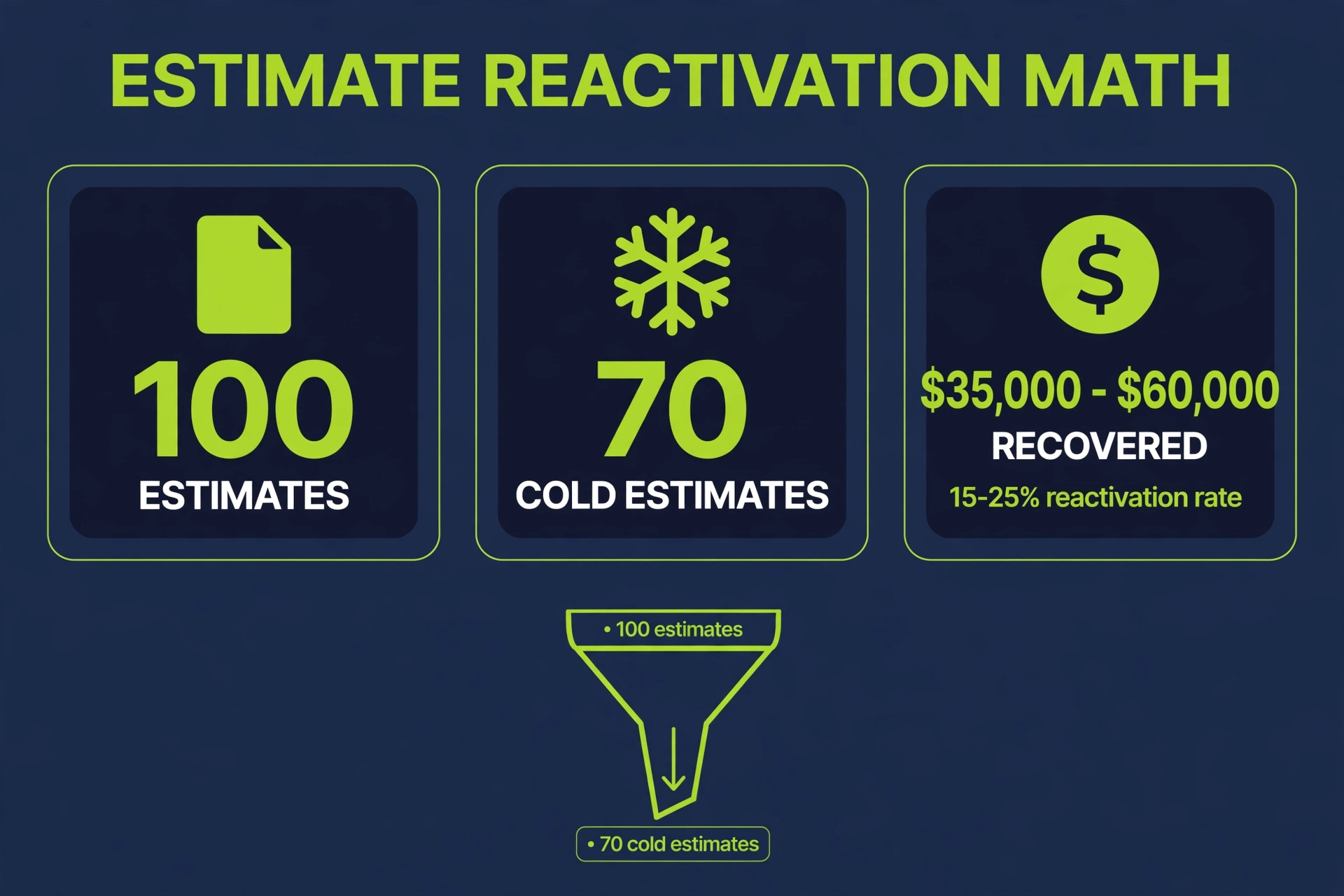
Take a residential roofer running 100 estimates a year, with illustrative middle-of-the-road assumptions: a 30 percent first-pass close rate, a $10,000 average job value.
100 estimates given, 30 closed on the first pass
70 cold estimates in the CRM × $10,000 = $700,000 in quoted work
The reactivation math: a disciplined sequence reactivates 15 to 25 percent of cold estimates into conversations, and roughly a third of those close (illustrative home-services benchmarks).
Conservative (15% reactivation): 70 × 15% = 10 to 11 conversations, × 33% close = 3 to 4 jobs = $35,000 recovered.
The aggressive but realistic end (25 percent reactivation): 70 × 25% = 17 to 18 conversations, × 33% close = 6 jobs = $60,000 recovered.
That is $35,000 to $60,000 a year from estimates you already paid to generate: the lead cost is sunk, the visit is done, the measurements are in the CRM. Compare new leads at $50 to $150 a pop, and reactivation is the cheapest revenue channel in the business. HBR's oft-cited finding holds: acquiring a new customer costs 5 to 25 times more than retaining an existing relationship.
One more number: 80 percent of sales require five follow-ups, yet 44 percent of salespeople quit after one and nearly half never follow up (widely cited benchmarks). The dead pile is a follow-up gap, not a demand gap.
What Is the 5-Touch Sequence?
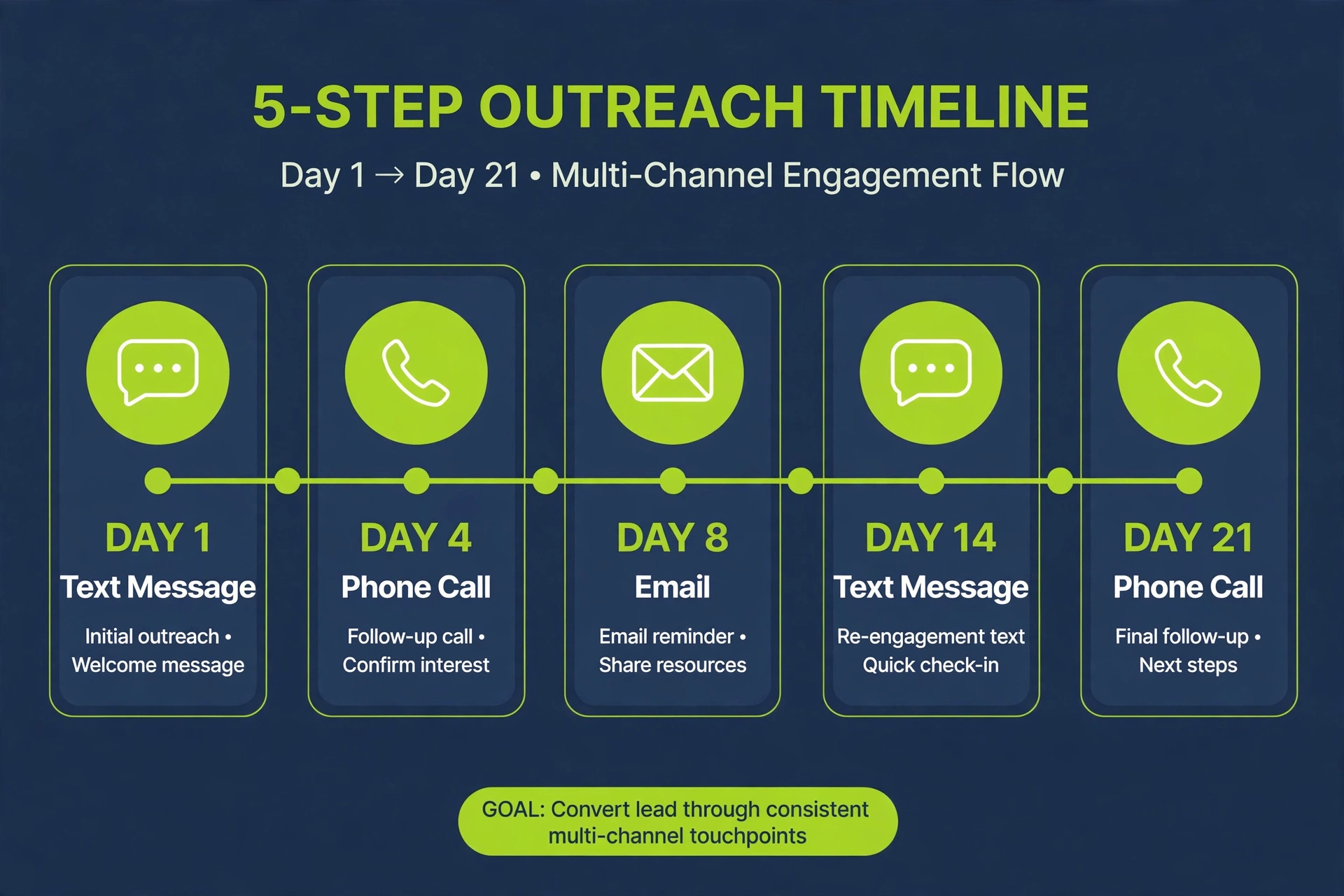
Five touches, 21 days, three channels, one rule: every touch gives a new reason to act. Nobody responds to "just checking in" five times; each touch is a different angle.
The channel mix matters: text gets opened, calls land after the text warmed them up, email carries documents. And 35 to 50 percent of sales go to the vendor that responds first (XANT/InsideSales); firms responding within an hour are nearly 7 times as likely to qualify a lead (HBR, 2011).
Here is the sequence:
Touch 1 (Day 1): The text check-in. Short, human, one question. Its only job: reopen the conversation.
Touch 2 (Day 4): The value-add call. Something new on a real call: a financing option, an insurance tip, a material note for their roof. Not "did you decide yet."
Touch 3 (Day 8): The email with proof. Photos from a recent similar job, a neighborhood testimonial, the estimate re-attached. Email is the channel for evidence.
Touch 4 (Day 14): The reason-to-act-now text. A genuine, specific reason tied to their situation: storm season, a schedule opening, a manufacturer price change. Real urgency, never manufactured.
Touch 5 (Day 21): The breakup call. The polite close: "I'll close out your file unless you tell me otherwise." It gets the highest response rate, because it gives permission to say no, and most homeowners would rather say "wait, not yet" than watch the file close.
After touch 5, non-responders enter the long-cycle drip below. Responders exit the sequence into a live conversation.
What Do You Actually Say on Each Touch?
Scripts, word for word. Adapt names and specifics; keep the structure.
Touch 1, Day 1, text:
> Hi [Name], it's [Your Name] from [Company]. Checking in on the roof estimate from [date]. Totally fine if the timing wasn't right, just wanted to see if you have any questions I can answer.
Why it works: it names the specific estimate, gives permission for the timing, and ends with a question. Questions get replies; statements get deleted.
Touch 2, Day 4, phone call with a voicemail-or-live script:
> Hi [Name], it's [Your Name] from [Company]. I was reviewing your estimate and realized I never walked you through the financing options, most customers are surprised at the monthly number versus the lump sum. No pressure; I just didn't want you deciding on the big number without the full picture. Call or text me back, [number].
Why it works: it brings new information (financing reframes sticker shock, the number-one estimate killer).
Touch 3, Day 8, email:
Subject: Your roof estimate + a job we just finished near you
> Hi [Name], > > Resending your estimate from [date] so it's easy to find, attached. We just wrapped a [shingle type] replacement on [nearby street], same roof profile as yours, and I've attached before-and-after photos. > > One thing worth knowing: [one relevant fact, e.g. the manufacturer updated warranty terms on this line / more hail claims are being approved in your zip code this quarter]. Happy to walk through any of it whenever you're ready. > > [Your Name], [Company], [number]
Why it works: the email carries proof, and the "one thing worth knowing" gives a reason to re-engage unrelated to being sold to.
Touch 4, Day 14, text with a real reason:
> Hi [Name], [Your Name] from [Company]. Quick heads-up: [specific, true reason, e.g. two install slots open the week of the 12th, then we're booking into next month / the manufacturer announced a price increase on [shingle line] next month]. Wanted you to hear it from me first. Happy to answer anything on your estimate.
Why it works: the reason must be true. One fake deadline destroys the trust the first three touches built.
Touch 5, Day 21, the breakup call:
> Hi [Name], it's [Your Name] from [Company]. I don't want to keep bothering you, so this is my last check-in: I'll close out your estimate file at week's end unless you tell me otherwise. If timing changes, just text this number and we'll pick it right back up. Thanks for considering us.
Why it works: permission to end the conversation is what restarts it. Most reactivations happen on this touch, often as "wait, don't close it, we just got the insurance paperwork."
When Is an Estimate Too Old to Reactivate?
Estimates have a shelf life; running the sequence on a two-year-old quote wastes everyone's time. The windows:
Under 90 days: prime territory. The homeowner remembers the visit and the numbers are roughly valid. Run the full sequence; this is where the 15 to 25 percent rate lives.
90 days to 12 months: the roof-age angle. The estimate may need refreshing, but the homeowner is a warm contact. The message shifts from "your estimate" to "your roof": seasonal check-ins, storm reminders, the roof-age email. Three touches over 30 days, then the drip.
Over 12 months: stop reactivating, start nurturing. The quote is stale; move them to the seasonal list. When the roof fails or the claim lands, you are the familiar name. Asphalt shingle roofs last 20 to 25 years, so every estimated homeowner is a future customer on a known timeline.
One hard rule: never reactivate an estimate you would not honor. If prices moved enough that the old number is fiction, say so in touch 1. Homeowners respect the honesty, and it gives you a reason to revisit the property.
How Do You Reactivate Without Sounding Desperate?
The fear that keeps roofers from following up is the fear of looking needy. The sequence avoids it by design, but the positioning underneath matters more than any script.
You are not chasing; you are stewarding. This homeowner invited you onto their roof and received your assessment. Following up on your own recommendation is the job: doctors call about test results, roofers call about estimates.
Never lead with a discount. Opening with "we can knock 10 percent off" tells the homeowner the original number was inflated and trains every future customer to stall for the discount. Discounts are a last resort for live negotiation, never a reactivation opener.
Each touch must be ignorable without awkwardness. Every message should read fine whether they ignore it or reply. No guilt ("I've tried reaching you several times"), no fake deadlines, no essays. Short, warm, specific, done.
Match their energy on reply. When a homeowner re-engages, do not flood them with questions. Answer what they asked, add one useful thing, suggest one next step. Nurtured leads make 47 percent larger purchases (Annuitas Group), and a reactivated estimate often converts bigger, because the homeowner has had months to consider upgrades.
What Happens After Touch 5?
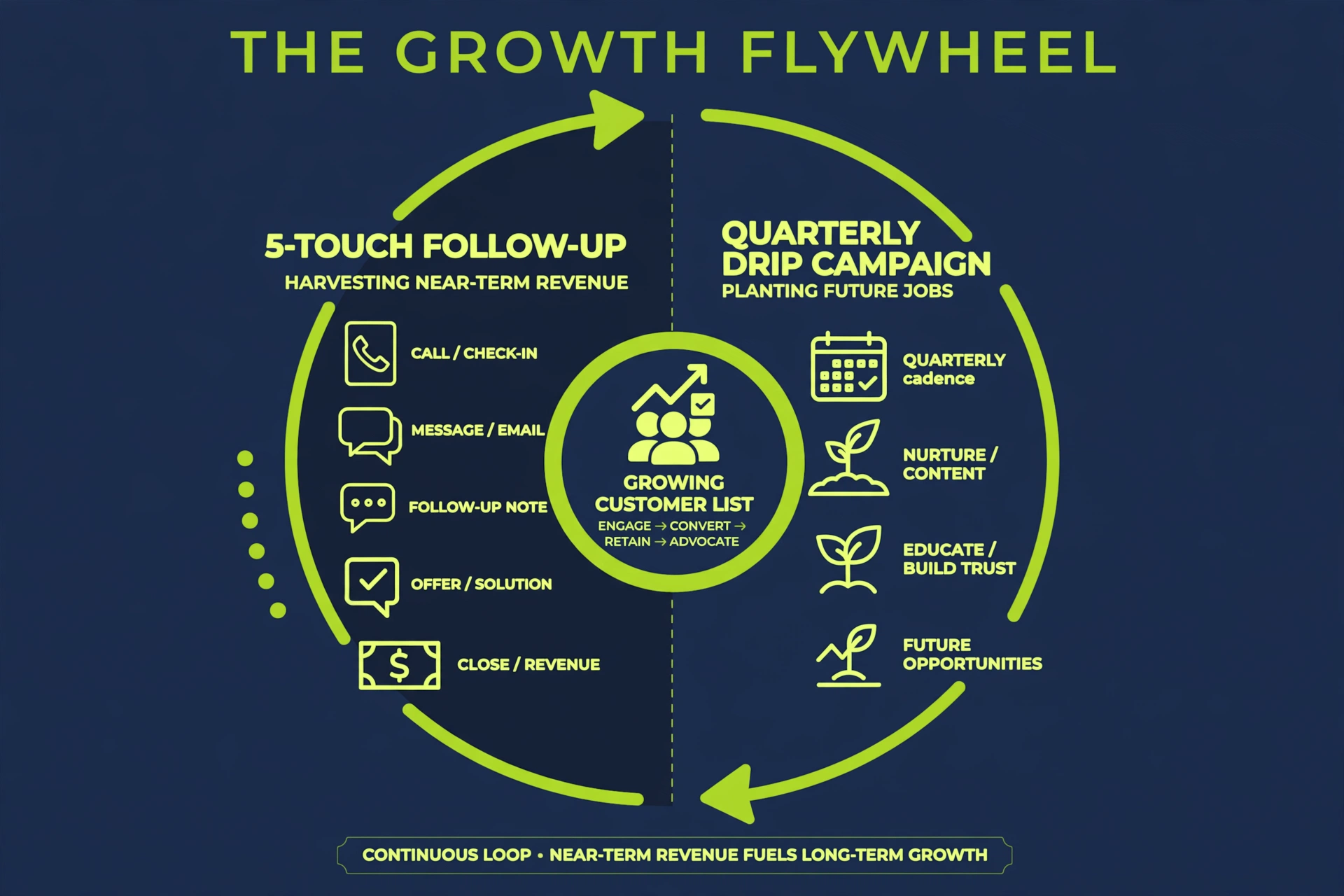
Homeowners who never respond are not lost; they are not ready. They enter the long-cycle drip, a different machine with one job: stay familiar until timing changes.
The long-cycle drip is quarterly, not weekly. Four touches a year, each one useful on its own:
Spring: storm-season readiness check and free inspection offer.
Summer: a recent local job story with photos (social proof from their zip code).
Fall: pre-winter roof health reminder (the "small fix now beats emergency later" angle).
Winter: insurance and warranty education (the quiet months are when homeowners research).
Every drip touch carries the standing invitation: "Your estimate from [month] is on file whenever you're ready." No pressure, no countdown. Familiarity is what makes them call you instead of Googling when the ceiling stain appears two years later.
Four touches a year to a list you own keeps you top-of-mind with hundreds of homeowners who already met you. When a fraction converts in years two and three, the visit's lifetime value doubles. The sequence harvests this quarter's revenue; the drip plants next year's.
Bottom Line
Your CRM holds the cheapest revenue in your business: seventy cold estimates at $10,000 average is $700,000 in quoted work, and five touches over 21 days recovers $35,000 to $60,000 at nearly zero acquisition cost (illustrative). Homeowners are not rejecting you; they are delayed by sticker shock, insurance timelines, phantom bids, and life.
This is exactly what RepuPilot's database reactivation runs for roofing companies: the dead-estimate list segmented by age, the five-touch sequence going out automatically across text, call, and email, every reply routed live, the quarterly drip keeping the rest warm. The roofers growing without buying more leads are collecting revenue their estimates already earned.
Frequently Asked Questions
Will the five-touch sequence annoy homeowners and hurt my reputation?
Not if every touch adds value. Annoyance comes from repetition ("just checking in" five times), not contact. Each touch brings something new, so homeowners experience thoroughness, not pestering. The breakup touch gives them an explicit out.
What if the homeowner already hired someone else?
Thank them and move them to the long-cycle drip: "Glad you got it taken care of, if anything comes up down the road, you have my number." Warranties get tested and contractors disappear; today's lost estimate is often tomorrow's repair customer.
Should I offer a discount on touch 4 or 5 to close the deal?
Only inside a live negotiation, never as a broadcast. If a re-engaged homeowner names price as the obstacle, discuss options one to one. A blanket discount trains the whole list to wait for the next one.
How do I handle estimates where the homeowner is waiting on insurance?
Put them in a separate track: touch 1 acknowledges the claim, touch 3 includes claim-friendly documentation (photos, line-item scope), and timing stretches to the adjuster's calendar. These close at higher rates because funding is already decided; the homeowner needs a roofer who speaks insurance.
What is a realistic reactivation rate for my first run?
Expect 10 to 15 percent to re-engage on your first run, improving toward 20 to 25 percent as you refine scripts and segment the list. The first run also cleans the list: wrong numbers and moved homeowners get removed, making every future run sharper.
How often should I re-run the sequence on the same list?
Run the full sequence once per cold estimate, then move non-responders to the quarterly drip permanently. The drip keeps you present; when their situation changes, they will raise their hand.