
The same-day text that turns every finished roof into a fresh Google review — the exact template, the one-hour timing rule, and the compliance-safe automation setup.
The text that gets a roofer a Google review within 24 hours goes out the same day the crew packs up, ideally within an hour of the final walkthrough, and it contains three things: one short thank-you, one sentence naming the work that was done, and one tappable link to the Google review page. Timing beats wording here. A plain, friendly text sent the night the job finishes will out-pull a polished one sent three days later, because homeowners decide whether to review you in the first few hours after you leave, while the new roof is still the biggest thing on their mind.
Quick Answer:
Send one short text the same day the job finishes, within an hour of the final walkthrough. Thank the homeowner by name, name the specific work, and include a single link to your Google review page. Text requests convert up to 15x better than email (Podium). Ask every customer equally, never filter, never incentivize.
Why Does the First 24 Hours Matter So Much for a Google Review?
Right after a roof replacement, your customer is living through the peak of the relationship. The old, leaking roof is gone. The crew just spent a day or two on the property and left it cleaner than they found it. That window of genuine enthusiasm is what powers a great review, and it closes fast.
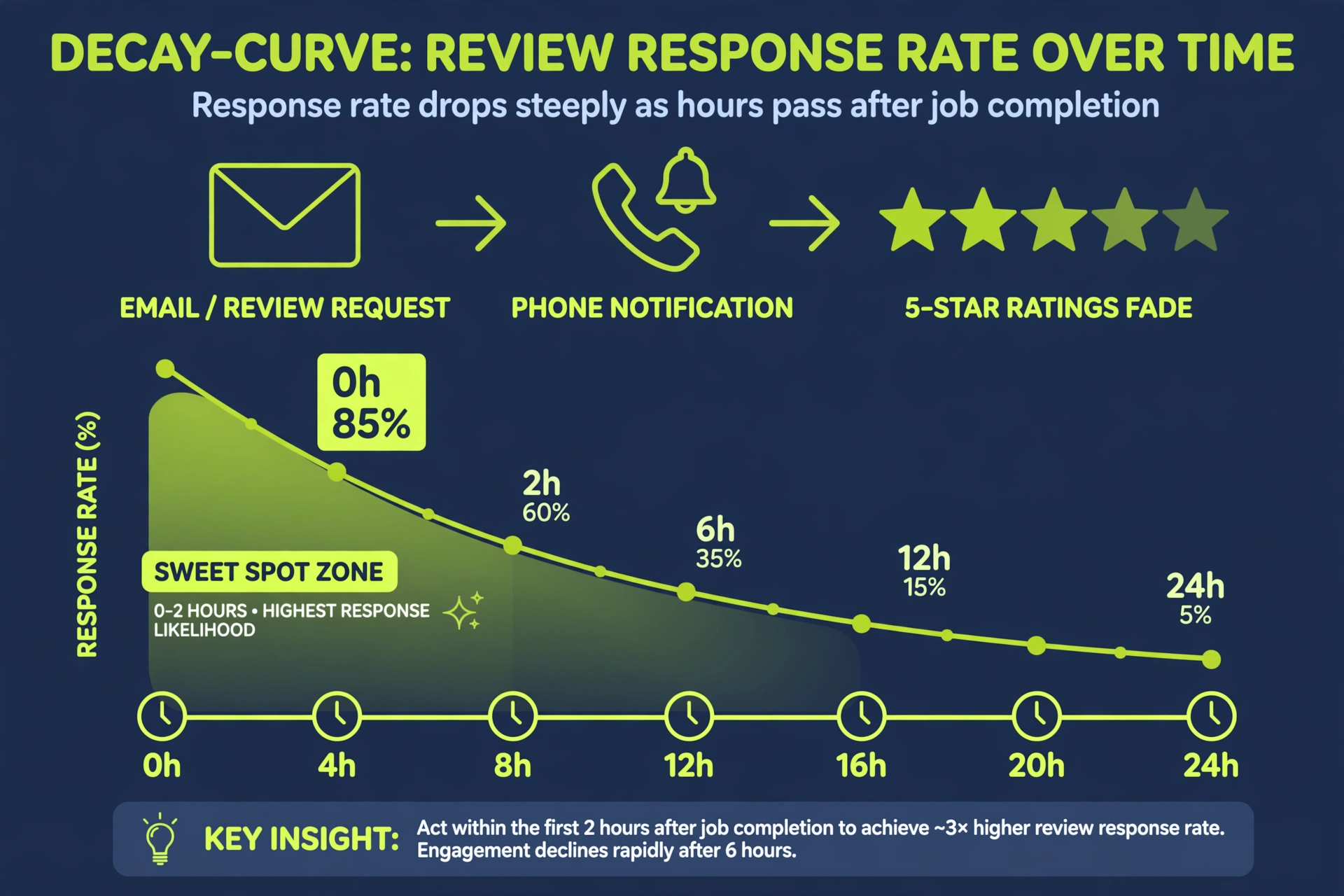
Two things decay at the same time. First, the homeowner’s motivation decays. The night of the install, they are thinking about the roof. Within days they are back to their normal life, and the mental note to “leave that roofer a nice review” does not survive contact with a normal week. Second, the details decay. A great Google review mentions specifics: the crew’s cleanup, the new ridge vent, the way the estimator explained the decking. Those details live in short-term memory. A week later the review is “great job, highly recommend” — pleasant, and worth far less to the homeowner reading it before hiring you.
Review velocity also feeds your ranking. Google’s local results reward profiles that earn reviews steadily and recently. BrightLocal’s 2026 survey found that roughly 74 of 100 consumers only care about reviews written in the last three months. A roofer who gets a review after every job looks alive to Google. A roofer whose newest review is from last hail season does not, even with a 4.9 average. After a major storm, the companies whose profiles show reviews from this month win the estimate appointments — a review posted within 24 hours timestamps you as the company working right now.
Why Does a Text Beat an Email, a Business Card, or Asking in Person?
Because the text is the only channel that matches the homeowner’s reality. Walk through what actually happens with each alternative.
The follow-up email has an open rate somewhere in the 20 to 30 percent range, per SMS marketing benchmarks from Sakari — meaning seven or eight of every ten review requests you email never get seen. Text messages sit near a 98 percent open rate, per the Mobile Marketing Association, and 90 percent are opened within three minutes of delivery (Sakari).
Then there is the friction gap. Podium’s Complete Guide to Online Reviews found that text-based review requests see completion rates up to 15x greater than email-based ones. The email sits behind a login and often means switching devices. The text arrives with a blue link under their thumb while they are on the couch: tap, five stars, two sentences, done in ninety seconds.
The business card with a QR code converts poorly. Cards get lost, they get handed to the wrong spouse, and scanning a QR code on a shadowed driveway is more effort than any review is worth.
Asking in person is the other failure mode, and it carries a compliance risk. Asking a homeowner to leave a review while you are standing in their driveway is pressure, however friendly it feels. Google’s review policies prohibit pressuring customers to leave reviews while on the premises, and enforcement has only gotten stricter. The right in-person move is to set up the text: “I’ll send you a quick text tonight with a link — if you had a good experience we’d love your feedback.” That is expectation-setting, not pressure, and the text does the actual asking.
What Should the Post-Job Text Actually Say, Word for Word?
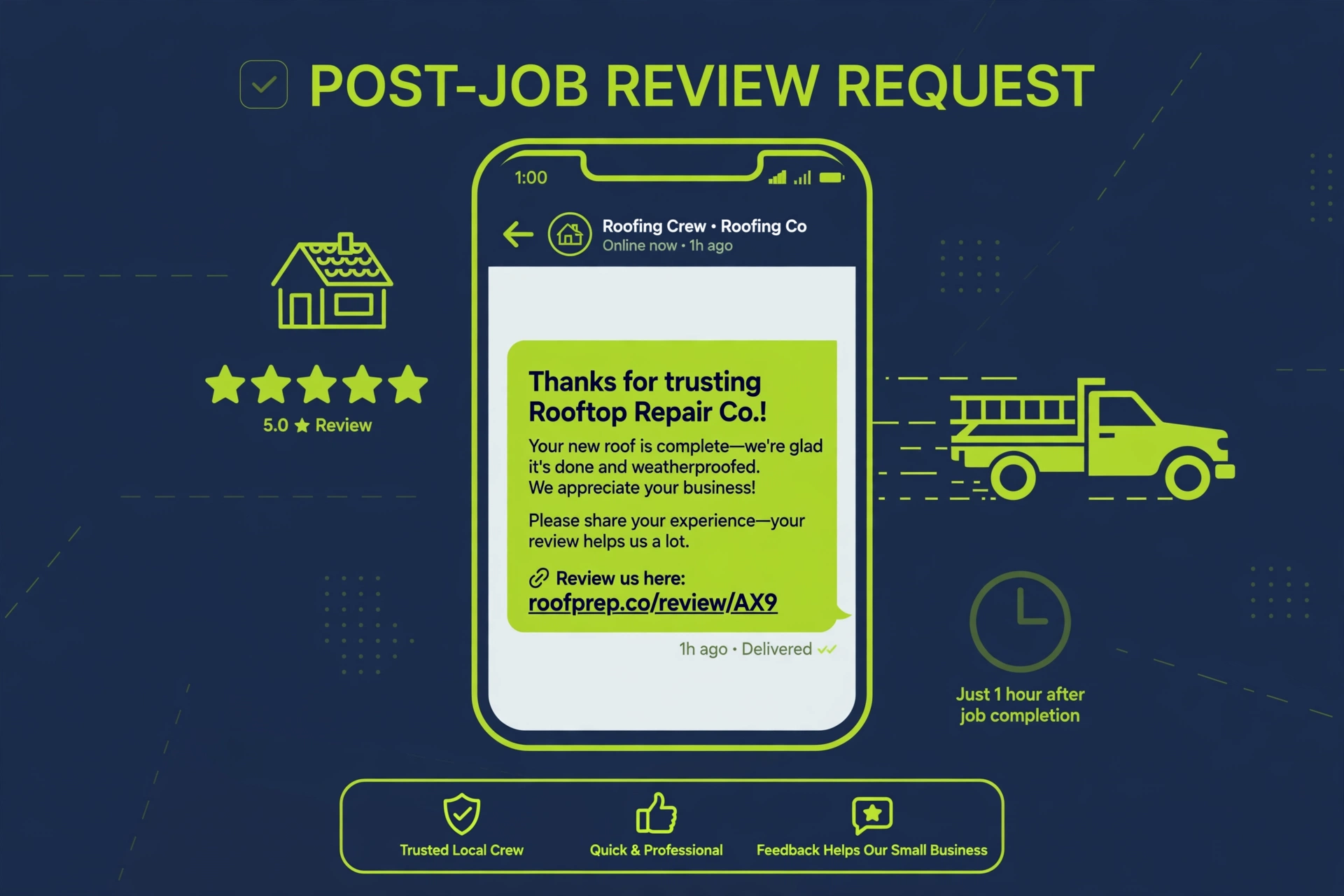
Here is the template:
> Hi [First Name], this is [Your Name] with [Company Name]. Thanks for trusting us with your new roof — the crew finished up today and the job site is all cleaned up. If you have a minute, we’d really appreciate your honest feedback here: [Google review link]
Every word earns its place. The first name beats “Hi there” because the homeowner’s phone already knows you from the estimate reminders. The company name is there because the number they saved might be labeled “roof guy.” Naming the specific work gives their review its first specific detail. And “your honest feedback” is an open-ended ask, not a fishing trip for five stars, which is what Google’s policies require.
What not to include: do not say “we’d love a 5-star review.” That is the most common unforced error roofers make. It asks for a specific sentiment, which is exactly what both Google’s prohibited practices and the FTC’s Consumer Review Rule (16 CFR Part 465, effective October 2024) treat as a violation — asks conditioned on a particular sentiment are banned, and FTC enforcement warning letters cite penalties exceeding $50,000 per violation. Beyond the rules, it backfires socially: telling a customer what rating to leave cheapens the review. Ask for feedback. The five stars come from the experience, not the request.
Get the mechanics right too. Send from the same number that texted them about the appointment and the crew arrival — familiarity converts, unknown numbers get ignored. Make the link a real direct link to your Google review page from your Business Profile, not your homepage. And send it once. The reminder comes later, once, and then you stop.
When Exactly Should You Send It — Before the Crew Leaves or After the Walkthrough?
After the walkthrough. Always after.
The job is not done until the walkthrough is done and the homeowner agrees it is done. Asking for a review before the final inspection reads as presumptuous, and if the homeowner spots a missed shingle during the walkthrough, your review request is now part of the complaint story. There is also the policy angle: on-the-spot asks while your trucks are still in the driveway count as the pressure situation Google flags.
The correct sequence is simple:
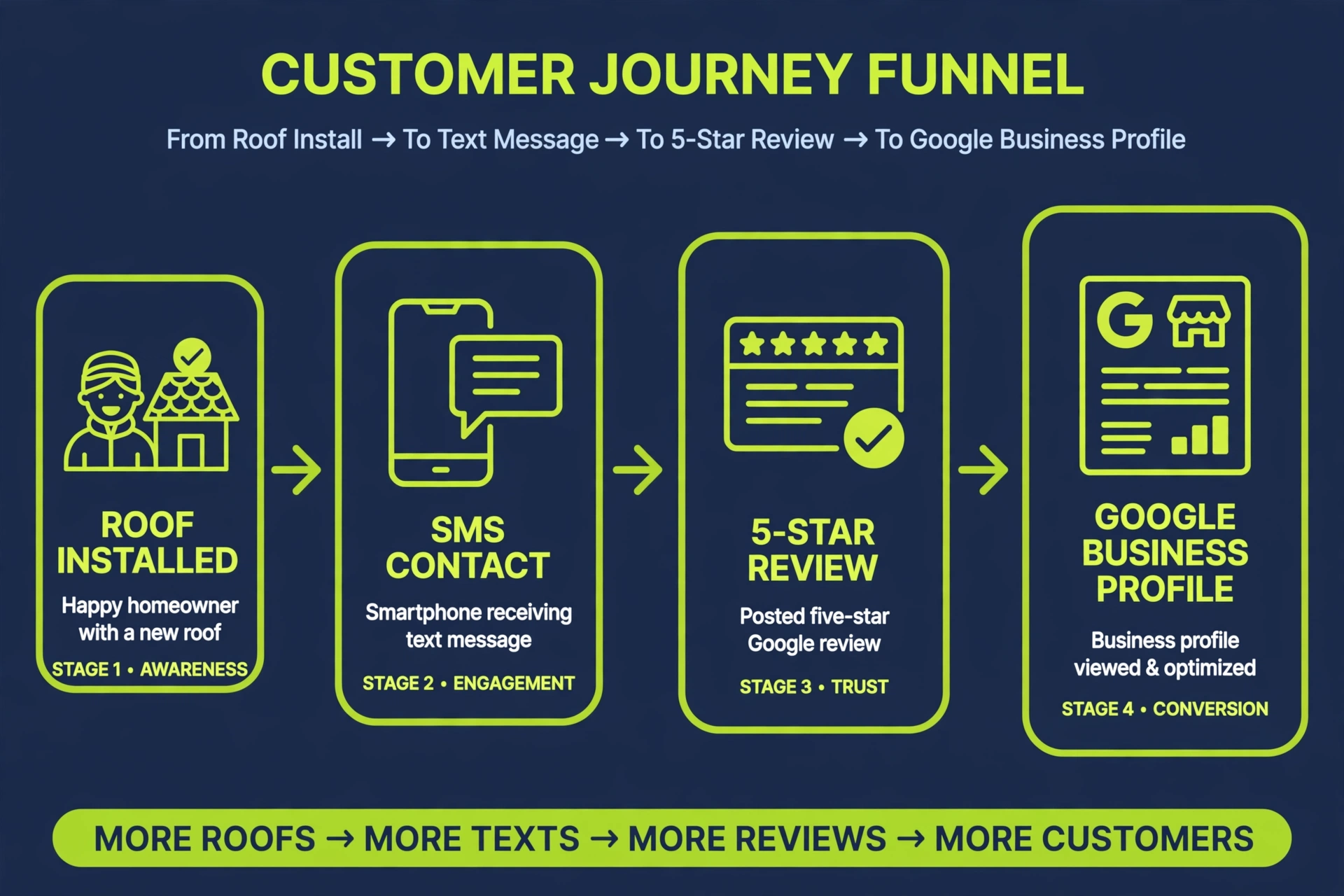
Crew finishes and cleans up.. Magnet sweep the yard, gutters cleared, all material hauled. 2. **Walkthrough with the homeowner.** Show them the finished roof, the attic vents, the new pipe boots. Answer the last questions. Get verbal confirmation. 3. **Collect payment and shake hands.** The business part is closed. 4. **The text goes out within the hour.** Not three days, not next Monday. That evening.
Why within the hour works is pure psychology. The homeowner just experienced the best moment of the whole transaction: the finished product, the clean yard, the handshake. The text arrives while that feeling is live and rides on it. Roofers who move the ask from a Monday-morning email to a same-night text routinely see their monthly review count roughly triple without changing a word of the message.
Watch out for the seasonal pileup too. After a big storm run, the office “will send the review requests Friday.” Friday never comes, or the batch text arrives five days late, when the homeowner’s enthusiasm is stone cold. The send must be triggered by the job, not by the office calendar.
What If the Job Didn’t Go Perfectly? Do You Still Send the Text to Everyone?
Yes. You send it to everyone, every job, with no filtering. This is the rule that protects you.
Review gating — asking only customers you expect to praise you — is explicitly prohibited by Google, and the FTC’s 2024 Consumer Review Rule separately prohibits suppressing negative reviews based on sentiment. The practice is a double violation: a platform rule and federal law.
But there is a better business reason. The homeowner who had a rough job and never gets asked has exactly one outlet: an unprompted 1-star review, posted whenever the frustration boils over. The homeowner who had a rough job and gets a polite, open-ended text has a third option — reply to the text. That reply is your private rescue lane, where complaints get solved before they become public reviews.
The post-job text is a sentiment radar, not just a review funnel. When a homeowner replies “the cleanup wasn’t great honestly,” your office has a live issue to fix within hours, not a 1-star review to discover in two weeks. Roofers who text every customer get fewer public complaints because they intercept the complaints while they are still text messages.
The ask is identical for everyone. Same template, same link, same timing. “We text every customer after every job” is a complete answer.
How Do You Automate the Ask Without It Sounding Like a Robot?
Automation handles the timing; the manual parts handle the human. You automate the send, not the relationship.
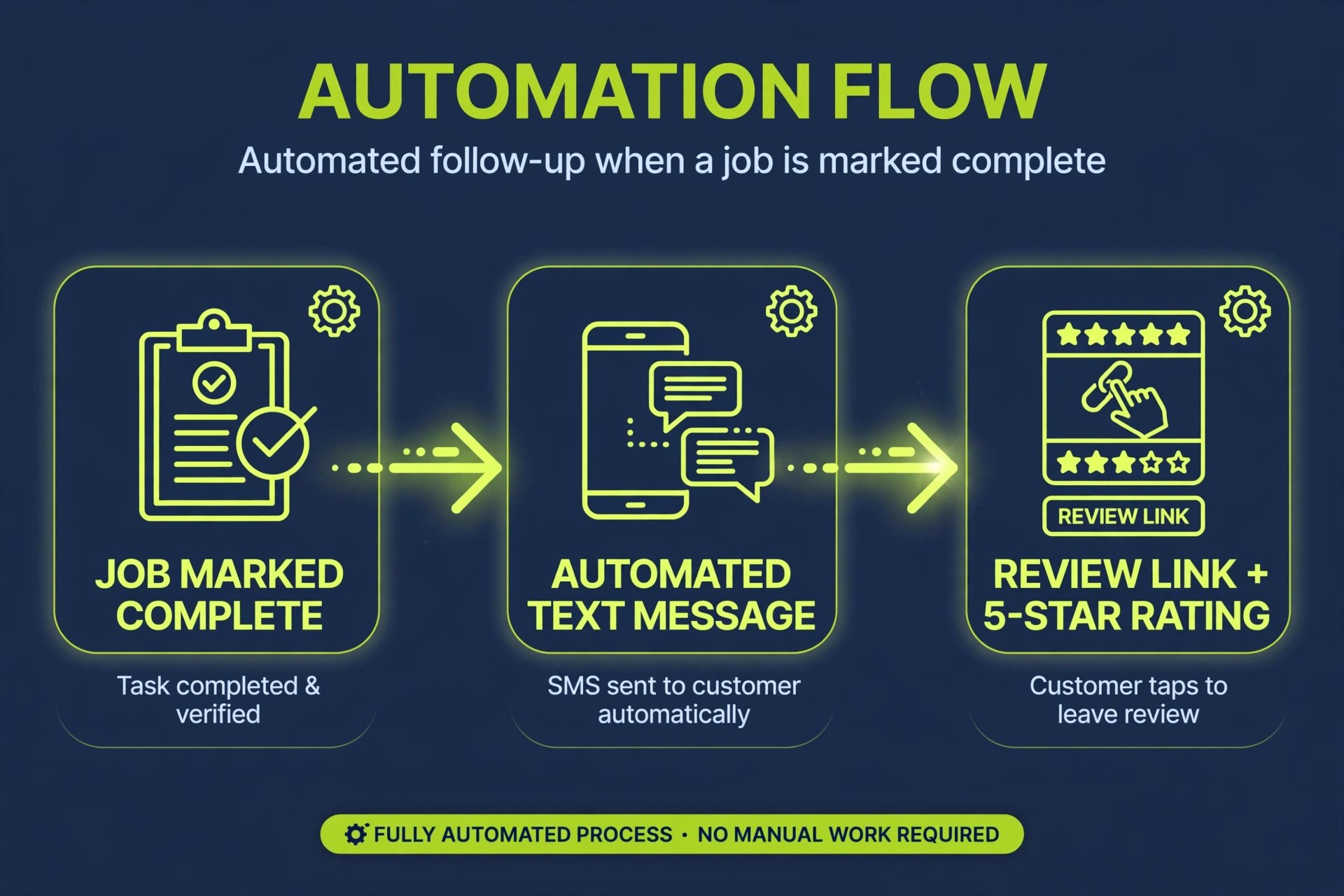
The trigger is the job status. The moment the job is marked complete — walkthrough signed, invoice paid, crew off site — the review text fires automatically. No one in the office has to remember, and the ask never waits for Friday. But the message has to read like it came from a person who was on that roof. Three rules keep it human:
Personalize the three fields that matter.. First name, company name, and the specific work. A text that says “your new roof” instead of “your project” does not feel automated, because no robot would know what kind of job it was. 2. **Sign it from a human.** “This is [Your Name] with [Company]” reads like the estimator who walked the roof. A message from “[COMPANY] — leave a review” reads like a billing system. 3. **Keep it conversational-length.** Two or three short sentences, one link, done.
On compliance: U.S. law requires prior express consent before business texting. A roofing customer who gave you their number for estimates and job updates has consented to transactional follow-ups — still include your business name, keep review texts inside the same thread as the appointment reminders they already get, and honor every STOP reply immediately. Automation sends the ask; a human answers replies within business hours.
And here is the math that makes the system worth building. Take a typical residential replacement at a $15,000 ticket and a 30 percent gross margin — $4,500 per job, illustrative example, not a market stat. If a steady stream of fresh reviews wins you just one additional job a month, that is twelve $4,500-margin jobs a year: $54,000 of gross profit from a text that costs fractions of a cent to send.
Bottom Line
The post-job text is the highest-leverage message a roofer ever sends. It goes out within an hour of the walkthrough, it names the customer and the work, it links straight to the Google review page, and it goes to every customer with no filtering. Text beats email by an order of magnitude on opens and completions, the first 24 hours carry the emotional fuel that makes reviews specific and enthusiastic, and a steady stream of fresh reviews keeps your profile ranking.
Build it as a system, not a habit. Job marked complete, text fires, a human owns the replies, one gentle reminder for the silent ones, and the profile compounds month after month.
This is exactly the kind of system RepuPilot sets up for roofing companies: the post-job review text fires automatically at the right moment, every customer gets asked equally, replies get handled before a complaint becomes a public review, and the steady velocity of fresh Google reviews quietly wins the next estimate.
Frequently Asked Questions
Is it legal to ask for Google reviews by text?
Yes. Asking for reviews by text is legal and common, as long as you respect two layers of rules. First, texting rules: you need the customer’s consent — a roofing customer who gave you their number for estimates and job updates has consented to transactional follow-ups. Include your business name and stop texting anyone who asks you to stop. Second, review rules: keep the ask open-ended, send it to all customers equally, and never tie any incentive to the review or its sentiment.
Can I only send the text to customers I know are happy?
No. Selectively asking satisfied customers while skipping unhappy ones is review gating, which Google explicitly prohibits and which the FTC’s Consumer Review Rule treats as deceptive. Filtering also destroys the system’s best feature: the text thread with a dissatisfied customer is your private rescue lane, where you fix the problem in hours.
Can I offer a discount or gift card in exchange for a review?
No. Google’s prohibited practices ban incentivized reviews outright, and the FTC’s rule prohibits incentives conditioned on a particular sentiment — which covers any “leave us a review and get $25” arrangement. Violations carry penalties exceeding $50,000 per violation under the FTC rule. Incentives are unnecessary anyway: text-based review requests already see completion rates up to 15x greater than email-based ones (Podium).
Should the text link go to Google, or should I give the customer a choice of review sites?
Send them to Google, and only Google. Google holds the overwhelming majority of local business reviews and is the profile homeowners check first, so a focused Google funnel concentrates your review velocity where it moves the needle. Giving three links creates a decision, and every decision costs reviews: the customer who has to choose a platform is the customer who closes the text and does nothing.
What if the homeowner ignores the text?
Send one gentle reminder, once, two to three days later, then stop permanently. One reminder captures the busy-but-willing customers. More than one turns your review system into spam and trains customers to ignore your texts — including future job communications. Never call to ask about the review and never mention it again at the door.
How long should the post-job text be?
Keep it under 300 characters: a greeting with the first name, one sentence about the finished work, one ask for honest feedback, and one link. Long texts read as marketing, and marketing gets ignored; short texts read as a person who was on the job.
Do I need written permission to text a customer about a review?
For a roofing customer, the consent picture is practical: when a homeowner gives you their mobile number to book an estimate, receive crew arrival texts, and get job updates, they have given prior express consent for transactional texts — which a post-job review request falls under. No separate signed form is needed. Include your business name, keep review texts to customers with an active recent relationship, and honor every STOP request immediately.