
The research behind the 5-minute window, what a 20-minute delay costs in roof jobs, and a response system roofers can run even while the crew is on a roof.
A roofing lead contacted within five minutes is dramatically more likely to become an inspection than the same lead contacted thirty minutes later. Research found the odds of even reaching the person drop about 100-fold when the first call waits thirty minutes instead of five (Oldroyd and InsideSales.com, 2007). Five minutes is the window when the homeowner is still sitting with your company on their screen, phone in hand, ready to book.
Quick Answer:
Contact every roofing lead within five minutes. The 2007 Oldroyd and InsideSales.com study found leads called within five minutes had about 100 times the odds of being reached and 21 times the odds of being qualified versus a thirty-minute delay. After five minutes the advantage decays fast, and most competitors take hours or never call back.
Why Does Lead Response Time Matter More for Roofers Than for Almost Any Other Trade?
A homeowner does not fill out a roofing form the way they sign up for a newsletter. They do it because water is coming through a ceiling, because a storm ripped shingles off last night, or because the insurance adjuster just left and they need an estimate now. That is a lead with a ticking problem and, crucially, a very short window of exclusive attention.
Roofing leads differ from most trade leads in three ways. First, urgency. A dripping ceiling cannot wait until your office manager finishes invoicing; the homeowner is on their phone and will keep scrolling until someone responds. Second, multi-submission. Homeowners needing a roof replacement routinely submit the same request to two or three companies at once. Whoever responds first usually gets the first inspection slot, and in roofing the first inspection often wins the job. Third, ticket size. A roof replacement runs $10,000 to $25,000. One missed lead is not a missed $99 service call. It is a missed five-figure job, and the marketing dollars you spent to get it are already gone.
Consider the math most roofers never do. If you spend $150 on a qualified lead and your crew closes one in three inspections, each booked inspection costs you roughly $150 in lead spend. When that lead sits uncalled for three hours, you have spent the same $150 for a fraction of the expected return. The lead did not get cheaper because you called late. Only the odds of converting it collapsed.
Storm season makes this worse. After a hailstorm, one neighborhood can generate forty estimate requests in a week, and every roofer in town knows about it. The companies that book inspections on day one own the season. The companies that call back on day three find homeowners who already signed with someone who answered on day one.
What Does the Research Actually Say About the 5-Minute Window?
The five-minute rule comes from one of the most replicated findings in sales research, and it is worth citing it correctly because the precise numbers are more persuasive than the folk version.
The core study is the 2007 Lead Response Management research by Dr. James Oldroyd, then a faculty fellow at MIT Sloan, with InsideSales.com. It analyzed three years of records across six companies: more than 15,000 web-generated leads and over 100,000 call attempts. The headline finding: the odds of contacting a web lead called within five minutes were about 100 times higher than at thirty minutes, and the odds of qualifying the lead were about 21 times higher. The decay is steepest at the start: between five and ten minutes, the odds of contact fall about five times and the odds of qualifying fall about four times. That early cliff is where the five-minute target comes from. Note what the study measured: contact and qualification, not closed deals, and the figures are odds ratios from call records, not guarantees for any single company.
Harvard Business Review published the second landmark in 2011, “The Short Life of Online Sales Leads” (Oldroyd, McElheran, and Elkington). This one measured differently and larger: an analysis of 1.25 million leads across 42 companies found that firms attempting contact within an hour of the inquiry were nearly seven times as likely to qualify the lead as firms that waited even one hour longer, and more than 60 times as likely as firms that waited 24 hours or more. The same article audited 2,241 US companies by submitting a test lead to each: 37 percent responded within an hour, 24 percent took more than a day, 23 percent never responded at all, and among companies that replied within 30 days the average wait was 42 hours.
Drift’s 2017 mystery-shopper survey of 433 B2B companies found only 7 percent replied to a sales form within five minutes, and 55 percent had not responded within five business days. The bar is remarkably low: a five-minute response beats roughly 93 percent of the competitive set.
The honest caveat: these studies cover web leads across industries, not roofing specifically. But the mechanism is identical and arguably stronger in roofing, because the lead is a homeowner with an active problem while competitors are one tap away. If the effect holds for B2B software leads with no urgency, it holds at least as well for a homeowner watching water stain their ceiling.
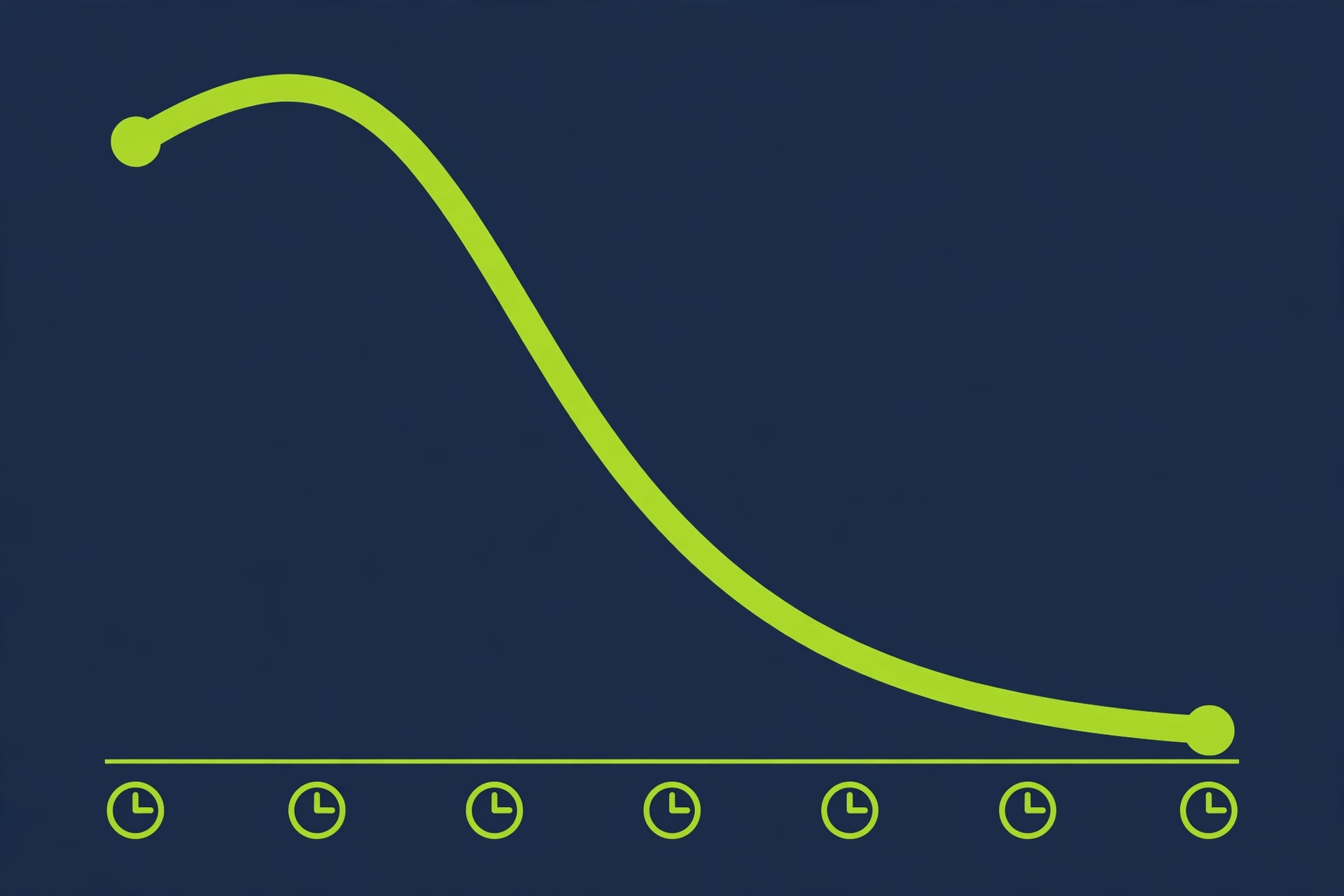
How Much Money Does a Slow Callback Actually Cost a Roofing Company?
Let us do the math a Revenue Leak Audit would do, line by line. We will use illustrative but realistic numbers, and I will label exactly where the illustration starts.
Start with the cost side. A typical roofing company buying leads through aggregators, Google ads, or storm-response marketing pays roughly $100 to $250 per qualified lead. Use $150 as the midpoint. Suppose you receive 60 web leads a month. That is $9,000 a month in lead spend, or $108,000 a year, before anyone picks up a phone.
Now the conversion side. Suppose your inspection booking rate is one in three when you reach the homeowner promptly, and your close rate on inspections is one in three. Sixty leads become 20 inspections, become roughly 7 jobs. On a $14,000 average roof replacement at a 30 percent gross margin (illustrative figures, not benchmarks), that is about $4,200 per job in gross profit, or roughly $29,400 a month against $9,000 in lead spend.
Now apply the delay. Treat this as illustrative arithmetic, not a study result: a company averaging two to three hours to first contact is plausibly booking a third to half as many inspections from the same 60 leads, because qualification odds collapse after the first hour per the HBR findings. Seven jobs become four or five. That is two to three lost jobs a month, roughly $8,400 to $12,600 in gross profit gone, from the same $9,000 in lead spend. Over a year, a slow callback habit can quietly cost $100,000 to $150,000 in gross profit at these illustrative volumes. That is a new crew truck evaporating into unanswered forms.
The number that should haunt you is the “never responded” rate. The HBR audit found 23 percent of companies never responded to a test lead at all. In roofing, where the office manager wears six hats, the real-world rate is at least as bad. Every zero-response lead is $150 thrown away. On 60 leads a month, five or six never-answered leads is roughly $800 to $900 a month in pure waste.
The last cost is invisible and larger: the competitor who answered. When your lead buys from the fast responder, you have not only lost the job, you have funded it. Your ad sent the homeowner into the market; the competitor who answered in four minutes gets the $14,000 job off your spend. That is what makes slow response a revenue leak rather than an inefficiency.
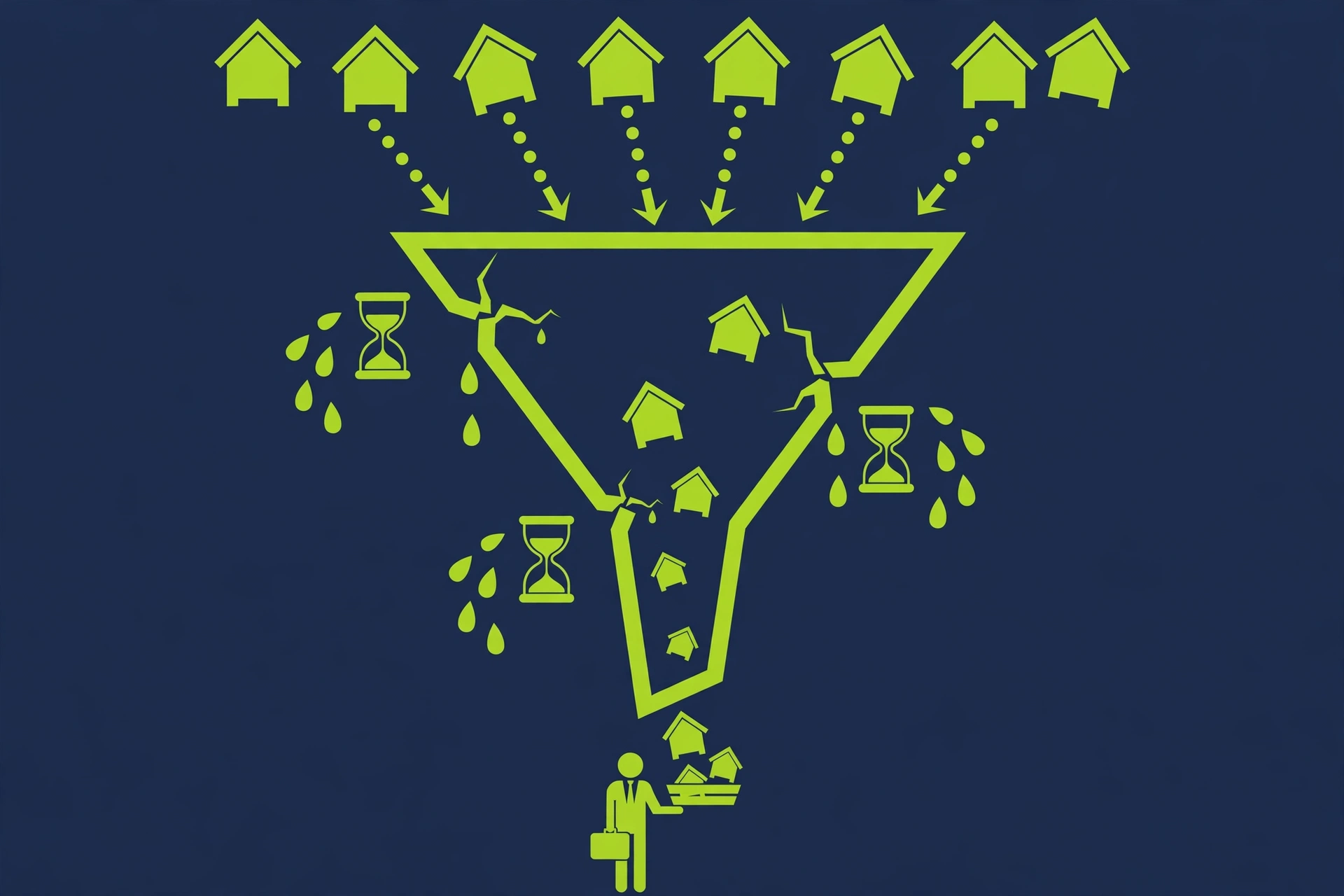
Why Do Roofing Companies Keep Missing the 5-Minute Window?
If the numbers are this clear, why does the average roofing company still take hours to call back? Because the business is structurally hostile to fast response, and no one has owned the problem.
Reason one: everyone is on a roof. Roofing is a field trade. The owner is often estimating or overseeing a crew. The crew is 30 feet up with gloves on. The office manager is invoicing, ordering shingles, and calming an unhappy homeowner about a delayed material delivery. When a web lead arrives at 11:14 a.m., there is simply no one whose job is to drop everything and call in four minutes. The lead lands in an inbox or CRM queue and waits its turn.
Reason two: after-hours is when the leads come. Homeowners shop for roofers in the evening and on weekends. A form filled at 8:40 p.m. sits until morning, by which time the homeowner has called a competitor or booked with the company whose system scheduled the inspection at 8:42. Storm damage does not respect office hours.
Reason three: no one measures it. Most roofers track leads, estimates, and jobs closed, but not minutes-to-first-contact. The number exists in no report, so no one feels it. A lost job gets recorded as “went with another company,” which hides the real story: we called three hours late.
Reason four: callbacks treated as filler work. The call-back is actually the highest-margin task in the business: a four-minute call protecting a $150 lead and a $14,000 job. Treating it as filler is how a $100,000-a-year habit forms.
The structural fix is not “try harder.” It is a system that responds in seconds whether or not a human is available, and a measurement that makes the delay visible.
What Does a Working 5-Minute Response System Look Like for a Roofer?
Here is the response system I would build for a roofing company of five to fifty people, in the order that pays for itself fastest. Everything here is operational, not theoretical. You can implement it this week.
Step one: fire an instant text-back within sixty seconds. When a web form or missed call arrives, an automated text goes out immediately: it names the company, acknowledges the request, and asks one qualifying question (“is this an active leak or storm damage?”). It is an honest holding message that keeps the homeowner from calling competitor number two. The text buys the human the minutes they need.
Step two: route the alert to whoever can actually call. The instant text is a bridge, not a replacement for the call. The alert must reach a person, not a queue: the owner during business hours, the on-call salesperson, the office manager with a phone that pings loudly. Set the rule in writing: first human call within five minutes, second attempt within twenty if no answer, third attempt the next morning. Assign one owner. If “someone should call” is everyone’s job, it is nobody’s job.
Step three: run an after-hours playbook. Homeowners submit most web leads between 6 p.m. and 10 p.m. and on weekends. The script: the instant text-back, an automated inspection-booking link so the homeowner can pick a slot at 8:45 p.m. without waiting for you, and a flagged follow-up for the first call of the next morning. A homeowner who books their own inspection at night is booked.
Step four: pre-write the call script. The five-minute call has one job: confirm the problem, qualify urgency, book the inspection. “Hi, this is [name] with [company], you just requested a roof estimate. Is this about an active leak or storm damage? Great, we can get an estimator out [tomorrow/Thursday]. Does morning or afternoon work better?” No pitch on the call. The pitch is the inspection.
Step five: follow up on the no-answer with texts, not just calls. If the first call goes to voicemail, text immediately after (“just tried calling about your roof estimate, when is a good time?”), then call again the next morning. Most roofers stop at one voicemail. The recovered jobs live in attempts two and three.
Step six: measure minutes-to-first-contact on a board the owner sees. Pull the timestamp of every lead and the timestamp of the first human contact, compute the median, and put it on a weekly board next to booked inspections. The target: median under five minutes during business hours, and under sixty seconds for the automated text-back at all hours. What gets measured gets answered.
This system costs almost nothing to run once it is set up. It requires one decision, one automation, one script, one assignment, and one number on a board. The companies that build it find that their “lead quality problem” was mostly a response problem. The leads were fine. The clock was broken.

How Do You Measure Whether Your Response Time Is Actually Improving?
Do not measure only jobs closed. Measure the chain, link by link. The four numbers that matter: median minutes to first contact, contact rate (what share of leads get a real conversation), inspection booking rate, and cost per booked inspection (total lead spend divided by inspections). The first two are pure speed measures; the second two show whether speed is turning into money.
The benchmarks describe typical companies, not good ones: the HBR audit’s 42-hour average and 23 percent never-responded rate, Drift’s 7 percent responding within five minutes. Set internal targets against best practice: median first contact under five minutes in business hours, text-back under sixty seconds always, contact rate above 60 percent, zero leads aging past 24 hours without a human touch.
Review the numbers weekly. If contact rate is up but booking rate is flat, the problem is the call script, not the clock. If the text-back fires but nobody calls, the problem is the alert routing. The chain tells you where the next fix goes, which is exactly what a Revenue Leak Audit does: it traces the dollars from the form fill to the signed contract and finds the link that is leaking.
Bottom Line
The five-minute rule is the cheapest competitive advantage in roofing. Your competitors are not running it: the research says most companies take hours or never respond at all, and the bar for a five-minute text-back is a fraction of what one recovered $14,000 job pays. Build the instant text-back, route the alert to a real person, run an after-hours playbook, and put minutes-to-first-contact on a board. In thirty days you will know exactly how many jobs your old response time was leaking.
This is exactly the kind of leak a Revenue Leak Audit finds: it maps every hour of delay between a lead arriving and a human responding, prices the lost jobs in real dollars, and installs the response system that closes the gap. The roofers who win their market in the next five years will not be the ones with the cheapest shingles. They will be the ones whose phone answered first.
Frequently Asked Questions
What is the 5-minute rule for lead response?
The 5-minute rule is the finding from the 2007 Oldroyd and InsideSales.com Lead Response Management study that web leads called within five minutes had about 100 times the odds of being contacted and 21 times the odds of being qualified compared to leads called after thirty minutes. In practice it means treating five minutes as the deadline for first human contact on every roofing lead.
Is five minutes really realistic for a roofing company?
The text-back is, and that is what matters most. An automated text within sixty seconds holds the homeowner while your estimator or office manager makes the real call. A median under five minutes for the human call during business hours is realistic for a company that assigns one owner and routes alerts to a person instead of an inbox. After hours, the text-back plus a self-booking inspection link does the job until morning.
Does responding fast really change anything if my prices are higher?
Yes. The homeowner usually stops shopping once they trust a contractor, and trust forms around the first real conversation, not the lowest bid. A fast response with a confident, helpful call script wins jobs over slower cheaper competitors regularly, especially on emergency leak and storm damage calls where urgency dominates the decision. Price objections at the estimate table are a separate battle from winning the inspection.
What counts as the “first response” — does an auto-reply count?
The studies measured meaningful contact: a call that reaches a live person, or a conversation with the decision maker. An auto-reply or instant text-back helps enormously as a bridge, but it is not the first response. Count both separately: seconds to the automated text-back, minutes to the first human call. The text-back keeps the lead alive; the call books the inspection.
What should I do if the lead goes to voicemail on the first call?
Text immediately after the missed call (“just tried calling about your roof estimate, when is a good time?”), then call again the next morning. Homeowners reply to texts far more often than they return voicemails from unknown numbers. Never stop at one voicemail: most recovered inspections come from the second or third attempt.
How do after-hours leads get handled under the 5-minute rule?
Homeowners submit most web leads between 6 p.m. and 10 p.m. and on weekends, when the office is empty. The after-hours playbook is an instant text-back acknowledging the request, an automated inspection-booking link so the homeowner picks a slot that night, and a flagged first call the next morning. A homeowner who books their own inspection at 8:45 p.m. is a booked inspection.
How long before I see results from improving response time?
Contact rate usually moves within days of installing the instant text-back and the five-minute call rule, because the fix applies to every new lead immediately. Inspection bookings and job volume follow over two to four weeks as the recovered leads work through estimates. Put the four numbers (median minutes, contact rate, booking rate, cost per booked inspection) on a weekly board so you see the trend instead of guessing.