
Late October is shoulder season. Leads are scarce, every estimate matters, and the phone ringing is the sound of money. Here is what that missed call actually costs.
One missed call is worth far more than most roofers think: a single unanswered phone call from a homeowner needing a roof often represents a $10,000-plus job that quietly goes to a competitor. With residential roof replacements running $8,000 to $15,000, even a handful of missed calls a month can add up to six figures in lost revenue over a year.
Quick Answer: One missed call can cost a roofing company roughly $2,000 to $4,000 in expected job revenue, depending on your average job value and close rate. CallRail’s 2025 survey found only 42% of consumers leave a voicemail, so most missed callers never call back. One missed call a week can quietly cost $100,000 or more per year.
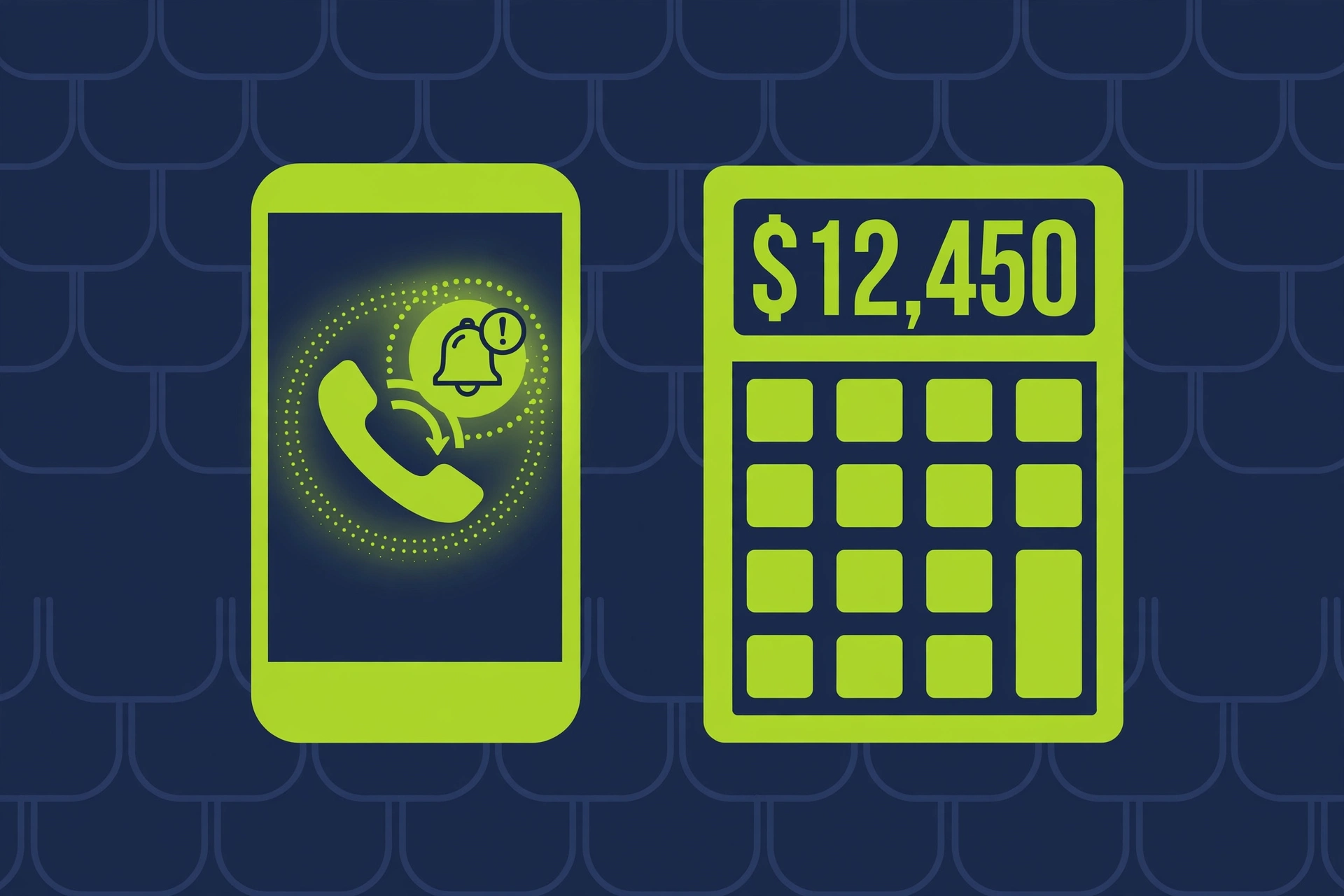
What Does One Missed Call Really Cost a Roofing Company?
Let us price a single missed call the way you would price a job: with numbers, not feelings. Every call you miss is not just a ringing phone. It is a homeowner with a problem, a roof, and a budget, moving one step closer to your competitor. Here is the math, worked with real roofing numbers.
Start with the job value. A residential roof replacement in the US typically runs $8,000 to $15,000 depending on the market, the material, and the square count. A mid-market composition shingle replacement on a 2,000 square foot home lands around $10,000 to $12,000 in most metro areas. Even a partial repair or a smaller job can run several thousand dollars. So the ticket attached to a homeowner’s phone call is not small. It is the largest single transaction most service businesses ever see.
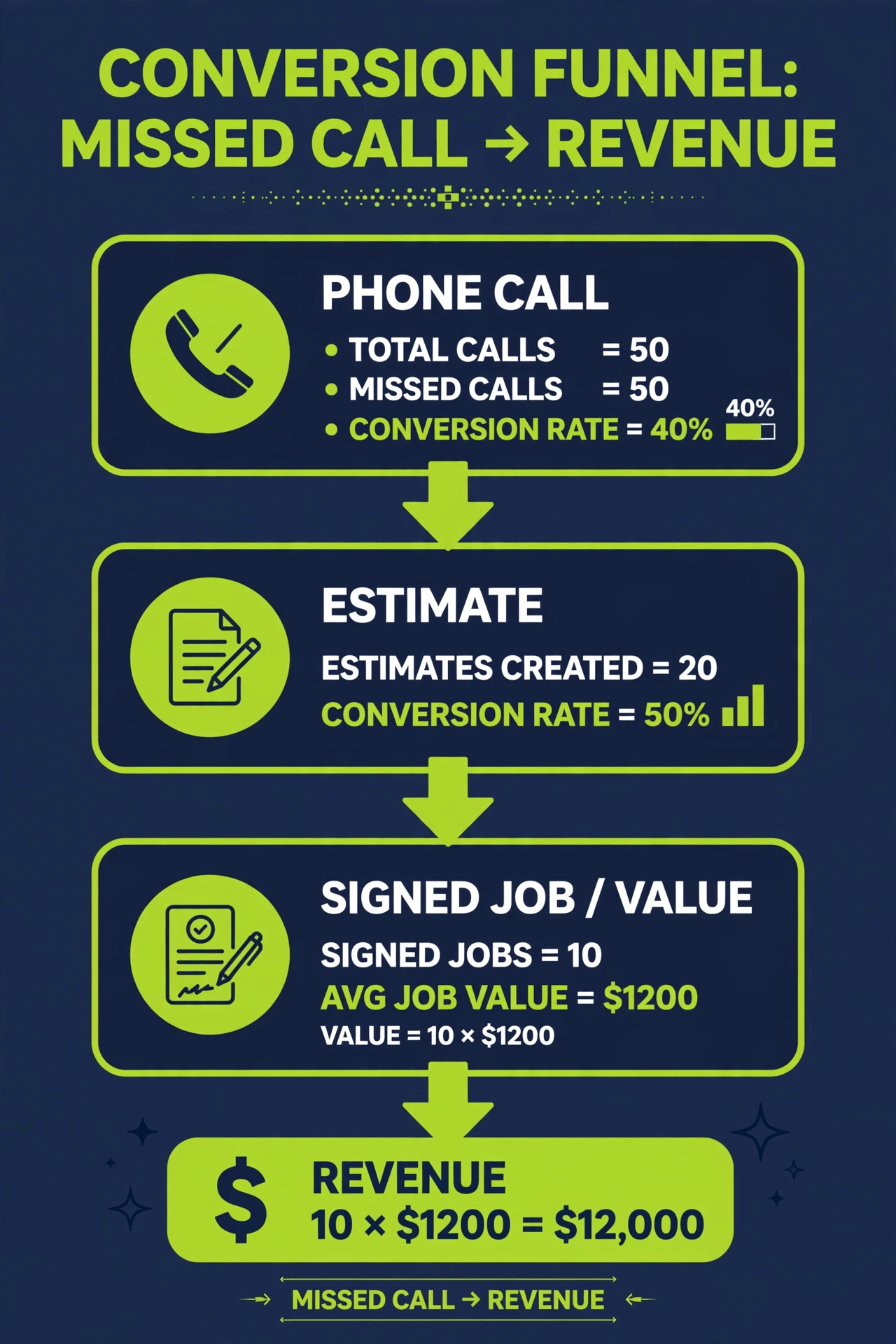
Next, the conversion path. Not every missed call is a $12,000 replacement job. Some are roofers calling you back, some are vendors, some are dead ends. Let us be conservative and say half of your missed calls are real homeowner opportunities (an explicitly illustrative assumption). Of those, maybe half become estimate bookings, and maybe a third of estimates become signed jobs. That means roughly one in twelve missed calls converts into a paying job. Put a $10,500 average job value on that, and the expected value of a single missed call is about $875.
Now run it at scale, because missed calls are never one-offs. Let us work an illustrative example: one missed call per weekday. That is 260 missed calls a year. Using the illustrative assumptions above (half real opportunities, half of those book an estimate, a third of estimates close), 260 missed calls turn into about 130 real homeowner calls, about 65 booked estimates, and about 22 signed jobs. At $10,500 each, that is roughly $231,000 in annualized revenue walking out the door. One missed call a day. Two hundred thirty-one thousand dollars. That is not a typo.
Your numbers will differ. Maybe your average replacement is $8,000, maybe $14,000. Maybe you close 25 percent of estimates, maybe 40 percent. Plug your own values in and the conclusion holds: the expected value of one missed call for a roofing company sits in the low thousands of dollars, and the annual number is enormous.
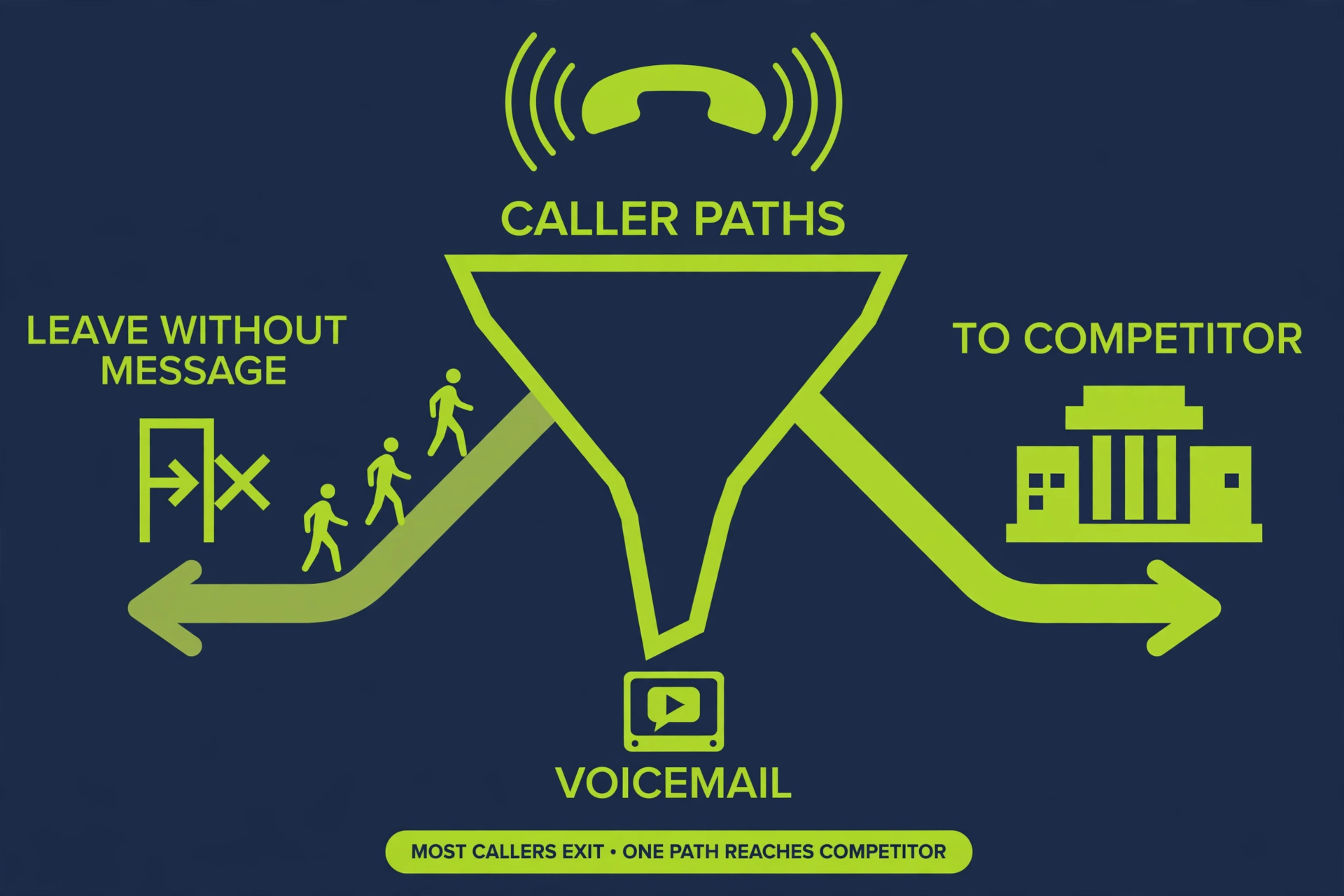
Where Do Homeowners Go When They Hit Your Voicemail?
Here is the uncomfortable part. When a homeowner calls and nobody picks up, they do not sit by the phone waiting for a callback. CallRail’s 2025 survey found that only 42 percent of consumers leave a voicemail, which means roughly 58 percent of the callers you send to voicemail never leave a message at all. They hang up. And many of them immediately call the next roofer on the Google results page.
Speed compounds the problem. Research from InsideSales and MIT found that leads contacted within 5 minutes are 21 times more likely to qualify than leads contacted after 30 minutes. The homeowner who calls you at 10:04 AM and gets voicemail is calling your competitor at 10:05 AM. By the time you listen to that message at noon (if they left one), the competitor has already booked the inspection.
This is why roofing calls are uniquely unforgiving. A homeowner with water coming through the ceiling is not a browser. They are a buyer in motion, and motion does not wait. Every minute before your callback is a minute the competitor uses to win the job you paid to generate.
Run your own numbers in the free Revenue Leak Calculator and see what your missed calls are worth with your own job values and close rates plugged in.
How Many Calls Does a Roofing Company Actually Miss?
Most roofers underestimate their missed-call volume by a lot, because the misses are invisible. You do not see the call you missed while you were on a roof, in a crawl space measuring an attic, sitting in an adjuster’s inspection, or eating dinner at 7 PM. You see a notification. By the time you return it, the moment has passed.
Here are the usual suspects in roofing:
On-roof time. The estimator is up on the slope with the homeowner watching. The phone is in the truck. Every roof walk and every inspection is 45 minutes of dead air. Adjuster and crew hours. Supplements, inspections, and crew coordination eat the middle of the day. The office is thin, or there is no office, just you and a scheduler who is also a project coordinator. After-hours calls. Roughly a third of homeowner calls come outside business hours, when the office is closed. A roof leak at 9 PM is an emergency to the homeowner. Voicemail at 9 PM is an invitation to call the roofer whose site has a 24/7 number. Shoulder-season scarcity. This is the one that matters right now. In late October, the storm surge is over and winter is coming. Lead flow thins out. In July, losing a lead stings less because three more are behind it. In October, the missed call might be one of five real opportunities this week. Each one is a bigger share of the pipeline.
The fix is not “answer the phone more.” The fix is a system that catches the call whether you are on the roof or asleep.
What Does One Missed Call Per Day Add Up to Over a Year?
Let us annualize this properly, because “about $875 a call” does not land the way the yearly total does. We will keep the illustrative assumptions explicit so you can check every step.
The illustrative example:
1. Missed calls: 1 per weekday, 260 per year 2. Real homeowner opportunities: 50% (illustrative), so 130 calls 3. Estimate bookings from those calls: 50% (illustrative), so 65 estimates 4. Close rate on estimates: 33% (illustrative), so about 22 signed jobs 5. Average job value: $10,500 (mid-range of the real $8,000 to $15,000 replacement range)
Result: roughly $231,000 in lost annual revenue from one missed call a day.
Now stress-test it with more conservative numbers. Suppose only one missed call per week (52 per year), your average job is $8,000, and only a quarter of real calls book an estimate. 52 calls, half real (26), a quarter book (about 7 estimates), a third close (about 2.4 jobs), times $8,000: roughly $19,000 a year. Even the conservative case pays for a lot of prevention.
And suppose the upside case: you are in a higher-priced market, average job $14,000, and your estimate close rate is 40 percent. One missed call a day at those numbers pushes past $300,000 a year. The exact number depends on your market and your close rate. The pattern does not depend on either: missed calls are five-figure line items hiding in a phone log nobody audits.
There is a second layer most roofers never price: the homeowner who does not get an answer does not just take this job elsewhere. They also take the referral, the five-star review, and the insurance-claim supplement relationship. One missed call is not one lost job. It is one lost job plus the lifetime value of a customer you will never meet.
Why Are Roofing Calls Especially Expensive to Miss?
Not all missed calls are equal. A missed call to a $65 haircut is an inconvenience. A missed call to a roofing company is a ten-thousand-dollar transaction changing hands. Here is what makes roofing calls the most expensive calls in home services to miss.
The ticket size. Nothing in residential contracting moves more money per transaction than roofing, outside of HVAC system installs. An $11,000 replacement closes in one signature. The insurance dynamic. A huge share of roofing revenue runs through insurance claims. When a homeowner calls about storm damage, the clock is already running: adjusters, supplement windows, and the neighbor’s roofer who knocked yesterday. A roofer who answers first often controls the claim narrative. A roofer who answers second bids against the first. The emergency profile. Roof leaks are urgency calls. Urgency buyers do not comparison shop patiently. They call until someone picks up. The company that answers first is not winning on marketing. It is winning on being awake. The seasonality of right now. Late October is the shoulder between storm season and winter. Storm work is tapering, retail replacements are slowing, and crews still need work. Every estimate booked now feeds November and December, the hardest scheduling months. A missed call in July costs you a job. A missed call in October costs you a job at the moment you can least afford to lose one.
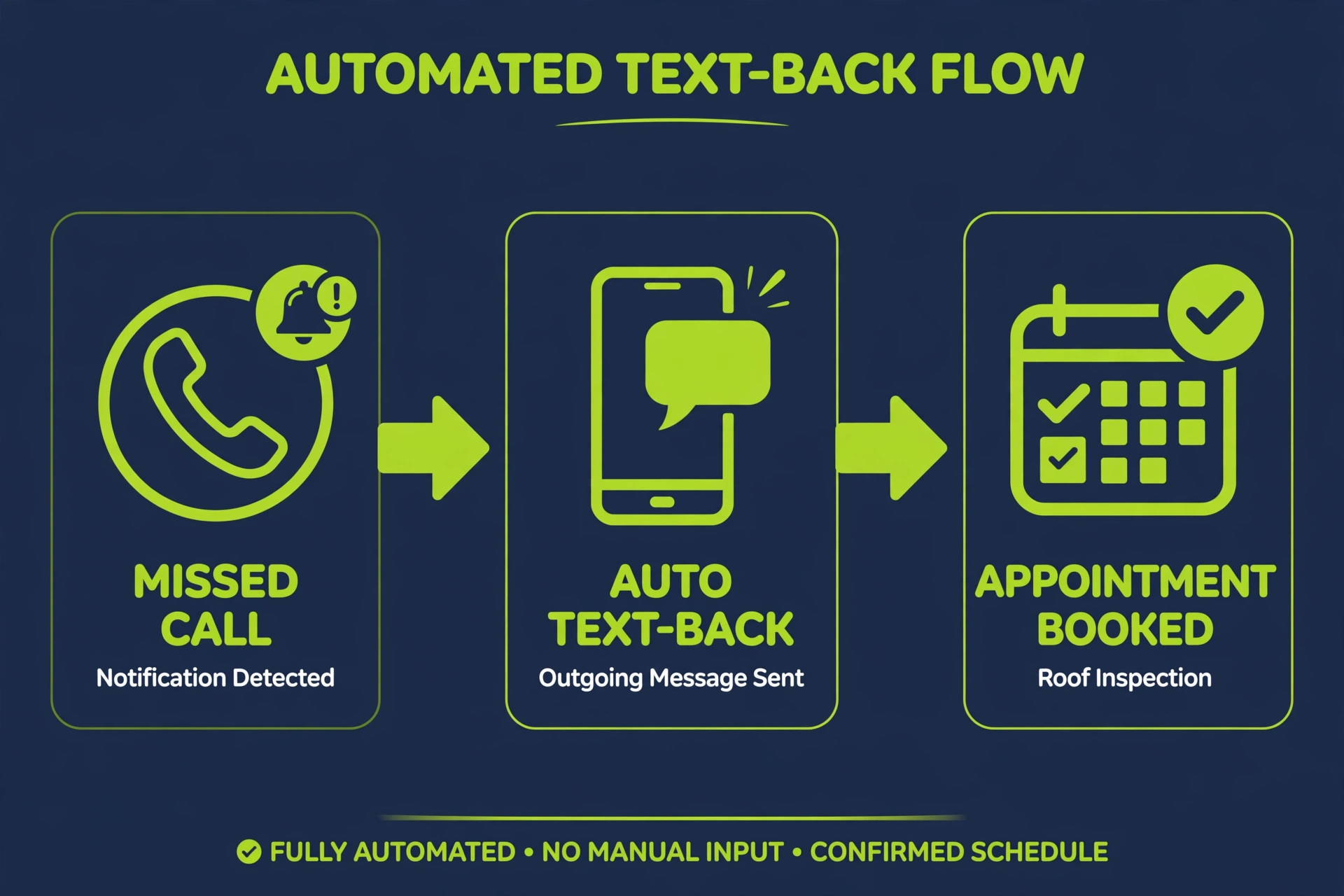
How Do You Catch Every Call Without Hiring an Office Team?
The answer is not a full-time receptionist. Most roofing companies cannot justify one, especially in the shoulder season. The answer is a system that responds instantly to every call you miss, before the homeowner calls anyone else.
Missed-call text-back is the 60-second version of this: the moment a call goes unanswered, the system automatically texts the caller something like “Sorry we missed your call. How can we help?” The homeowner who was about to dial your competitor now has a conversation instead. Texts get opened fast, and the caller feels answered even though you were on a roof.
Here is how to set it up properly, whether you automate it or run it manually this week:
1. Respond in under two minutes. The InsideSales and MIT research gives you 5 minutes as the cliff; aim for 2. The text-back should fire automatically the moment the call ends, not when you check your phone. If you are doing it manually, set up a shortcut on your phone so the reply takes five seconds. 2. Make the first text an open question, not a pitch. “Sorry we missed your call, this is Mike at [Company]. What can I help you with?” Not “Visit our website for a free quote.” The goal is conversation, not conversion. Conversion follows conversation. 3. Book the inspection in the thread. Once the homeowner answers, the next step is a time, not more texting. “I can have someone out Thursday morning or Friday afternoon. Which works for you?” Every extra round trip is a chance to lose them. Inspectors book jobs; text threads do not. 4. Cover after hours. This is where most roofers leak. A text-back that fires at 10 PM catches the leak emergency the office would have found at 9 AM, 11 hours too late. Shoulder-season storms do not keep office hours. 5. Audit the log weekly. Friday afternoon, pull your missed calls for the week and check that every one got a text-back and a follow-up. Fifteen minutes. The phone log is the one report that tells you exactly how much money almost got away.
Run your own numbers in the free Revenue Leak Calculator to see exactly how much your missed calls are costing with your own job values and close rates.
Bottom Line
One missed call is not a minor inconvenience. At roofing ticket sizes, it is a low-four-figure expected loss, and a single missed call a day works out to roughly $231,000 a year in the illustrative example above. Most of those callers never leave a voicemail (only about 42 percent do, per CallRail’s 2025 survey), and the leads that matter most arrive when you are hardest to reach: on a roof, with an adjuster, or after hours in the middle of shoulder season.
This is exactly the kind of system RepuPilot sets up for roofing companies: missed-call text-back that fires automatically, catches the homeowner before the competitor does, and turns ringing phones into booked inspections. Run your own numbers in the free Revenue Leak Calculator and see what your missed calls are really worth.
Frequently Asked Questions
What is the average value of a missed call for a roofing company?
Using illustrative assumptions (a $10,500 average replacement job, about half of missed calls being real homeowner opportunities, and a typical estimate close rate), the expected value of one missed call lands around $875 to $3,500 depending on your market and close rate. Your actual number depends on your job value and close rate, which is exactly what the free Revenue Leak Calculator on the RepuPilot homepage will compute for you.
How many roofing calls are typically missed?
There is no single published benchmark for roofing specifically, because every company’s phone discipline differs. What matters is your own phone log: most roofers are surprised by how many calls arrive during on-roof time, adjuster hours, and after hours. Pull 30 days of missed calls and divide by your total inbound volume. That percentage is your leak rate.
Do homeowners really leave when they get voicemail?
Most of them never leave a message. CallRail’s 2025 consumer survey found only 42 percent of consumers leave a voicemail, so roughly 58 percent hang up without messaging you at all. And urgency buyers, which is what most roofing callers are, tend to call the next company on the list immediately rather than wait for a callback.
How fast should I respond to a missed call?
Within 5 minutes at the outside. InsideSales and MIT research found that leads contacted within 5 minutes are 21 times more likely to qualify than leads contacted after 30 minutes. An automatic text-back fires in seconds, which puts you ahead of the cliff by a wide margin.
What should the missed-call text say?
Keep it short, human, and open-ended: “Sorry we missed your call, this is Mike at [Company]. What can I help you with?” The goal of the first text is to start a conversation, not to pitch. Once the homeowner replies, offer two inspection times. Book the appointment inside the thread.
Does missed-call text-back work after hours?
After hours is where it works best. Emergency roof-leak calls peak when offices are closed, and those callers are the least patient of all. An automatic text at 10 PM converts a leak panic into a morning inspection, while voicemail converts it into a competitor’s job.
How do I figure out my own missed-call losses?
Pull a month of missed calls from your phone system. Estimate what share are real homeowner opportunities (the illustrative math above uses 50 percent, but use your own feel), multiply by your average job value and your real estimate close rate, and annualize. Then run the same numbers through the free Revenue Leak Calculator at https://repupilot.7coxmos.com/ to check your math.