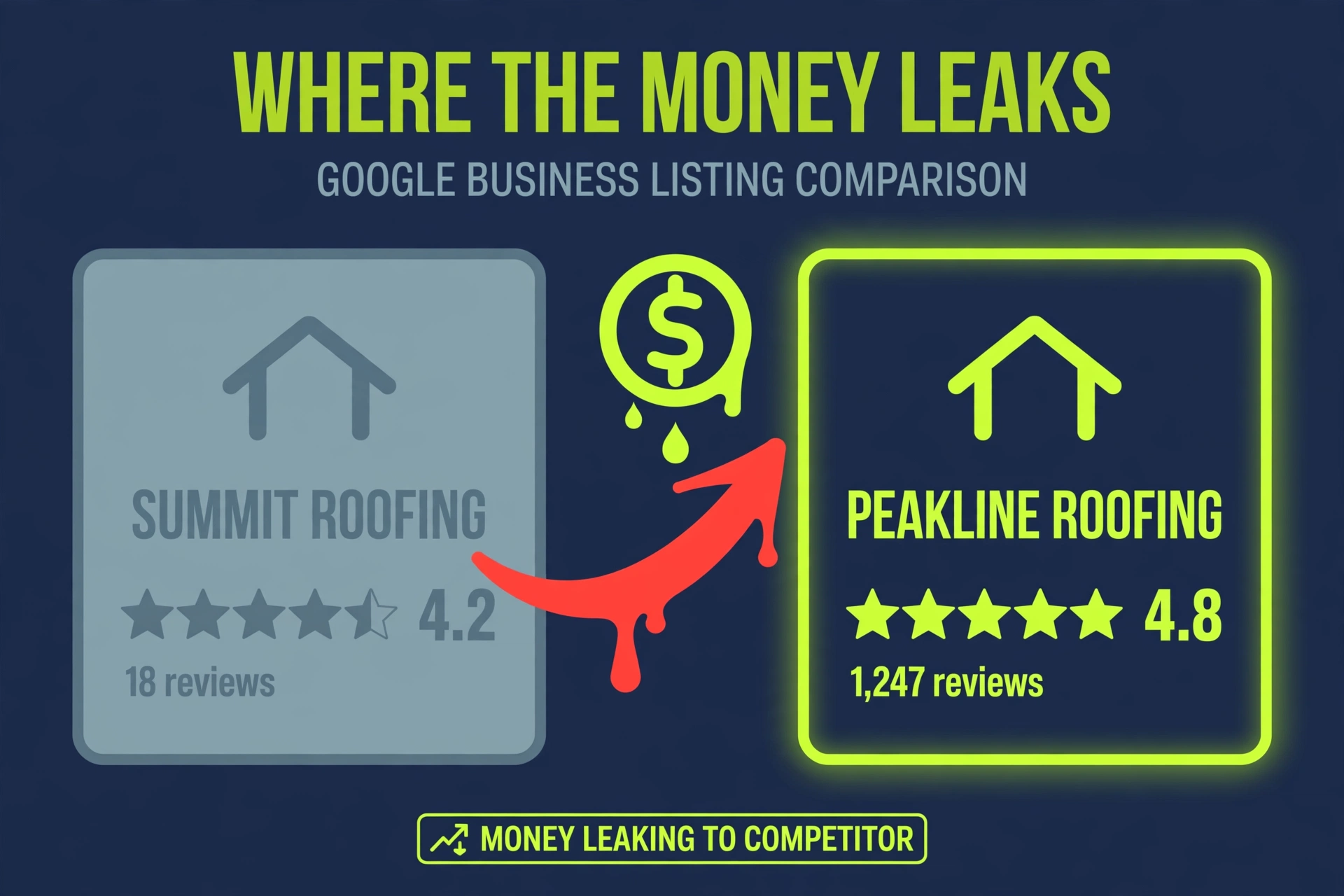
Your rating feels respectable. But in the local pack, 4.2 stars next to a competitor’s 4.8 is not a small gap. It is a shortlist filter. Here is how to turn that star gap into the exact number of jobs and dollars it costs you.
A 4.2-star rating costs a roofing company real jobs every month, more than most owners expect. When a homeowner sees 4.2 stars beside a competitor’s 4.8, the 4.2 roofer does not lose a coin flip. The homeowner never calls them at all. That is the leak: quiet, invisible, and priced in roof replacements.
Quick Answer:
A 4.2-star rating can cost a roofing company several lost jobs every month through the shortlist effect. BrightLocal’s 2026 survey found 68% of consumers will only use a business with 4 stars or more, and 31% require 4.5 stars or higher. When your rating sits at 4.2 and the competitor sits at 4.8, a large share of homeowners filter you out before a call.
How Does a 4.2-Star Rating Actually Read to a Homeowner?
It reads the way you think it does when you are the buyer. You search “roof replacement near me” because the ceiling stain grew over the weekend and the shingles are twenty-two years old. Three roofers appear. The first shows 4.8 stars across 312 reviews. The second shows 4.7 stars across 428 reviews. The third shows 4.2 stars across 64 reviews.
You do not investigate the third one. Nobody does. You tell yourself you will call all three. Then you call two. The 4.2-star roofer never hears the phone ring.
That is the first thing to understand about star ratings: they are not scored in isolation. They are scored in a lineup. Your 4.2 is never just “4.2”; it is “4.2 compared to 4.8,” and comparison is the entire game. A 4.2 where every competitor sits at 4.3 is a rounding error. A 4.2 where two competitors sit at 4.8 is a reason to disappear.
The second thing: the bar moved recently, and it moved fast. BrightLocal’s 2026 Local Consumer Review Survey, covering 1,002 US adults, found that 92% of consumers care about star ratings when choosing a business. Sixty-eight percent will only use a business with 4 stars or more, up from 55% the year before. And 31% now require 4.5 stars or higher, nearly double the 17% who said so in 2025. At 4.2 stars, you clear the 68% filter but sit below the line drawn by nearly one in three consumers. The 4.8-star competitor clears both.
So a 4.2 is not “above average” anymore. It is below a rising third of the market’s cutoff.
How Many Homeowners Filter Out a 4.2-Star Roofer Before the First Call?
Let us put real numbers on the filter. The BrightLocal 2026 survey gives us three benchmark figures, and we will use each one exactly once, then build an explicitly illustrative example around them.
- 68% of consumers will only use a business with 4+ stars. At 4.2, you pass this filter. Barely. One bad review cycle away from 3.9 changes your life.
- 31% will only use a business with 4.5+ stars. At 4.2, you fail this filter outright. Nearly one in three consumers will not consider you, no matter what your trucks, your warranties, or your crew photos say.
- 92% of consumers say star ratings matter when choosing a business. Ratings are not a tiebreaker. They are the primary lens.
Add the volume threshold, because rating without volume is its own problem: 47% of consumers will not use a business with fewer than 20 reviews. A 4.2-star profile with 14 reviews fails two filters at once: the star filter for the 31%, and the volume filter for nearly half the market.
These are national consumer benchmarks, not roofing-specific conversion rates. Roofing is a high-trust, high-ticket purchase, so homeowners scrutinize ratings harder here than in most trades. The filter runs stricter.
How Many Jobs Does a 4.2-Star Roofer Lose to a 4.8-Star Competitor?
Here is the illustrative worked example. Every number below is labeled: benchmarks are real (BrightLocal 2026), and the job-level math is explicitly illustrative so you can see the shape of the leak in your own market.
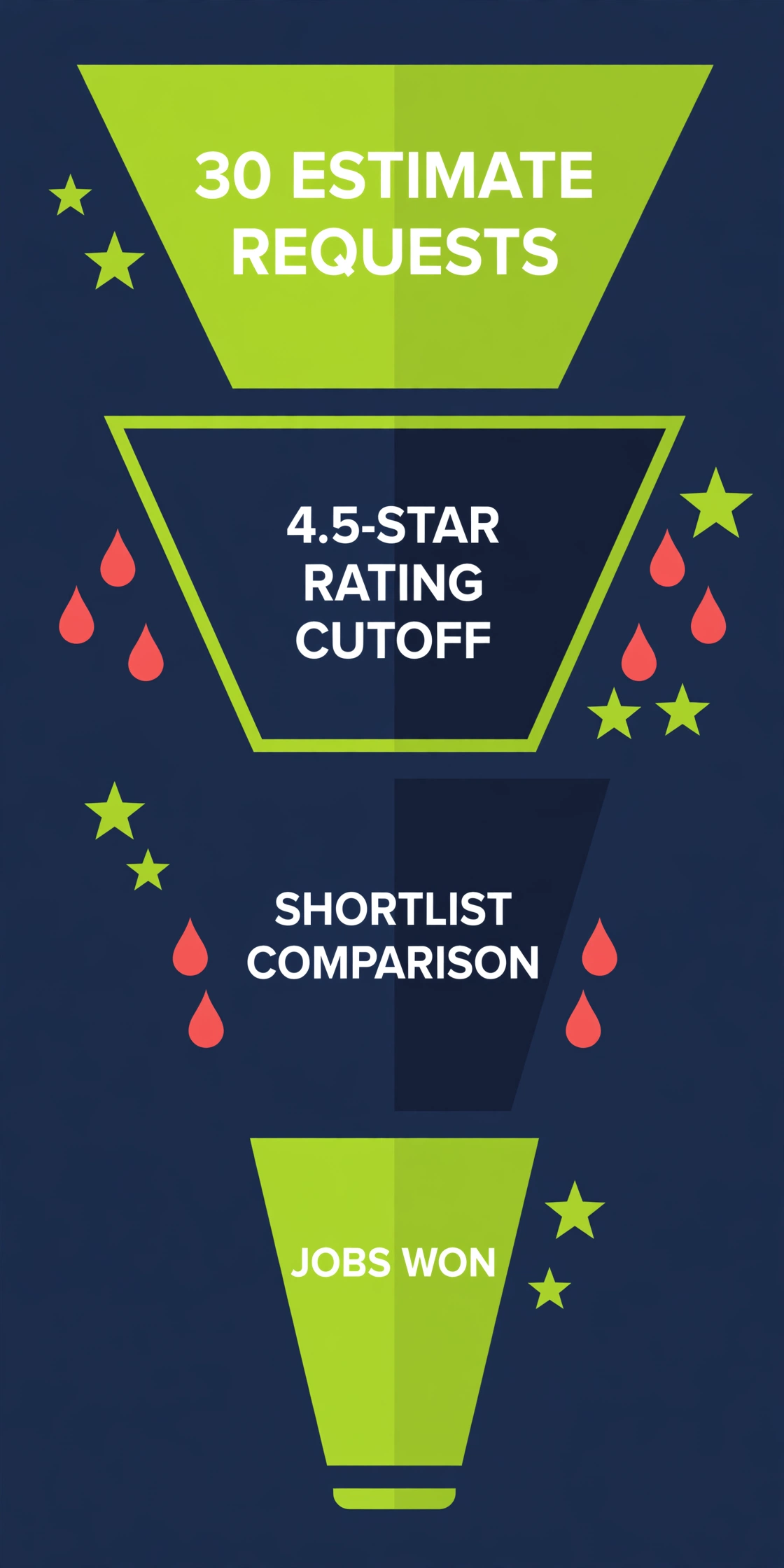
Setup: Two roofing companies in the same metro, same zip code radius, same advertising. You are the 4.2-star roofer with 58 reviews. The competitor is the 4.8-star roofer with 340 reviews. Each company generates roughly 30 inbound estimate requests per month from Google: calls, estimate forms, and Google Business Profile messages.
The filter math: Apply the 31% benchmark. Of the homeowners who would have shortlisted you otherwise, roughly 31 in 100 draw the line at 4.5 stars. On 30 monthly estimate requests, that is about 9 homeowners who remove you before any conversation. (Illustrative: national benchmark applied to a roofing funnel.)
The comparison math: In a two-company shortlist, the profile with 4.8 stars and 340 reviews wins the tiebreak most of the time. Of the homeowners who consider both companies, the rating gap swings the bulk of decisions.
The conservative close: Let us be generous to the 4.2 roofer and say the rating filter plus the shortlist comparison costs them just 4 jobs per month, well below the raw 9-homeowner filter estimate. Four estimate appointments that never happen, or happen with the competitor.
Four jobs a month: that is the illustrative shape of a 0.6-star gap.
Run your own numbers in the free Revenue Leak Calculator: plug in your star rating, your review count, and your monthly estimate volume to see the job-level math for your company.
What Do Those Lost Jobs Cost Per Year?
Now price the leak. Average residential roof replacement values run roughly $8,000 to $15,000. Use a mid-range $10,500 average job value (illustrative; substitute your own).
- 4 lost jobs per month x $10,500 = $42,000 per month in leaked revenue.
- x 12 months = $504,000 per year.
Half a million dollars a year, leaking through a 0.6-star gap. At the low end of job values, 4 jobs a month at $8,000 is still $384,000 a year.
And late October is when this hurts most. Shoulder season means the storm-season rush is over, insurance-claim volume is thinning, and every estimate appointment counts double. A roofer running 30 estimates a month in October who loses 4 to a rating gap is losing more than jobs. They are losing the pipeline that carries the crew into winter. The winter calendar is built now.
This is also why “we are fine at 4.2” is the most expensive sentence in roofing. The jobs never appear in your CRM. There is no lost-lead report for the homeowner who never called. The leak is invisible unless you measure it.
Why Does Review Count Matter as Much as the Star Number?
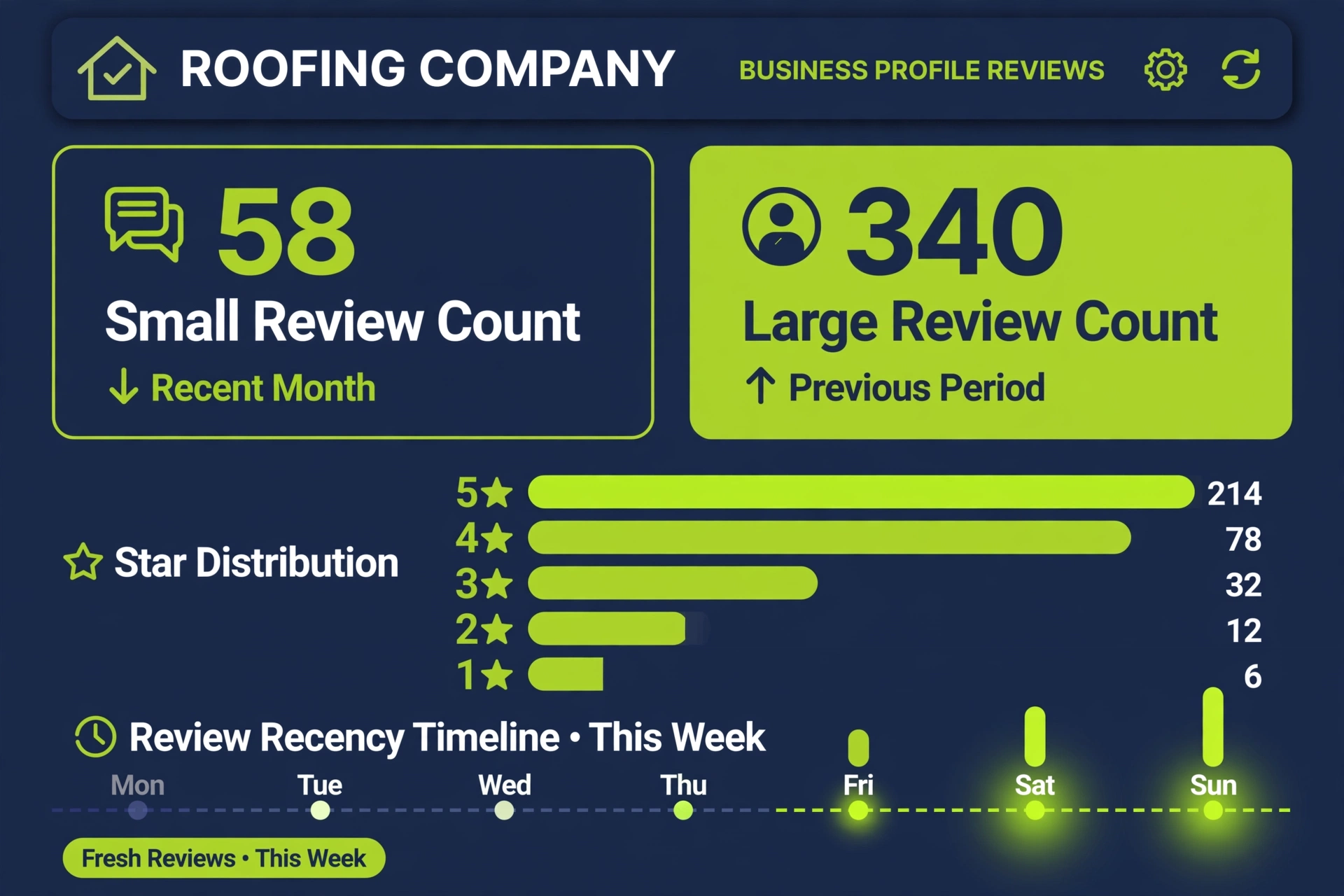
Stars are the filter. Count is the confidence. A 4.8 from 340 reviews is a verdict. A 4.2 from 58 reviews is a warning sign with a small sample size. Homeowners read both signals at once.
The BrightLocal benchmark: 47% of consumers will not use a business with fewer than 20 reviews. But roofing sits above that floor. When the competitor shows 340 reviews and you show 58, the homeowner reads the gap as market share: more reviews means more jobs completed, more neighbors served, more track record in this zip code. In storm-season markets, review count is a proxy for who worked the last hail event. Volume sells.
Then recency. BrightLocal 2026 found that roughly 74 of 100 consumers only trust reviews from the last three months. A 4.2-star profile whose newest review is two months old reads as a company drifting; a 4.8-star profile with reviews this week reads as the company working right now. The homeowner scores all three signals in about six seconds.
How Do You Climb From 4.2 to 4.6 Without Gaming the System?
The honest way is the fast way, because shortcuts are policed. Google prohibits review gating (asking only happy customers for reviews), and the FTC’s Consumer Review Rule treats suppressing negative reviews as deceptive, with penalties over $50,000 per violation. Asking everyone is not just the rule; it is the only strategy that holds.
1. Ask every finished job, automatically. The review ask fires the day the job completes, for every customer, triggered by job status, not by whoever remembers on Friday. A roofer finishing 8 to 10 jobs a week who captures a review from every third homeowner adds roughly 12 to 15 reviews a month. (Illustrative capture math; your rate depends on your market and your ask.)
2. Reply to every review, especially the old bad ones. Eighty percent of consumers are more likely to use a business that responds to all reviews (BrightLocal 2026). A calm, professional reply to that old 1-star review does not fix the star count, but it changes what the next homeowner thinks when they read it.
3. Fix the repeatable complaint before chasing stars. Read your 3-star and 4-star reviews and find the pattern: cleanup, scheduling, communication during the insurance claim. The pattern is a production problem wearing a rating disguise. Fix it and the next twenty reviews move up a half star on their own.
4. Protect the average from math. At 58 reviews, a single 1-star review drops a 4.2 more than most owners realize. The defense is volume: every new 5-star review dilutes the old damage. This is why review velocity matters as much as review requests.
5. Time the push for the recency window. With roughly 74 of 100 consumers trusting only the last three months of reviews, a steady 8 to 12 new reviews per month does more for your profile than a one-time burst of 50. Steady beats spiky.
The climb from 4.2 to 4.6 is usually 40 to 60 fresh 5-star reviews at typical review volumes (illustrative; depends on your current count). At one review captured per two or three jobs, that is a 4 to 8 month project for a company running steady volume, entirely achievable inside one roofing season if the system starts now, in the shoulder months.
Bottom Line
A 4.2-star rating is not a badge. Next to a 4.8-star competitor, it is a filter that quietly removes you from the shortlist of nearly a third of homeowners, then loses the comparison for most of the rest. The math is unforgiving: at illustrative rates, 4 lost jobs a month at $10,500 is half a million dollars a year, leaking through six-tenths of a star. And in late October, when every estimate builds the winter calendar, there is no worse time to be leaking.
The good news: this is the most fixable leak in the business. No new ad spend, no new crews, no price change. A post-job review system that asks every customer automatically, replies that change how old reviews read, and steady velocity through the recency window. This is exactly the kind of system RepuPilot sets up for roofing companies: the review ask fires the moment a job completes, every customer gets asked equally, unhappy replies get handled before they become public reviews, and the rating climbs the honest way: review by review, month by month.
Run your own numbers in the free Revenue Leak Calculator and see exactly what your current rating is costing you per year. Then fix the leak before spring storm season makes it expensive again.
Frequently Asked Questions
Is a 4.2-star rating bad for a roofing company?
It is not terrible in isolation, but in a competitive lineup it functions like a bad rating. BrightLocal’s 2026 survey found 31% of consumers will only use a business with 4.5 stars or higher, so a 4.2 fails that filter outright. Next to a 4.8-star competitor, the gap reads as a quality signal the homeowner can see in six seconds. In most roofing markets, 4.2 is below the shortlist cutoff.
How many reviews does a roofer need before the star rating matters less?
Volume raises the trust floor. About 47% of consumers will not use a business with fewer than 20 reviews (BrightLocal 2026); in roofing, aim for 150 to 300-plus. Volume also dilutes old bad reviews, which is the main mechanical benefit.
Can I get my rating from 4.2 to 4.6 before spring storm season?
Usually yes, if the system starts now. The climb takes roughly 40 to 60 fresh 5-star reviews at typical review counts (illustrative). A roofer capturing a review from every second or third job across October through March enters hail season with a climbing profile and a recency record. Start in the shoulder season and the spring rush multiplies it.
Why does my competitor’s 4.8 look so much stronger than my 4.2?
Three reasons compound: the gap fails the 4.5-star cutoff for 31% of consumers, their higher review count reads as market share, and fresher reviews inside the three-month trust window make their profile look active while yours looks drifting. The star number is just the most visible of the three.
Do negative reviews from years ago still hurt my rating?
Both ways. They hurt the numerical average, and they hurt first impressions: a 1-star review from 2023 is still the review many homeowners read first. Responding to old negative reviews publicly changes how they read: 80% of consumers are more likely to use a business that responds to all reviews (BrightLocal 2026). Reply to every old review you never answered, starting with the worst ones.
Is it against the rules to ask only happy customers for reviews?
Yes. Google prohibits review gating, and the FTC’s Consumer Review Rule treats suppressing negative reviews as deceptive, with penalties exceeding $50,000 per violation. Ask every customer equally. Intercepting an unhappy customer’s complaint by text is how 1-star reviews get prevented.
How do star ratings affect my Google Business Profile visibility?
Ratings feed local search behavior directly: 92% of consumers care about star ratings, and profiles with steady recent reviews earn more clicks and calls from the local pack (BrightLocal 2026). Google also surfaces ratings in review snippets, ads, and the local finder. A low rating does not just lose the click; it can suppress the impressions that follow.
What is the fastest legal way to get more 5-star reviews?
Make the ask automatic and same-day: the review text goes out within an hour of the final walkthrough, tied to the job being marked complete, to every customer. Then reply to every review within 24 hours. Most roofers sit at a fraction of their possible capture rate because the ask depends on someone’s memory.