
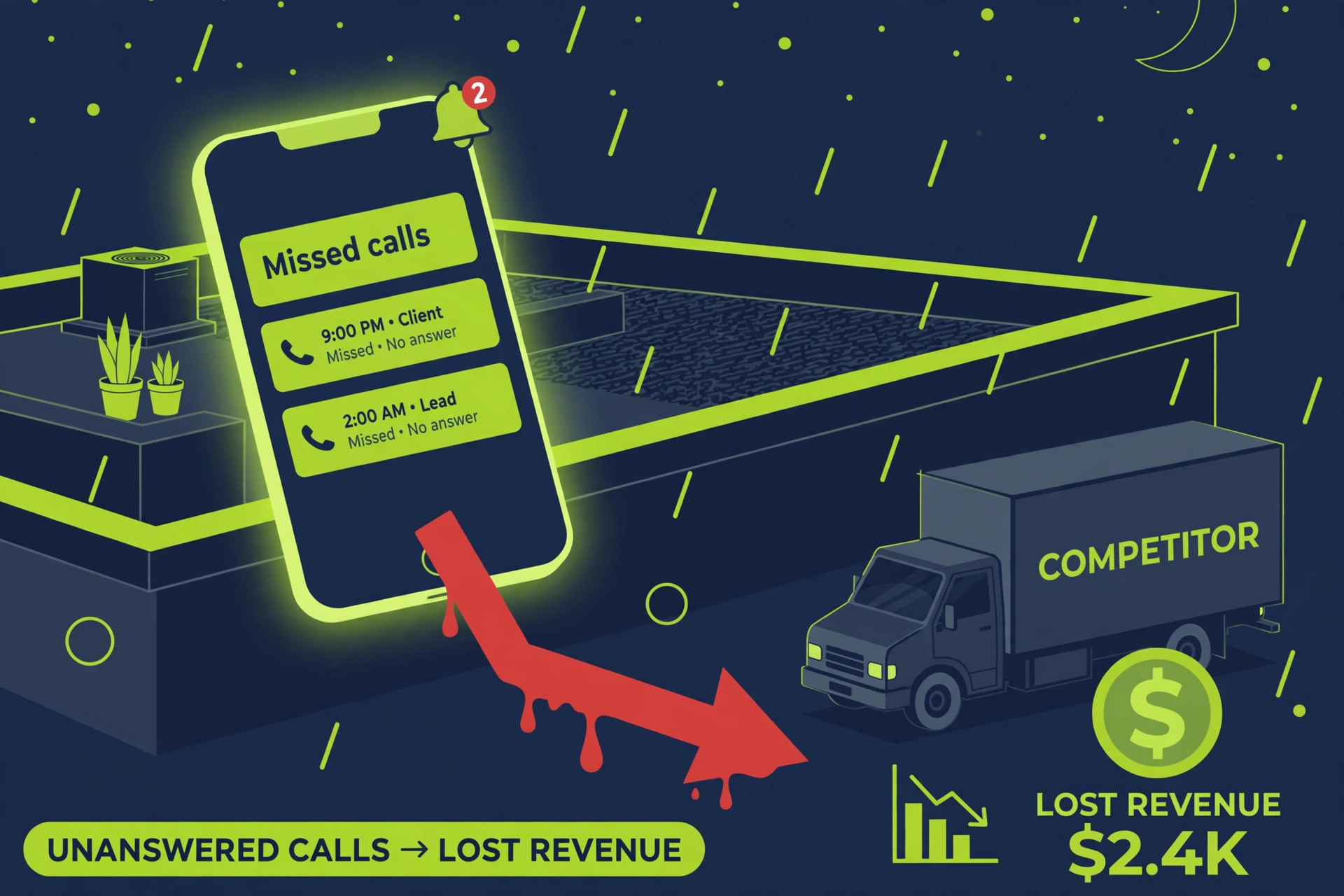
The phone rings at 9 PM, Saturday morning, 2 AM after a storm. Nobody answers. Those are not missed calls. They are jobs you will never hear about.
After-hours calls are the most expensive leads most roofing companies never see. An office that answers 8 to 5, Monday through Friday, sits unanswered for 123 of the 168 hours in a week. And roofing problems ignore office hours: the homeowner calling at 9 PM has water coming through the ceiling, and if nobody answers, they call the next roofer in the search results.
Quick Answer:
After-hours roofing calls (evenings, weekends, storm nights) are high-intent emergency leads that most companies send straight to voicemail. A roofer who only answers during business hours is effectively closed for 123 of 168 hours each week. Emergency callers rarely wait: they call the next roofer. A 60-second automated text-back turns those silent callers into morning inspections instead of lost jobs.
Why Do So Many Roofing Calls Come in After Hours?
Because homeowners live on a different schedule than your office. They notice the ceiling stain after dinner, find wet insulation on Saturday morning, and Google “roof leak repair near me” from the couch at 9:40 PM, while the worry is fresh.
Then storm season: hail at 6:15 PM on a Tuesday, shingle photos in the neighborhood group chat by 8 PM, homeowners calling roofers by 8:30. The roofer who answers that night gets the first inspection slot; the one on voicemail gets nothing.
The hours math: open 8 to 5, Monday through Friday, and you are reachable for 45 of the 168-hour week. That leaves 123 hours, roughly three quarters of every week, where the phone rings into the dark, and storm season stacks even more demand into those hours.
That is the invisibility problem: your CRM shows the calls you answered and the estimates you ran, but nothing about the 9 PM calls that went to the competitor who picked up.
Why Are After-Hours Callers Your Highest-Value Leads?
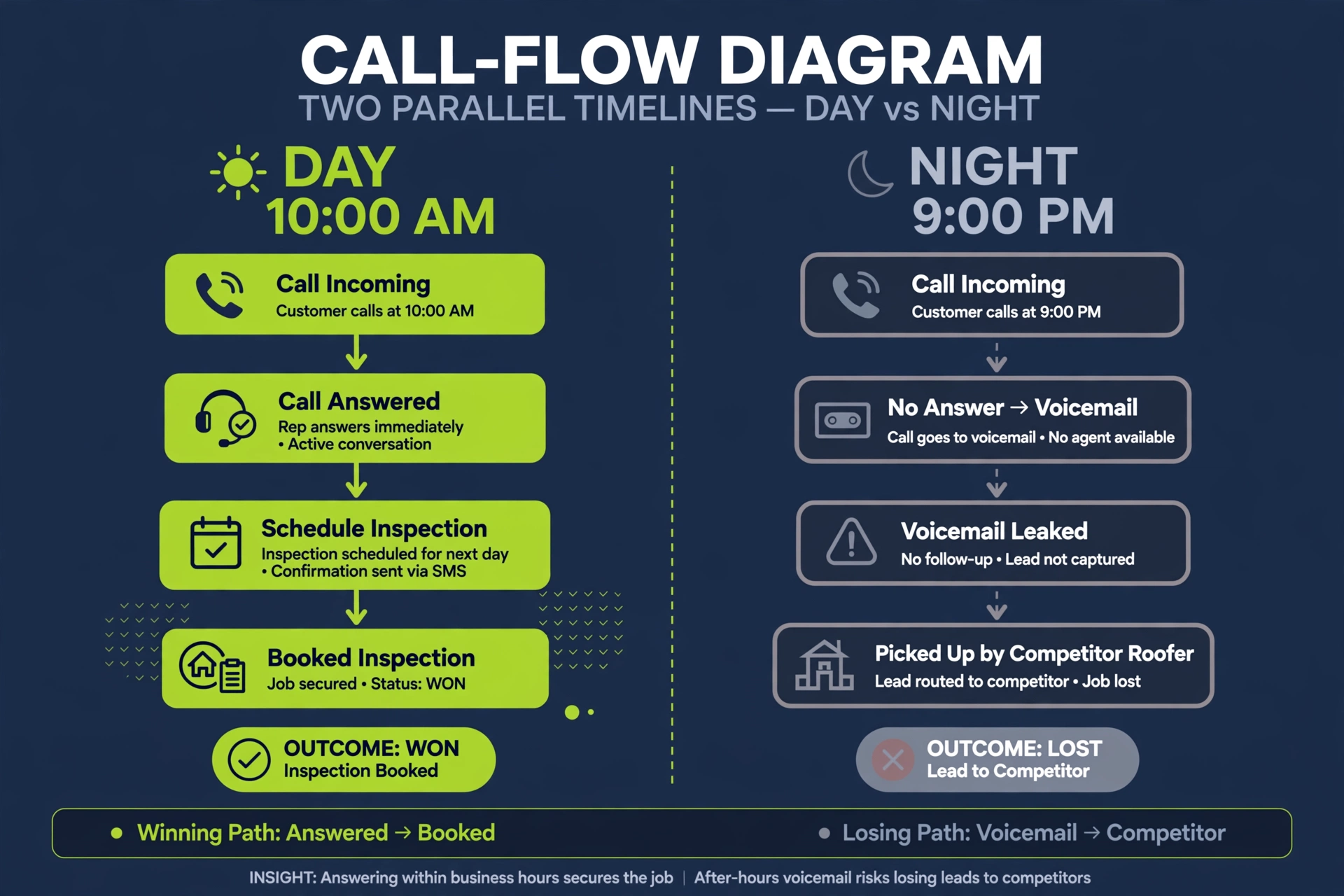
A caller at 2 AM is not comparison shopping. They are standing under a leak with a bucket. That caller is price-insensitive, urgency-maxed, and ready to say yes to whoever shows up first. In roofing, urgency is value.
Emergency leak calls convert at the highest rate of any lead source and carry the biggest tickets. The midnight caller with active water intrusion needs a tarp tonight and a replacement quote tomorrow: tarp visit becomes inspection, inspection becomes insurance claim, claim becomes a $10,000-plus replacement with a deductible the homeowner barely flinches at. (Illustrative; substitute your own.)
Compare that to a 10 AM Tuesday caller getting three quotes on an aging roof they plan to replace next year. Same phone system, wildly different economics. The daytime caller is a shopper. The night caller is a buyer.
Insurance claims make this even more valuable: claims filed in the first 24 hours move faster through adjusters, and the roofer on the roof first usually manages the claim. Once a homeowner has walked their property with one roofer, the second is just auditing someone else’s scope. The after-hours caller is a first-on-the-roof job, handed to whoever answers.
How Many After-Hours Calls Does a Typical Roofer Miss Each Month?
Work the funnel with explicitly illustrative numbers, and the shape of the leak becomes hard to ignore.
Setup: A residential roofer running steady local advertising. About 60 inbound calls a month from Google, yard signs, referrals, and repeat customers. The office answers 8 to 5, Monday through Friday; nights, weekends, and holidays go to voicemail.
The funnel: With phones unanswered for 123 of 168 weekly hours, be conservative and say 40% of the 60 monthly calls arrive outside business hours (illustrative; many roofers measure higher): 24 after-hours calls a month. Of those 24, be generous and say a quarter leave a message (illustrative). That is 6 voicemails. The other 18 hang up: in an emergency, most callers do not compose a message; they call the next roofer on the list.
The illustrative picture: 60 calls a month, 24 after hours, 18 with no trace, 6 voicemails returned tomorrow morning, after the caller was already inspected by whoever answered first. Those 18 hang-ups are the invisible part: no voicemail, no form fill, no CRM record. Eighteen homeowners a month who needed a roofer, now in your competitor’s pipeline.
What Do Those Missed After-Hours Jobs Cost You Per Year?
Now price it conservatively: say your callback system saves a third of the 6 voicemails and none of the 18 hang-ups, leaving roughly 16 missed after-hours callers a month (illustrative).
After-hours emergency callers close high: they called with a problem, not a curiosity. Use a 25% close rate (illustrative; emergency work closes above daytime averages): 16 missed callers become 4 lost jobs a month.
Average job value: $10,500 (illustrative; substitute your own).
- 4 lost jobs per month x $10,500 = $42,000 per month in leaked revenue.
- x 12 months = $504,000 per year.
Half a million dollars a year, leaking out of 123 unanswered hours a week, and that is conservative. Raise the after-hours share, the close rate, or the ticket to storm-season emergency numbers and the leak grows fast: during hail season, one busy month can leak more than a quiet quarter.
Late October sharpens this: the rush is cooling, claim volume is thinning, and the calendar you build now carries your crew through winter. A November inspection booked from a 9 PM October caller fills the slow weeks, so every after-hours miss in the shoulder months is a hole in the winter schedule.
The math compounds: the homeowner whose 2 AM leak you answered becomes a 5-star review, a referral source, and a repeat customer when the next storm hits. The lifetime value of an emergency caller is a replacement, a review, and a neighborhood. The leak is not one job; it is the whole downstream tree.
Run your own numbers in the free Revenue Leak Calculator: enter your call volume, after-hours share, close rate, and job value to see what the night shift costs you per year.
Why Doesn’t Voicemail Save These Callers?
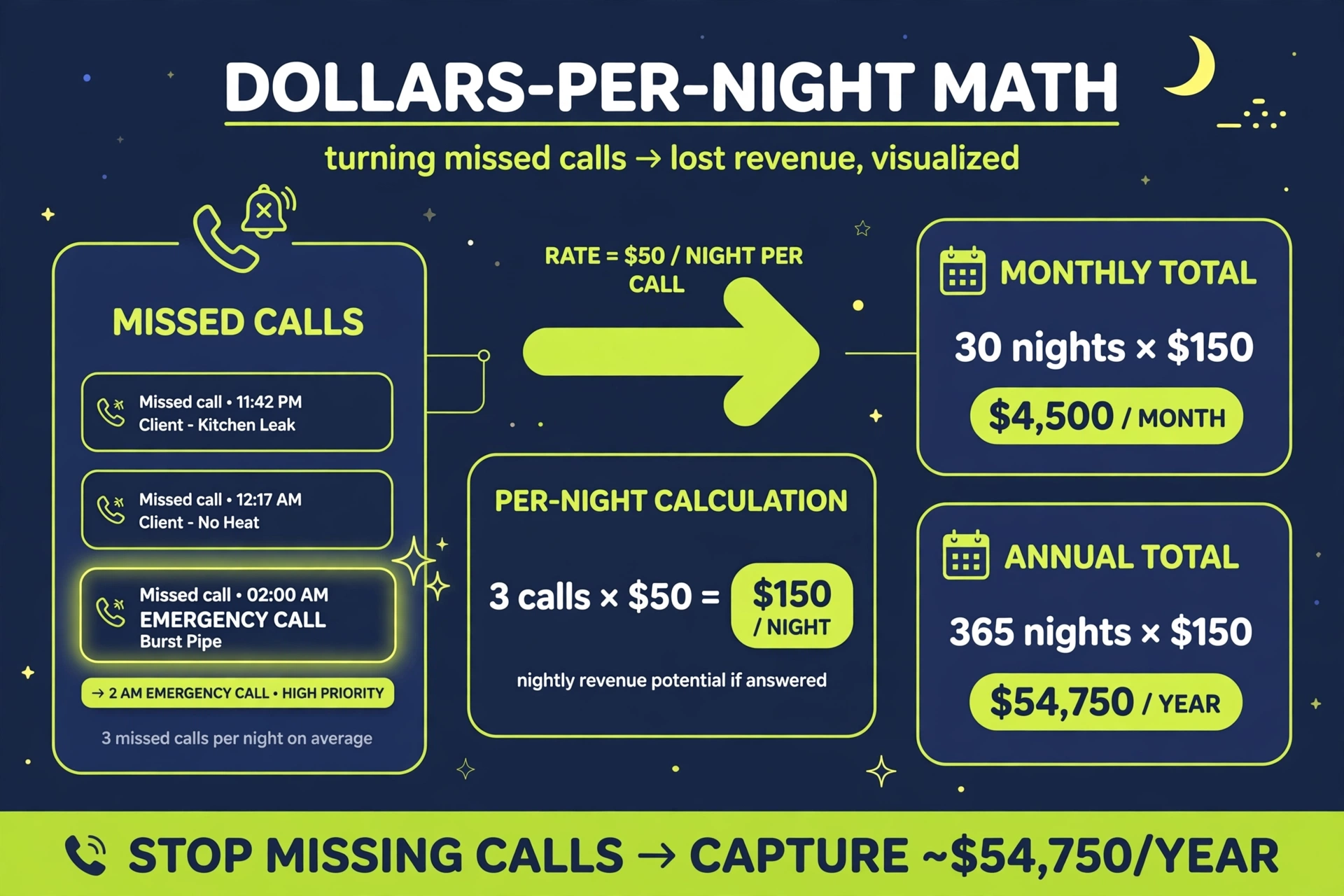
Voicemail answers a question the caller is not asking. The caller is not asking “can I leave a message.” They are asking “who can get here fastest.” Voicemail promises a callback tomorrow; the caller needs a roofer tonight.
The response research backs this up. InsideSales.com’s landmark Lead Response Management study found that 78% of buyers purchase from the company that responds to them first. The roofer who calls back at 8 AM is not the first responder. The roofer whose text arrived at 9:47 PM was.
And the callback window is shorter than most owners think. Lead response research shows contact and qualification rates fall off sharply within the first hour, with fast responders seeing 7x higher qualification odds (per the Harvard Business Review-covered lead response research). Your voicemail callback the next morning competes with a competitor who texted back last night and already booked the inspection. You are not losing on callbacks. You are losing on first response.
Then the second voicemail problem: most after-hours callers never reach your voicemail at all. They hear the greeting and hang up. Your missed-call log knows they called; your voicemail box does not. The 18 hang-ups from our illustrative funnel are the norm for emergency callers. A system built on voicemail serves only the minority who leave messages.
How Does a 60-Second Text-Back Turn Night Calls Into Morning Inspections?
The fix is a 60-second rule you can set up this week: every missed call gets an automatic text within 60 seconds, no matter the hour. Here is the system:
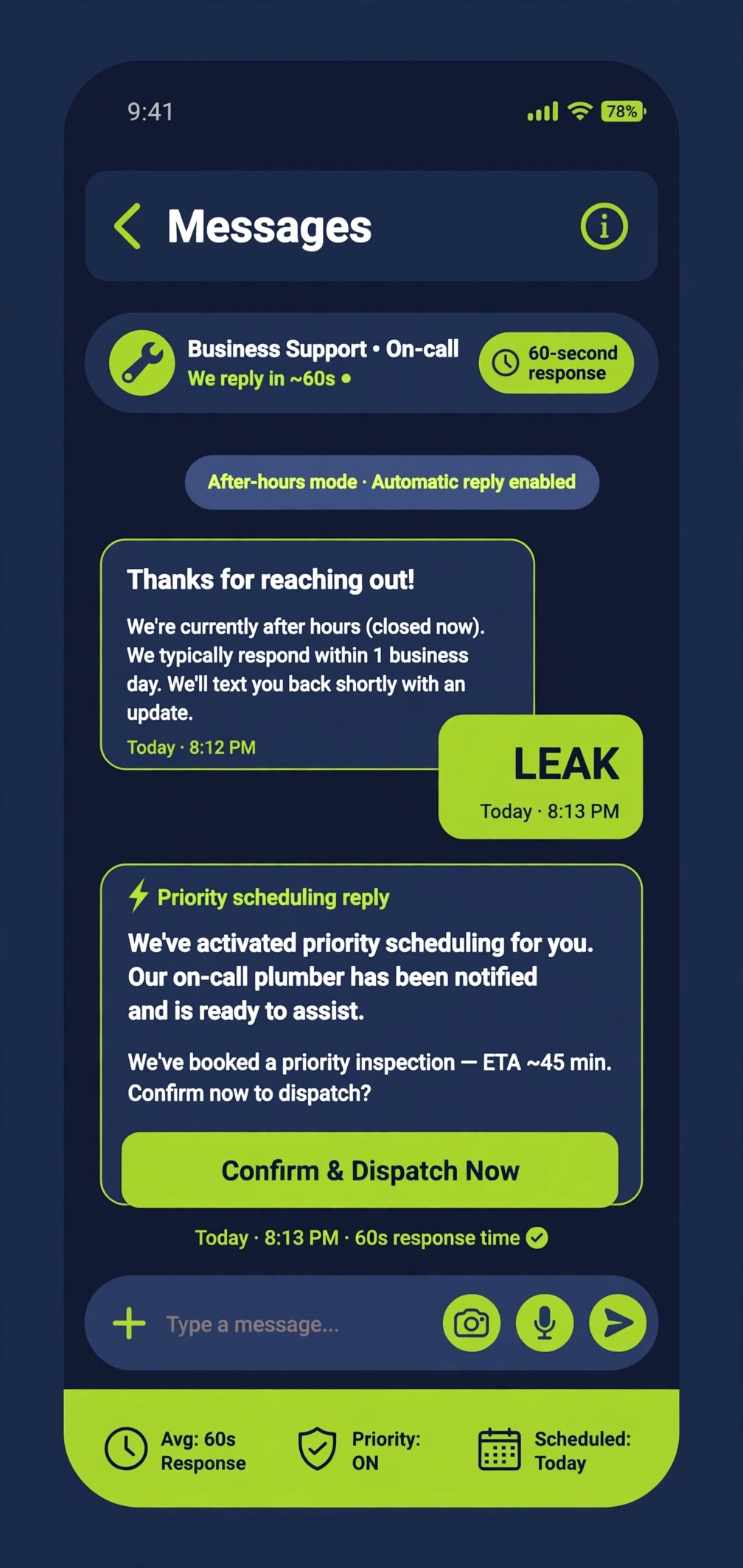
1. The trigger fires on the missed call. A 9:12 PM call goes unanswered. Within 60 seconds, the caller gets a text from your business number: “Sorry we missed you! This is [Company]. Emergency leak or can we schedule an inspection? Reply LEAK if water is coming in and we will prioritize you.” Dead end becomes conversation in under a minute.
2. The emergency keyword routes the hot ones. A caller who replies LEAK gets: “Got it. A tech will call you within 15 minutes. Where is the water coming in?” That thread routes to the on-call number, not the office line: tarp tonight, inspection tomorrow, claim this week.
3. The non-emergency caller gets a morning slot. A routine caller gets: “Thanks! First inspection slot tomorrow is 9 AM. Does that work, or is there a better time?” By office open, the calendar already holds a booked inspection, and the caller never needed to call a second roofer.
4. The morning dispatcher sees a thread, not a voicemail. Instead of a voicemail box of cold messages, the office opens to text conversations already in motion. The follow-up is a reply, not a cold call back, and reply rates beat voicemail callbacks by a wide margin, because the homeowner started the conversation.
That is the 60-second window the research rewards: a text that lands at 2:01 AM beats a voicemail callback at 8 AM, because the automation answers in the night and the human follows up in the morning.
One rule: the text must come from your real business number, and the first reply must arrive fast. A text that says “we will get back to you within 24 hours” is voicemail with extra steps.
What Should You Set Up First This Week?
Start with measurement, because the leak is invisible until you count it.
Step 1: Count the dark-hours calls. Pull 30 days of call logs. Count the calls outside your answered hours that never got a callback within 5 minutes: that number, times your close rate, times your average job value, is your personal version of the worked example. Most owners find the number uncomfortable.
Step 2: Turn on the 60-second text-back. Missed call triggers text, the emergency keyword routes to the on-call line, and everything else books the morning. One person carries the night phone on rotation, with a 15-minute SLA for LEAK replies.
Step 3: Set the callback SLA in writing. Every after-hours text thread gets a human follow-up by 8 AM. Return voicemails within 30 minutes of open, newest first: the newest caller is the warmest.
Step 4: Watch the storm nights. When a storm hits, extend the on-call rotation and tighten the SLA. Storm nights are the highest-value after-hours volume of the year: whole neighborhoods calling at once, all emergencies, all price-insensitive. One good storm night with the text-back running fills two weeks of inspections; one on voicemail is a donation to the competitor who answered.
Do step 1 this week to learn the exact size of your leak; do steps 2 through 4 and the leak starts closing the same night.
Bottom Line
Your office is open 45 hours a week; roofing emergencies are open 168. The gap is where after-hours calls leak: high-intent, high-ticket callers who reach a voicemail greeting, hang up, and call the next roofer. At illustrative rates, roughly 4 lost jobs a month and half a million dollars a year, before the reviews, referrals, and repeat work each emergency caller brings downstream.
The fix is not longer hours. It is a 60-second text that lands while the caller is still holding the phone. This is what RepuPilot sets up for roofing companies: missed-call text-back that fires automatically, emergency keywords routing hot calls to the on-call line, and morning threads that become booked inspections before the competitor’s voicemail callback happens. The night shift starts answering, even while you sleep.
Run your own numbers in the free Revenue Leak Calculator and see what your night shift is worth per year. Then set up the text-back before the next storm night makes it expensive.
Frequently Asked Questions
What counts as an after-hours call for a roofing company?
Any inbound call that lands when nobody picks up: evenings after office close, weekends, holidays, and storm nights. For a typical 8-to-5, Monday-to-Friday office, that is 123 of the 168 hours in a week, roughly three quarters of all calling hours.
How fast should I respond to an after-hours missed call?
Within 60 seconds, by text. InsideSales.com’s lead response research found 78% of buyers purchase from the company that responds first, and response odds fall sharply after the first hour. A text at 9:01 PM beats a voicemail callback at 8 AM, every time.
Is a 2 AM emergency call worth answering myself?
The call itself, usually not. The 60-second text, always. Let the automation acknowledge the caller instantly and route LEAK replies to an on-call rotation. You sleep; the system answers. The tarp visit or the emergency callback happens on your terms, but the job stays yours.
Won’t an automated text feel impersonal to an emergency caller?
Less impersonal than voicemail. A 2 AM caller does not want warmth; they want acknowledgment and a plan. A fast, specific text reads as a company that has its act together. Silence reads as a company that is closed.
What should the text-back message say?
Name the company, acknowledge the miss, and give a one-reply action: “Sorry we missed you! This is [Company]. Emergency leak or inspection? Reply LEAK if water is coming in and we will prioritize you.” Short and specific, written for a stressed homeowner on a phone screen.
How do I know how many after-hours calls I’m missing?
Pull 30 days of call logs and count the calls outside your answered hours that never got a callback within 5 minutes. That count times your close rate times your average job value is your leak. No call logging yet? Start there: you cannot fix a leak you cannot count.