
The math behind the quietest revenue leak in roofing, and exactly what the gap is worth in jobs, dollars, and years.
If your competitor has twice your review count and the same star rating, they are not just more popular. They are quietly taking a measurable share of your calls every single month, and this post shows you the math so you can price the leak yourself.
Quick Answer:
A competitor’s higher review count steals jobs two ways: it lifts them in the Google 3-pack and wins the head-to-head profile comparison. BrightLocal’s 2026 survey found 97% of consumers read reviews, 37% weigh review count heavily, and 47% avoid businesses under 20 reviews. Most roofers find the gap costs 5 to 15 jobs monthly.
Why Does Review Count Decide Who Gets the Call?
When a homeowner’s roof leaks at 6 AM or a hailstorm just rolled through the county, they do not open a spreadsheet. They search “roofing contractor near me,” they glance at the three names Google shows in the map pack, and they compare two numbers before they read a single word: the star rating and the review count. Both matter. But here is the part most owners miss: when two roofers have the same star rating, the count becomes the tiebreaker.
BrightLocal has surveyed US consumers on this behavior for over a decade, and their 2026 edition of the Local Consumer Review Survey (1,002 US adults) puts hard numbers behind what you already feel in your gut. Ninety seven percent of consumers read reviews for local businesses, and 41% say they always read them. When they compare options, star rating (38%) and number of reviews (37%) are the two most important factors right after proximity. That means for “roofer near me,” your review count is doing almost as much work as your rating.
The Whitespark Local Search Ranking Factors survey, published November 2025 with 47 local search experts scoring 187 factors, gives the ranking side of the story. Review signals now make up roughly 20% of what decides who lands in the local 3-pack. High Google ratings sit at factor #6, the number of Google reviews with text sits at #9, and review recency sits at #11. So review count is not just a trust signal for the homeowner. It is a ranking signal for Google. More reviews means higher rank, which means more visibility, which earns more jobs, which earns more reviews. That loop is the whole game.
And the kicker: 72% of consumers look at three or fewer businesses before deciding. If your competitor’s review count puts them in the 3-pack and keeps you out, you are not even one of the three. You never got a shot.
What Does the Review-Count Gap Actually Look Like in One Zip Code?
Let us stop talking in theory and look at a real shaped scenario. Picture two roofers in the same suburban zip code outside a metro market like Dallas or Columbus. Similar crews. Similar quality. Similar pricing.
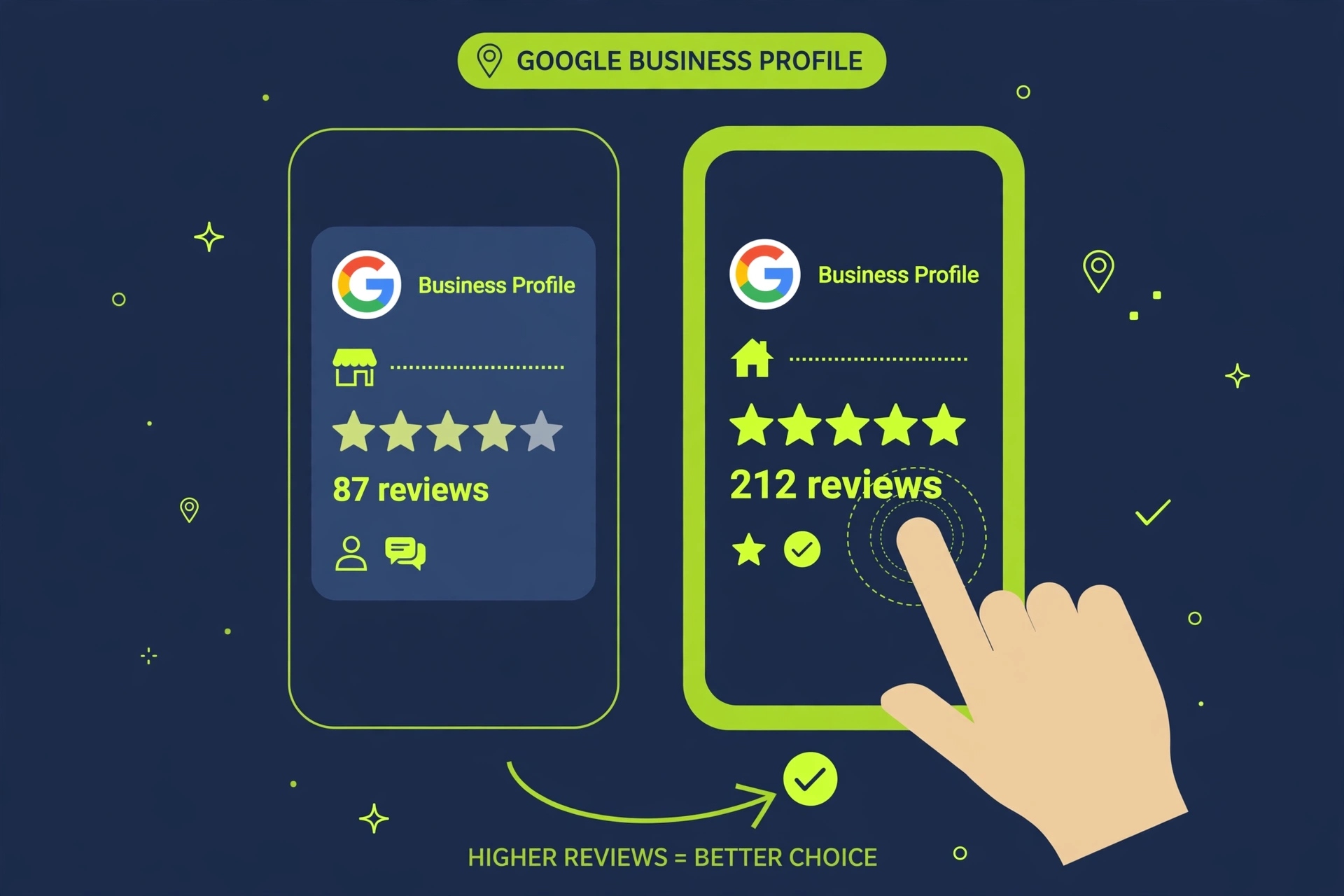
- Your company: 87 Google reviews, 4.7 star average
- Your competitor: 212 Google reviews, 4.7 star average
Same rating. Same trade. Same zip code. The only difference is 125 reviews. Now let us follow a homeowner. She searches “roofing contractor near me” after a storm tears up her neighborhood. Google shows her the 3-pack. The competitor sits at position one or two with 212 reviews under their name. You sit lower with 87.
She opens both profiles side by side, the way real consumers do. There are no negative reviews here and both look clean, so her eyes drop to the count: 212 versus 87. That gap reads, fairly or not, as a gap in experience. A business that 212 people trusted feels like the safer pick. And with 47% of consumers refusing to use a business with fewer than 20 reviews, you know volume has crossed from decoration into qualification. The contrast is what costs you.
This is the review gap: not your absolute number, but the distance between your number and the number of the business sitting in the 3-pack above you.
How Do You Turn a Review Gap Into Lost Jobs and Lost Dollars?
Here is the worked example, step by step, so you can check every line. The research figures are real and cited. The local market assumptions are clearly labeled illustrative, because every zip code is different, and I want you to plug in your own numbers after this.
Step 1: The real research inputs.
- 97% of consumers read reviews for local businesses, and 37% rank the number of reviews as a top decision factor, second only to proximity and star rating (BrightLocal Local Consumer Review Survey, 2026, 1,002 US adults).
- SOCi’s 2026 Local Discovery Index measured a near 3% lift in Google Business Profile conversions for every 10 new reviews. That one is gold for our math.
- The average US roof replacement reached $17,631 in 2025, per Verisk’s U.S. Roof Report 2025 (cited by GAF). We use a blended average job value below, since your month mixes replacements and repairs.
Step 2: The illustrative market assumptions.
- Your zip code produces 400 high intent Google searches a month for roofer type queries (illustrative).
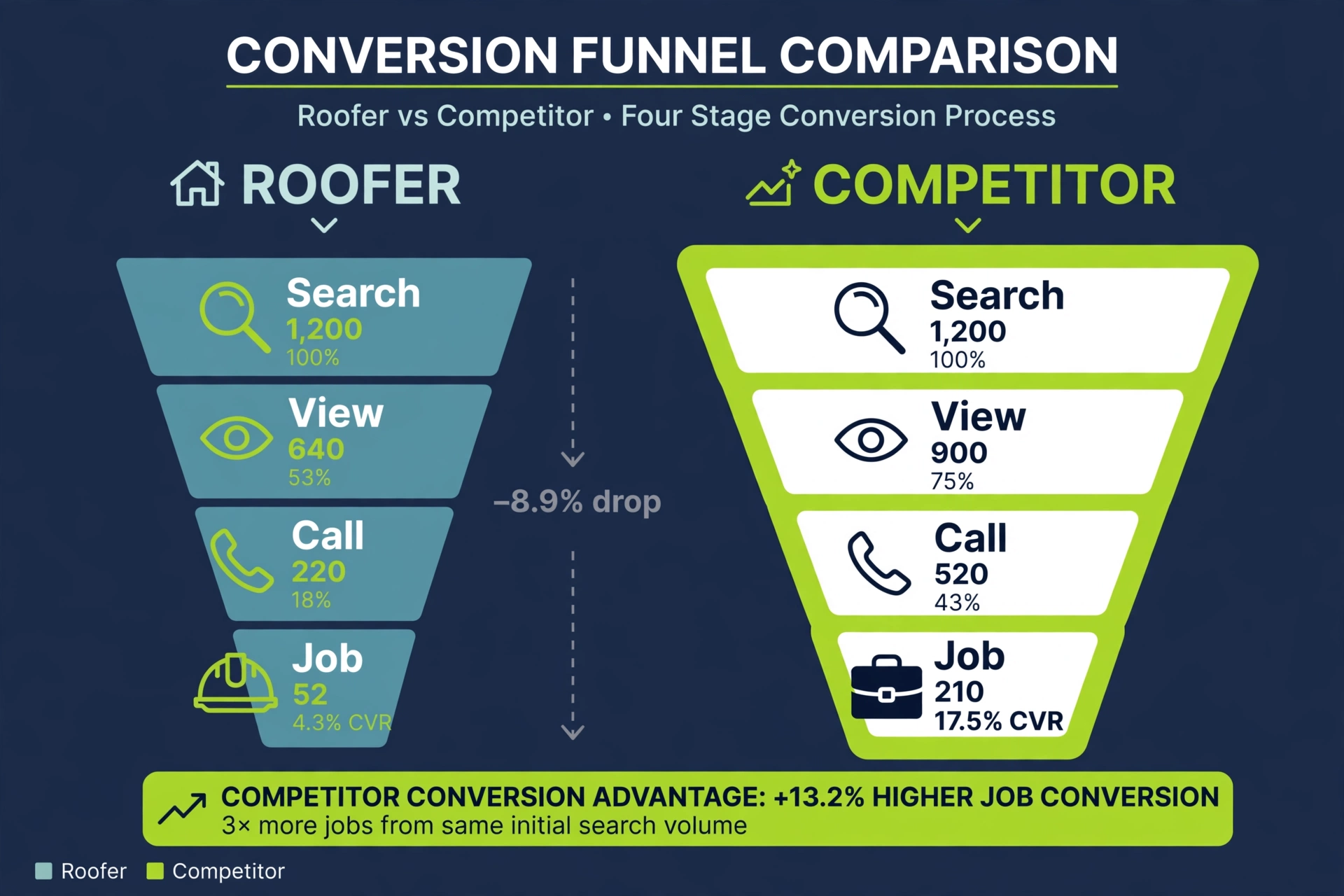
- Your competitor’s 212 reviews hold them in the 3-pack, giving them profile views from roughly 75% of those searches: 400 × 0.75 = 300 views a month (illustrative).
- Your 87 reviews leave you ranking lower, giving you profile views from roughly 60% of searches: 400 × 0.60 = 240 views a month (illustrative).
- Baseline view to call conversion is 15% for both profiles (illustrative).
Step 3: Apply the review-count effect on conversion.
The gap is 212 minus 87 = 125 reviews. SOCi’s measured 3% conversion lift per 10 reviews means the gap is worth roughly 12.5 blocks of ten reviews, times 3%, which is about a 37.5% relative conversion advantage for the competitor. Your competitor’s view to call rate becomes 15% × 1.375 = 20.6%. Your rate stays at 15%.
- Your calls: 240 views × 15% = 36 calls a month
- Competitor’s calls: 300 views × 20.6% = 61.8, round to 62 calls a month
Step 4: Convert calls to jobs.
Assume both companies close calls at 40% (illustrative, realistic for roofing when the call is qualified):
- Your jobs: 36 × 40% = 14.4 jobs a month
- Competitor’s jobs: 62 × 40% = 24.8 jobs a month
- The gap: about 10.4 jobs a month
Step 5: Price the jobs.
Verisk puts the average full replacement at $17,631. A typical roofer’s month mixes replacements, repairs, and insurance claim work, so use a blended average job value of $12,000 (illustrative). That is conservative against the replacement average.
- 10.4 jobs × $12,000 = $124,800 a month
- $124,800 × 12 = $1,497,600 a year
Run your own numbers in the free Revenue Leak Calculator at https://repupilot.7coxmos.com/ and see what your actual review gap is costing you before you change a thing.
Try it with your own numbers below.
Review Gap Calculator
See what your Google rating gap is costing your roofing company, in real dollars.
Enter your numbers
See your result
Estimate based on a simple rule: every 0.1 star below 4.5 costs about 3% of ready to buy homeowners, who call the higher rated roofer instead. Your real number depends on your market. The fix is a steady flow of new reviews, every single month.
Close the gap
RepuPilot roofers close this gap with automatic review requests after every job, replies handled for them, and a shield that catches unhappy customers before they post.
See How RepuPilot Closes Your GapWhat If You Closed the Gap? Running the Numbers Backward
The example above is the bad news. Now run it in reverse, because this is where owners usually get excited. Suppose over the next six months you collect 120 reviews through a simple post job review request system, and you land at 207 reviews against their 212. The gap is nearly gone.
Your view share climbs as your profile gains review signals, and the SOCi conversion lift starts working in your favor instead of against you. Even a partial close, from a 125 review gap down to 25, wipes out roughly 80% of their conversion advantage. In our illustrative model, your monthly calls move from 36 toward the high 40s, and the job gap shrinks from 10.4 a month to about 2 or 3.
At the same $12,000 blended job value, that is roughly $90,000 to $100,000 a month in recovered revenue. That is the return on a review system. Not a billboard. A simple habit: ask every customer after every job, and make the asking automatic so it happens when you are on a roof, not when you remember.
One free bonus from the research. Review recency is factor #11 in the Whitespark ranking survey, and BrightLocal’s latest data shows recency is what consumers watch most closely. A competitor with 212 reviews but nothing new in three months is weaker than their count suggests. Fresh reviews count double: once for the ranking, once for the homeowner who checks dates before calling.
How Many Reviews Does It Take to Win Your Zip Code?
There is no national number, and anyone who gives you one is guessing. The target is local. Count the reviews of the three businesses sitting in your 3-pack for your money searches (“roofing contractor near me,” “roof repair [your city],” “roof replacement [your zip]”). Write down each count. Your target is not the average. Your target is the top count plus a buffer of about 20%, because while you are building, they are building too.
If the top dog has 90 reviews, the zip is winnable this quarter. If the top dog has 600, you plan for a longer campaign and win on recency and rating while you build count. Measure the gap, close the gap, and keep a system running so the gap never opens behind you again.
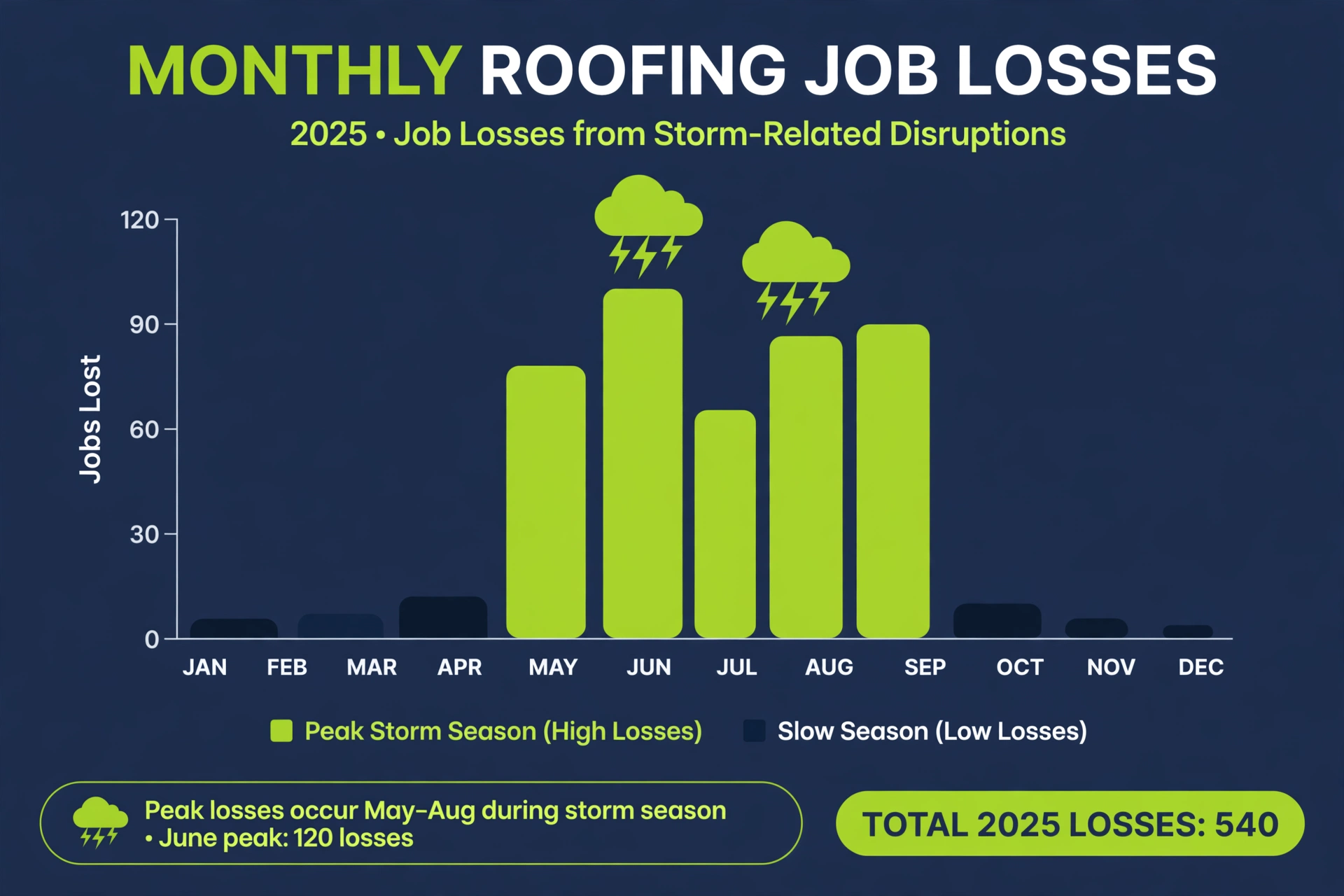
And keep this in mind during storm season. Demand spikes, search volume multiplies, and every advantage in the 3-pack gets amplified. A review gap that costs you 5 jobs a month in February can cost you 15 a month in May when hail is doing your marketing for you. If you are going to close a gap, close it before the storms arrive.
How Should You Respond When a Competitor Pulls Ahead on Reviews?
First, do not panic and do not do anything shady. The FTC’s rule on consumer reviews took effect in October 2024 and it bans fake reviews, bought reviews, and review suppression, with civil penalties that can reach into the tens of thousands of dollars per violation. The shortcut is not worth it and it is not needed, because the honest path is faster than most owners think.
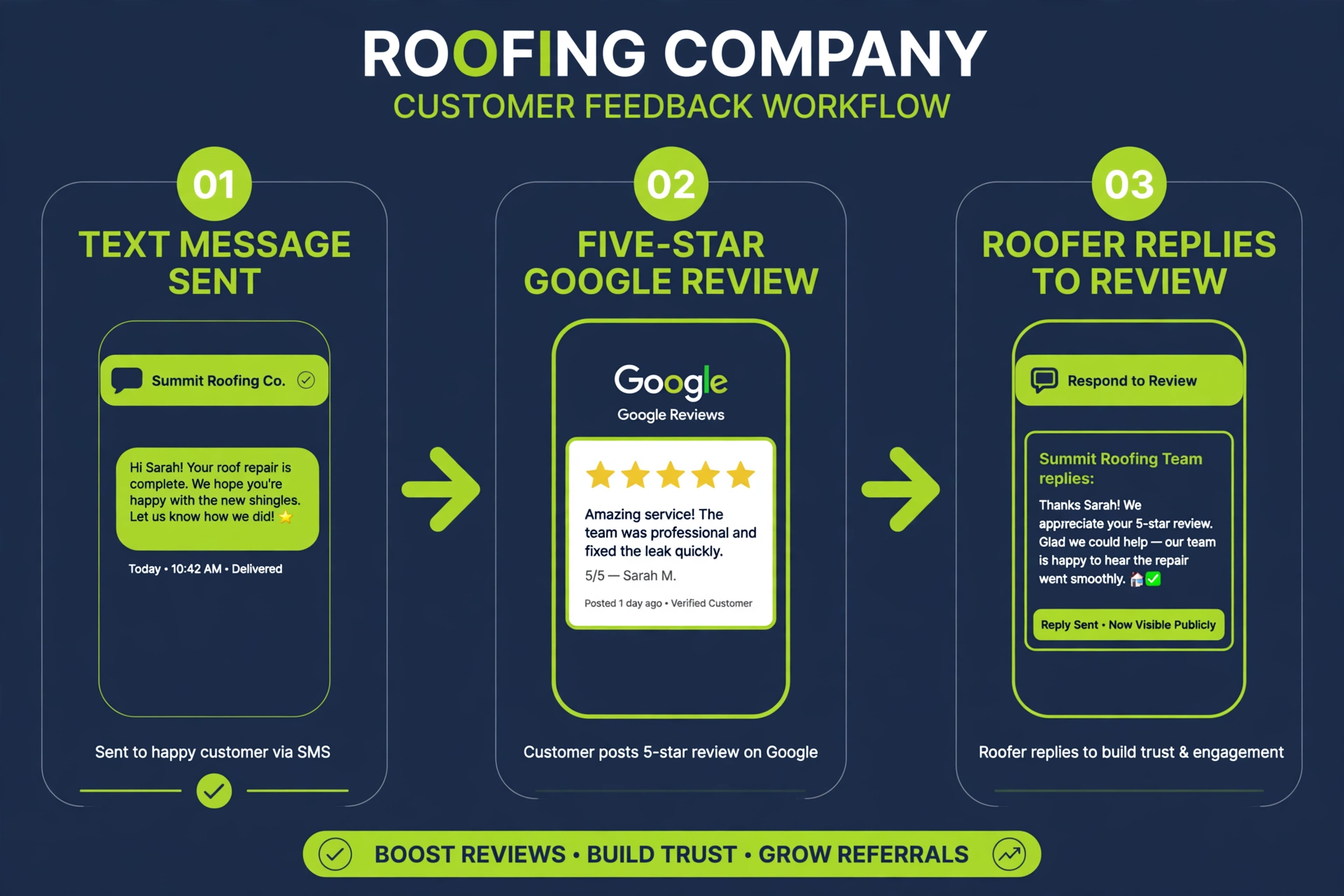
What actually works is boring and repeatable. Text every customer a review link the day the job wraps, while the new roof is still making them happy. Reply to every review you get, because BrightLocal found 80% of consumers are more likely to use a business that responds to all its reviews. Put the review link on the final invoice and on the yard sign you leave behind. Ask insurance claim customers too, since those are some of your biggest tickets and they rarely get asked.
The owners who win the count game do not have a secret. They have a system that asks every time, so reviews arrive every week instead of in bursts. Google rewards sustained velocity, homeowners trust recent dates, and the gap closes month by month while you are busy roofing.
Bottom Line: Is Your Review Count or Your Competitor’s Paying You?
Here is the uncomfortable summary of the math. In a single mid sized zip code, a 125 review gap against one competitor modeled out to roughly 10 jobs and $125,000 a month, or about $1.5 million a year, with every market assumption labeled so you can swap in your real numbers. The research behind it comes from BrightLocal’s consumer survey, Whitespark’s ranking factors study, SOCi’s conversion data, and Verisk’s cost reporting. The gap is real, it compounds, and it gets worse every month you let it sit.
RepuPilot exists for exactly this kind of problem. It is a reputation and revenue protection platform built for roofing contractors, and the free Revenue Leak Calculator on the homepage is the fastest way to put your own review gap into dollars. Run your own numbers in the free Revenue Leak Calculator at https://repupilot.7coxmos.com/ and see what the gap is costing you this year. Then set up the simple post job review habit that closes it, because the competitor collecting reviews this week is pricing your next twelve months right now.
FAQs
How many Google reviews does a roofer need to compete? There is no national number. Count the reviews on the three businesses in your 3-pack for your money keywords, then target the top count plus a 20% buffer. For many suburban zip codes that lands between 150 and 300 reviews, but always measure your own market rather than chasing a generic benchmark.
Does review count matter more than star rating? They work together. BrightLocal’s 2026 survey found star rating is the top factor for 38% of consumers and review count for 37%, both right behind proximity. When two roofers share the same rating, the count becomes the tiebreaker that decides who gets the call.
Can a roofer with fewer reviews outrank one with more? Yes. The Whitespark ranking factors survey shows recency (#11) and reviews with text (#9) carry their own weight alongside raw count, and rating (#6) matters too. A smaller profile with fresh, detailed, high rated reviews can beat a stale big profile, especially if your rating is higher.
How fast can a roofing company close a review gap? With a post job text sent after every completed job, most residential roofers can collect 10 to 25 reviews a month. A 125 review gap closes in roughly 6 to 12 months at that pace, and you will feel the conversion lift well before the gap hits zero because homeowners respond to momentum.
Do reviews really affect Google 3-pack rankings? Yes. Review signals make up about 20% of the local 3-pack ranking weight in the November 2025 Whitespark survey, up from 16% in earlier editions. Rating, review quantity with text, and recency all rank among the top individual factors.
What is the fastest legitimate way to get more reviews? Text every customer a direct Google review link the day the job is finished, while satisfaction is highest. Add the link to the final invoice, reply to every review you receive, and include insurance claim customers. Consistency beats bursts: Google and homeowners both reward steady weekly reviews over occasional floods.
Should I worry about a competitor’s reviews during storm season? Yes, more than any other time. Search volume multiplies after hail and wind events, which amplifies every 3-pack advantage. A review gap that costs you 5 jobs in a slow month can cost you 15 in a storm month, so close the gap before storm season, not during it.
Is it illegal to buy fake reviews to catch up? Yes. The FTC’s Consumer Reviews and Testimonials Rule took effect in October 2024 and bans fake and AI generated reviews, buying reviews, and suppressing honest negative reviews. Violations can carry civil penalties. The honest system, asking every customer after every job, is faster and permanent.