
Small weekly losses feel like rounding errors. Run them over 52 weeks and they become a missing marketing budget, a missing hire, or a missing truck.
Eight hundred dollars a week in lost roofing revenue annualizes to $41,600 a year — the cost of a full replacement job every five weeks, gone without a trace. Small leaks are the most dangerous kind because they never trigger an alarm: no angry customer, no failed inspection, just a quiet, steady drain that compounds into six figures while you are busy on the roof.
Roofing owners are trained to watch big numbers: monthly revenue, crew payroll, material costs. The small numbers — one unanswered call a week, one slow follow-up a day, one estimate that never got a second touch — do not get meetings. But revenue leaks compound exactly like interest. This post annualizes the small ones so you can see what they really cost, with real roofing numbers worked end to end.
Quick Answer:
An $800-per-week revenue leak compounds to $41,600 a year. For a roofing company, a handful of ordinary small leaks — one missed call a week ($750), one slow estimate follow-up a week ($500), one unanswered review touch a week ($300) — stack to roughly $1,550 a week, or about $80,600 a year, nearly a full-time estimator’s salary, lost to leaks nobody watches.

Why Do Small Leaks Escape Every Owner’s Attention?
Three reasons, all human.
No single event. A lost $9,500 job is a story: the homeowner picked a competitor, the crew talks about it, the owner remembers. A missed call that went to voicemail at 7:40 PM on a Tuesday is nothing. Nobody calls a meeting about it. Small leaks are invisible because they arrive as non-events.
Mental accounting. Owners mentally file small losses under “cost of doing business.” One unanswered inquiry a week feels like the normal friction of running a company. But friction is not free; it has a price, and the price compounds.
Attention goes to the loud. Storm season, crew problems, material price jumps — these are loud and get attention. Leaks are quiet by definition. The quiet line items on the P&L are where the money actually goes.
The fix is mechanical, not motivational: annualize everything. Any recurring weekly loss, multiplied by 52, becomes a number big enough to deserve a system. Eight hundred a week is $41,600 a year. Two hundred a week is $10,400 — a month of ad spend. The annualization is what turns a shrug into a decision.
What Does $800 a Week Actually Look Like in a Roofing Company?
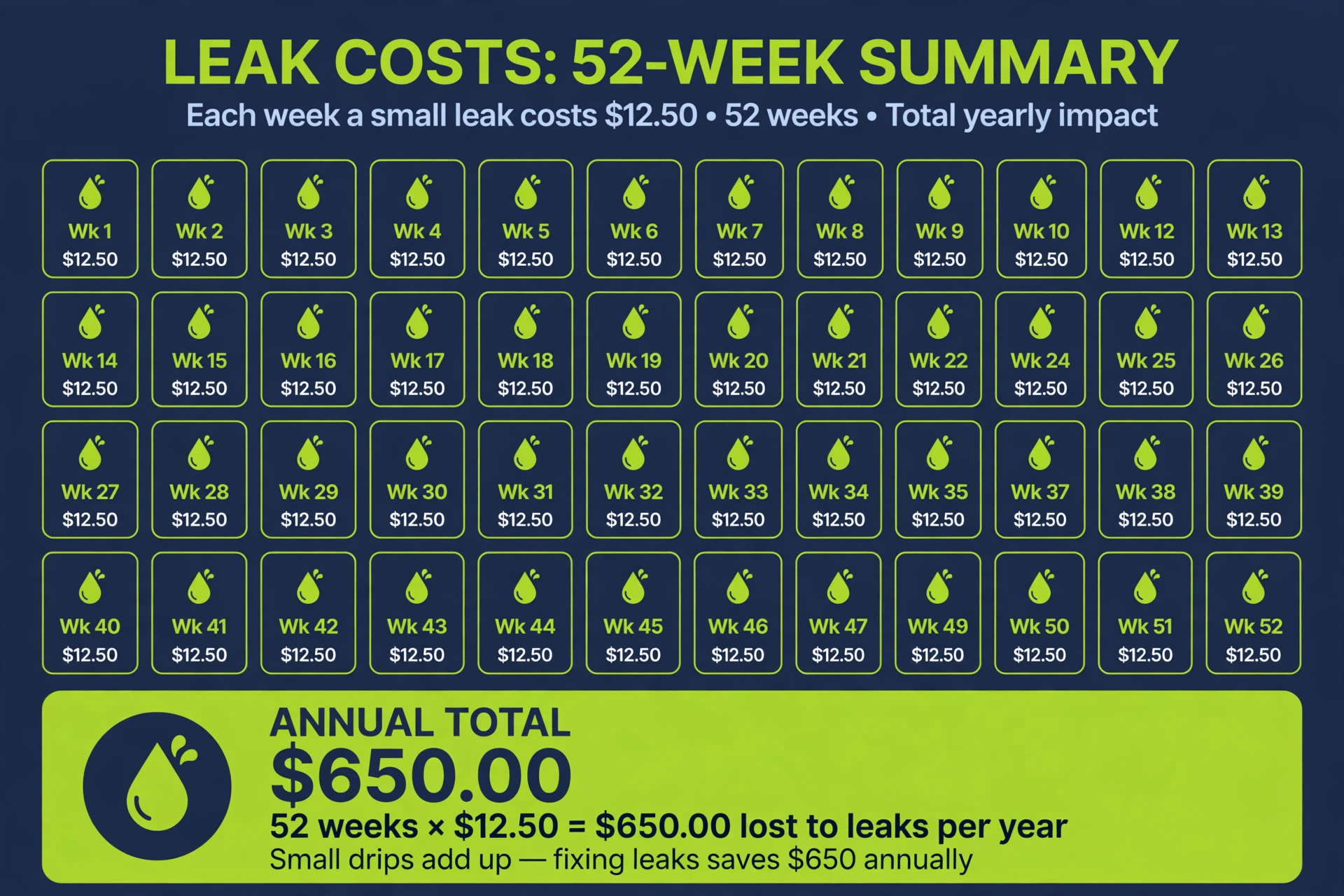
$800 a week does not arrive as an $800 line item. It arrives as ordinary days. Here is what $800 a week is made of in a typical residential roofing operation.
The missed call ($400). One call goes to voicemail during a crew huddle on Thursday. The homeowner needed a leak repair quote and called three roofers. Yours rang out. Industry data on lead response consistently shows that the first responder wins the job a large majority of the time — and the roofer who texts back within minutes recovers most of these. One lost call a week at an average repair-plus-inspection value of $400 is $400 a week. (Illustrative; repair values vary.)
The slow estimate ($250). An estimate went out Monday. The homeowner asked one question Tuesday. The answer came Friday. By then they had a competitor’s quote and a signed contract. One slow follow-up a week, at a 30 percent close rate on a $9,500 average replacement, prices at roughly $250 a week in expected value — the math is one lost job every nine to ten weeks. (Illustrative expected-value math.)
The dead review touch ($150). A homeowner left a 4-star review with a concern in the text. Nobody replied. Two prospects read it this week and called the competitor with the answered reviews instead. One lost inquiry a week at a modest conversion prices around $150 a week. (Illustrative.)
Total: $800 a week. Nothing dramatic happened. No single failure is worth a meeting. The annual number: $41,600. That is a marketing budget, a used truck, or the down payment on the estimator who would have prevented the leaks in the first place.
How Does the Compounding Actually Work?
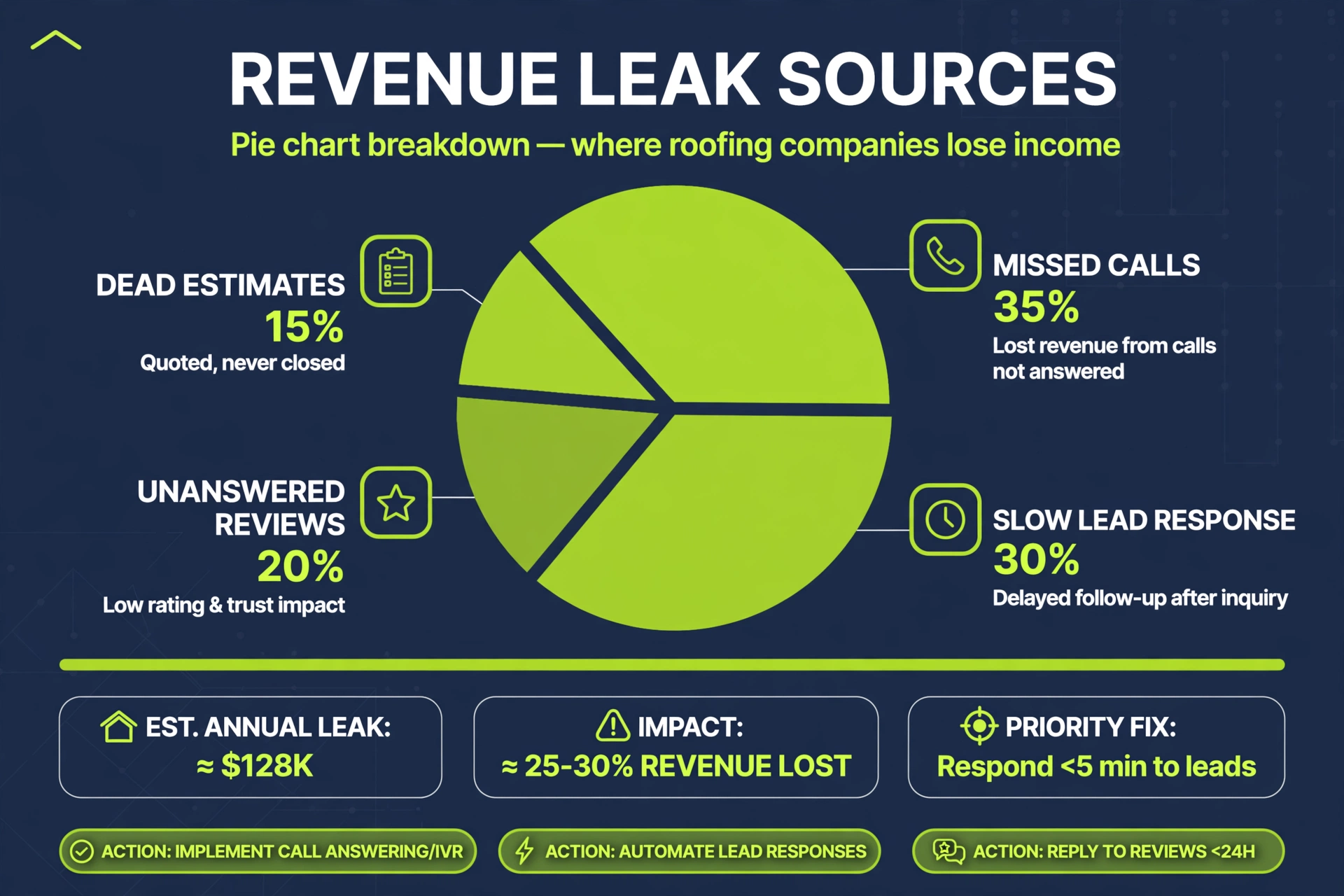
The annualization math is simple multiplication, but the compounding is real because leaks interact.
Leak stacking. The missed call and the slow estimate are not independent. The homeowner who got your voicemail and your competitor’s text-back is gone — but they also leave a review mentioning the competitor by name, and they tell a neighbor. Each leak feeds the next one’s environment.
The response-time decay curve. Lead response data shows a brutal curve: respond in under 5 minutes and you convert at your best rate; respond in 30 minutes and conversion roughly halves; respond the next day and you are competing on price against everyone else. So a “small” delay is not a small penalty — it moves the lead from your best conversion bucket to your worst. The leak is not the minutes; the leak is the bucket change.
The annual multiplier effect. Take the $800-a-week example over three years: $124,800. Over a decade of ownership: $416,000. The leaks do not stay flat, either — as the company grows, call volume grows, and the same leak rate prices higher. A 2-crew company losing $800 a week becomes a 5-crew company losing $2,000 a week at the same leak rate. Scale multiplies leaks before it multiplies profit, unless the systems get fixed first.
The opportunity comparison. $41,600 a year is what many roofing companies spend on their entire annual Google Ads budget. Owners scrutinize ad spend to the dollar — cost per click, cost per lead, ROAS — while the leak quietly exceeds the ad budget. Plug your own numbers into the free Revenue Leak Calculator and compare the two side by side. Most owners find the leak is the bigger number.
What Are the Five Smallest Leaks Worth Annualizing First?

Not all leaks are equal. Annualize these five first, because they are the highest-frequency and the cheapest to fix.
1. After-hours calls. Roofing emergencies do not respect business hours — storm damage, active leaks, and panicked homeowners call at 9 PM and 6 AM. Companies without an after-hours answer system lose 2 to 4 of these a week in storm season. At emergency repair values, that is $600 to $1,200 a week, or $31,200 to $62,400 annualized. A text-back system costs a fraction of one recovered job.
2. The 5-minute response window. Every web lead that waits more than 5 minutes for a response loses conversion fast. One delayed lead a day, five days a week, at a $400 blended expected value per lead, is $2,000 a week — $104,000 a year. This is usually the single biggest small leak in the building.
3. Unanswered reviews. Every review without an owner response is a small trust leak. Prospects read responses to judge how you handle problems. The math: if unanswered reviews cost you one inquiry a week, that is $150 to $400 a week, $7,800 to $20,800 a year. The fix takes 60 seconds per review.
4. The one-touch estimate. Estimates that get a single follow-up and then die are the classic small leak. One dead estimate a week at a 10 percent recoverable rate and $9,500 average value is $950 a week — $49,400 a year. A 5-touch sequence recovers a meaningful share of these at nearly zero cost.
5. The forgotten past-customer list. Past customers need roof inspections, have neighbors who need roofers, and age into replacements. One uncontacted past customer a week who would have booked an inspection at $250, or referred one job a quarter, prices at $250 to $2,375 a week annualized to $13,000 to $123,500 a year. A quarterly email costs almost nothing.
Add the midpoints: roughly $1,550 a week across the five, or about $80,600 a year. For a company doing $1.5M in revenue, that is over 5 percent of gross revenue leaking through cracks nobody watches.
How Do You Run the Annualization Audit Yourself?
Here is the exact method, in an afternoon.
Step 1: List the recurring small losses. Walk a normal week and write down every small revenue event that went wrong: missed calls, slow responses, dead estimates, unanswered reviews, uncontacted past customers. Be honest and specific. Most owners find 5 to 8 items.
Step 2: Price each one weekly. For each leak, estimate: how many times per week does it happen, and what is the expected dollar value of each occurrence? Use your real average job values and your real close rates. When unsure, use the conservative number — the total will still shock you.
Step 3: Multiply by 52. This is the whole trick. A $200-a-week leak is $10,400 a year. Write the annual number next to each item. The annual column is what gets attention in a way the weekly column never does.
Step 4: Rank by annual value divided by fix cost. A $40,000-a-year leak with a $100-a-month fix goes first. A $10,000-a-year leak requiring a new hire goes later. This ranking is your fix order for the quarter.
Step 5: Fix one leak per month. Do not try to fix all five at once. One system a month — text-back in January, estimate follow-up in February, review responses in March — compounds like the leaks did, but in your favor. Twelve months of one fix a month transforms the P&L.
If you want the audit done for you with your real numbers, run your own numbers in the free Revenue Leak Calculator — it walks the same five leaks and prices each one annually in about a minute.
What Does a Fixed Leak Compound Into?
Flip the math. A $1,550-a-week leak fixed is $80,600 a year recovered — but recovered revenue compounds too.
Year one: $80,600 recovered. Some of it is pure margin (reactivated past customers cost almost nothing to acquire), some of it funds growth.
Year two: The fixed systems keep working while the company grows. The same leak rate on a bigger revenue base would have cost more; instead the systems hold. Plus, recovered customers refer, review, and repeat — the flywheel runs forward.
The real comparison: $80,600 a year at a 20 percent net margin is $16,120 in profit — or, viewed correctly, it is profit that required zero additional ad spend, zero additional crews, and zero additional trucks. There is no cheaper growth than recovered revenue. The most expensive marketing channel in roofing is the leak you already paid to create: the lead you bought, the estimate you wrote, the customer you served, and then let slip away.
Bottom Line
Small leaks feel like rounding errors because they arrive as non-events — a missed call here, a slow reply there. Annualized, they are a second payroll: $800 a week is $41,600 a year, and a typical residential roofer carries five small leaks totaling $60,000 to $100,000 a year. The audit takes an afternoon, the fixes take a month each, and recovered revenue is the cheapest growth in the business.
This is exactly the thinking RepuPilot is built around: find the quiet leaks — missed calls, slow responses, dead estimates, silent reviews — and plug them with systems that run while you are on the roof. Start by pricing your own leaks in the free Revenue Leak Calculator. The annual number is the one that changes decisions.
FAQs
How do I calculate my weekly revenue leak? List each recurring small loss (missed calls, slow responses, dead estimates), estimate weekly occurrences times your average job value times your close rate. Sum them, then multiply by 52 for the annual figure.
Is $800 a week realistic for a small roofing company? Yes — it is conservative for most. One missed call and one slow estimate follow-up a week easily exceed $800 in expected value at typical residential job values. Larger companies leak proportionally more.
What is the biggest small leak in roofing? Slow lead response. One delayed web lead a day can annualize past $100,000 at normal job values. The 5-minute response window is the highest-leverage fix in the building.
Do small leaks really compound, or is that just marketing language? They compound in two real ways: leaks interact (a missed call today becomes a competitor’s review tomorrow), and scale multiplies them (the same leak rate costs more as call volume grows). Both effects are measurable.
How fast can I fix a revenue leak? Most small-leak systems — missed-call text-back, estimate follow-up sequences, review response routines — deploy in days to weeks. The audit itself takes an afternoon.
Should I fix leaks before increasing ad spend? Almost always yes. Every dollar of ad spend poured into a leaking pipeline converts at the leaked rate. Fixing a $40,000-a-year leak first is equivalent to finding $40,000 in free ad budget.
What is a good annual leak number to target? Zero is the target; under 2 percent of gross revenue is healthy. Most roofing companies discovering this math for the first time find 5 to 10 percent. The audit tells you where you stand.