Your next customer is reading your Google reviews right now. Before they ever call you, they’ve already decided whether you look trustworthy — and that decision comes down to three things: how many reviews you have, how recent they are, and what star rating shows next to your name.
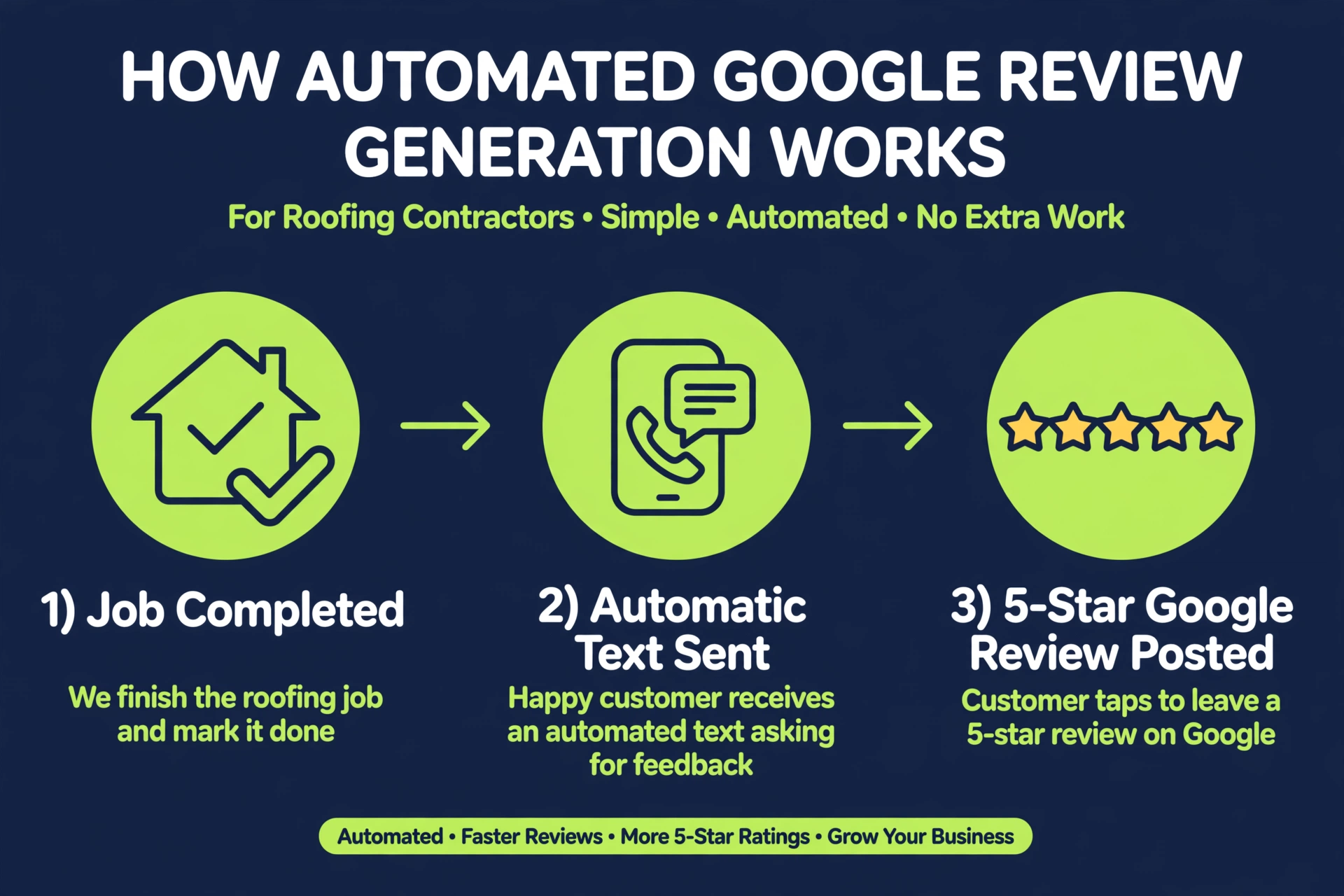
Here’s the direct answer: roofing companies get more Google reviews by asking every single customer at the exact moment they’re happiest — right after the final walkthrough — using an automated text message with a one-tap review link. The companies that do this consistently collect 5 to 15 new reviews per month. The ones that “remember to ask sometimes” collect almost none.
Quick Answer
Roofing companies get more Google reviews by building a simple automated system: send every customer a text message with a direct Google review link within 24 hours of job completion, follow up once by email if they don’t respond, and make leaving a review take less than 60 seconds. Companies that ask 100% of customers average 4.6+ stars and 100+ reviews within a year; companies that ask sporadically stall under 30 reviews. Reviews directly drive calls — 98% of consumers read online reviews for local businesses before choosing (BrightLocal, 2024).
Why Do Google Reviews Matter So Much for Roofers?
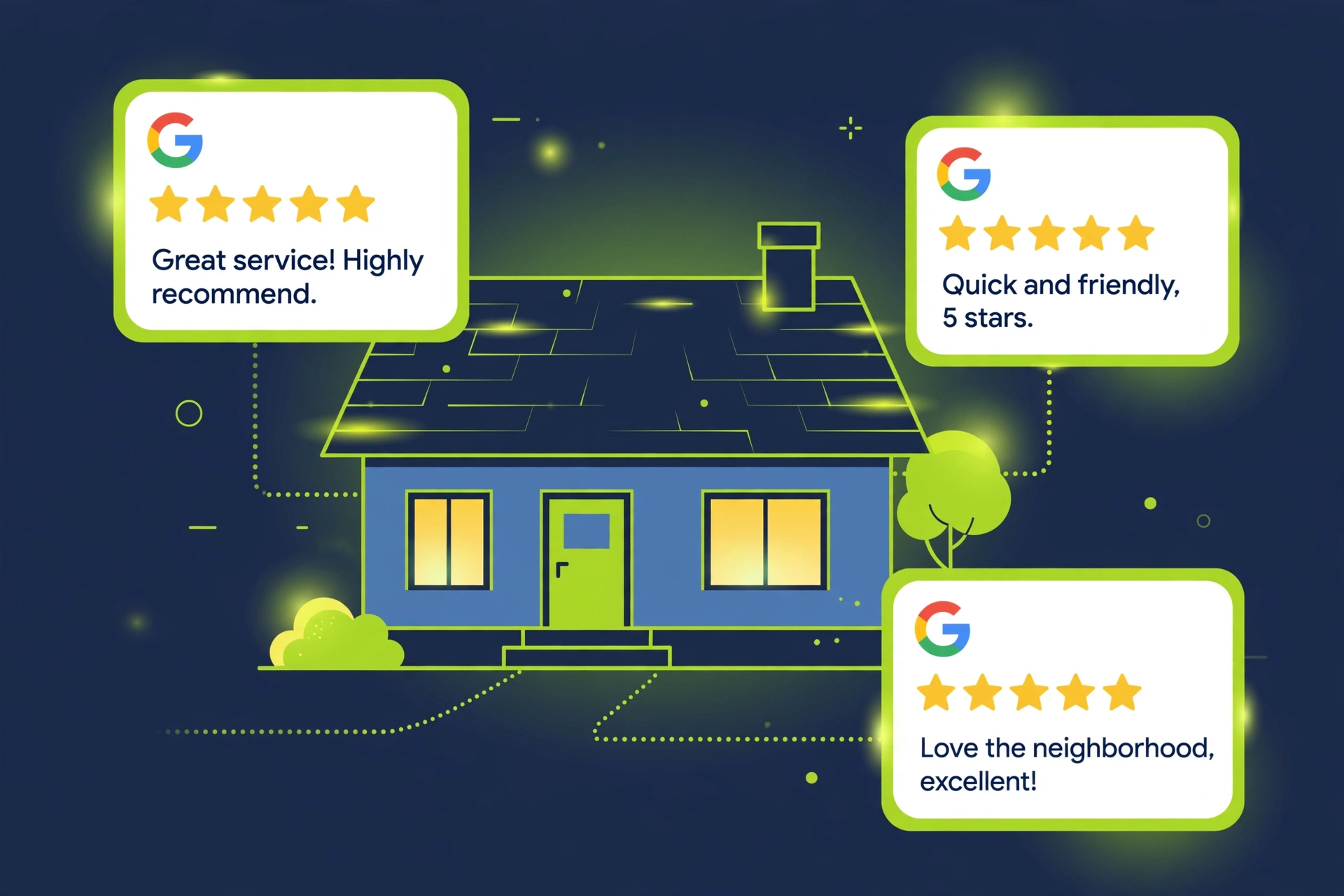
Think about how a homeowner picks a roofer. Their roof is leaking or 20 years old. They don’t know you. They search “roofing company near me” and Google shows them three businesses with star ratings right in the results.
The roofer with 4.8 stars and 187 reviews gets the call. The roofer with 4.2 stars and 23 reviews doesn’t — even if their work is better.
This isn’t a theory. BrightLocal’s 2024 consumer research found that 98% of people read online reviews for local businesses, and the average consumer reads about 10 reviews before trusting a business. For high-ticket purchases like a $12,000 roof replacement, that number is even higher. Homeowners are spending five figures. They’re nervous. Your reviews are their safety net.
And it compounds. Google’s local ranking algorithm weighs review quantity, recency, and rating. More recent reviews push you higher in the map pack. Higher in the map pack means more calls. More calls mean more jobs, which mean more reviews. It’s a flywheel — but it only spins if you feed it.
How Many Reviews Does a Roofing Company Actually Need?
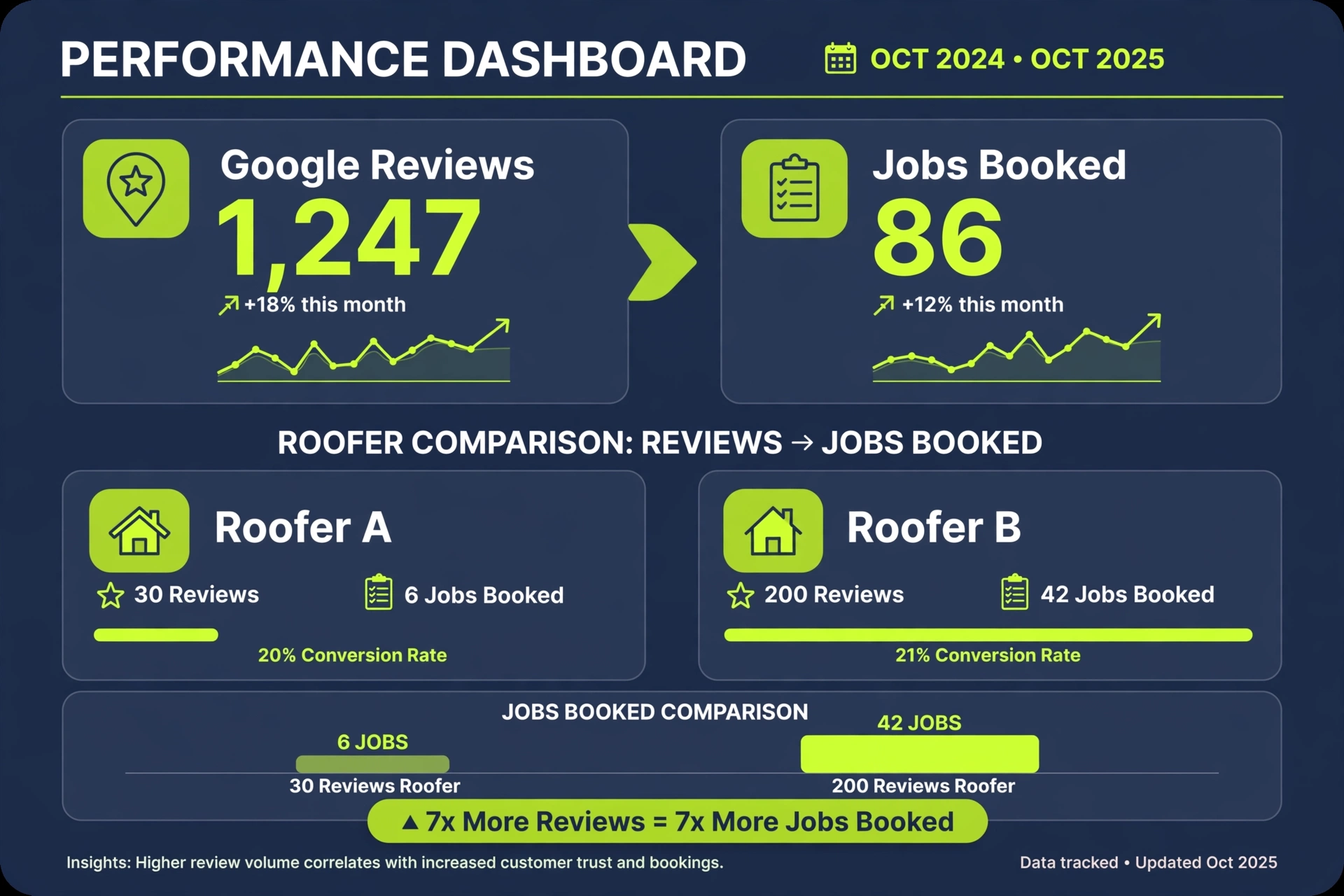
There’s no magic number, but there are useful benchmarks. In most US metro markets, the roofing companies dominating the map pack have:
If you have 28 reviews and your competitor has 210, you’re not competing — you’re invisible. The good news: review count is the most fixable marketing problem a roofer has. You already did the work. You just need to capture the proof.
When Is the Right Moment to Ask a Homeowner for a Review?
Timing is everything. Ask too early (mid-job, when there’s dust everywhere) and you’ll get silence. Ask too late (three months later, when they’ve forgotten your crew’s names) and you’ll get silence.
The golden window is within 24 hours of the final walkthrough. Here’s why:
The best roofing companies build the ask into the job-closeout process: final walkthrough done, final payment collected, and before the crew truck pulls away, the office sends the review text.
What Should the Review Request Actually Say?
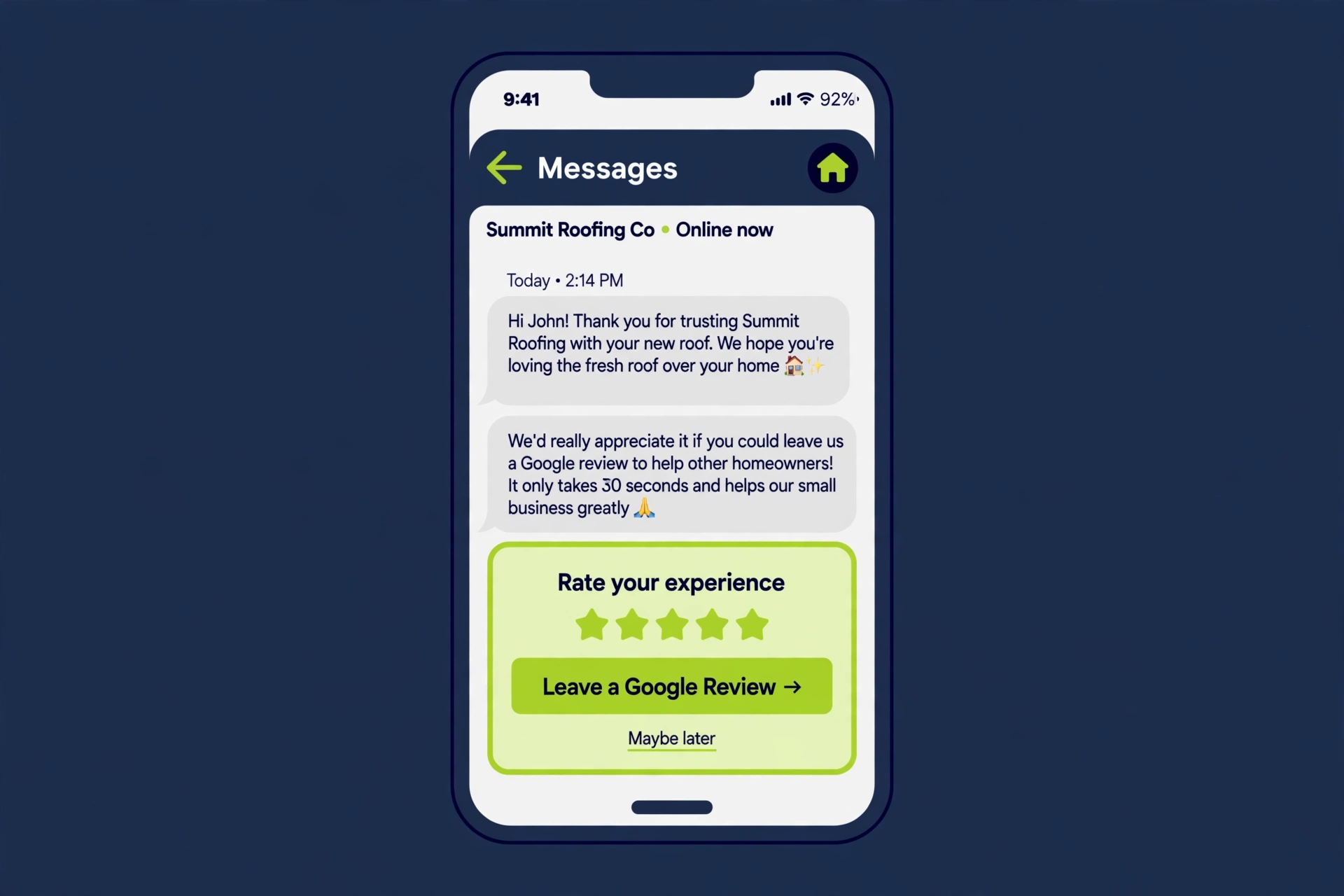
Short. Grateful. Specific. Here’s a template that works:
Hi [Name], this is [Your Name] from [Company]. Your new roof looks fantastic — thanks for trusting us with your home! Would you mind leaving us a quick Google review? It takes about 60 seconds and means the world to our crew: [review link]
That’s it. No paragraphs. No begging. Three elements: gratitude, the specific thing you did (their new roof), and a frictionless link.
The link matters enormously. Don’t send them to your Google Business Profile and hope they find the review button. Generate your direct review link in your Google Business Profile dashboard (under “Get more reviews”) — it opens the review form directly. Every extra click costs you 30% of potential reviews. (Illustrative estimate based on funnel-drop benchmarks.)
Should You Follow Up If They Don’t Leave a Review?
Yes — once. One polite follow-up, 3 to 5 days later, by a different channel (if you texted first, email second). Something like:
Hi [Name], just floating this back up — if you have 60 seconds, we’d really appreciate a Google review of your roofing project: [review link]. Thanks again!
After that, stop. Two asks is professional. Three is pestering. You want reviews, not resentment.
The follow-up email typically captures another 10-15% of reviewers who missed the text. (Industry-reported benchmark for automated review request sequences.)
How Do You Handle It When a Customer Had a Problem?
This is where most roofers freeze. “We had a callback on that job — should we still ask for a review?”
If you resolved the problem well, yes — and those reviews are often your BEST reviews. A homeowner who had an issue that you fixed fast writes something like: “There was a small issue with the flashing, but they came back the next day and fixed it perfectly. That’s why I trust this company.” That review sells more roofs than ten generic five-star reviews.
If the problem is unresolved, fix it first. Never ask for a review while a customer is unhappy. But the moment it’s resolved, ask — and mention it: “I’m glad we got that flashing sorted for you. If you’re happy with how we handled it, a Google review would mean a lot.”
What About Negative Reviews — Won’t Asking for More Reviews Invite Bad Ones?
This fear keeps roofers from asking at all, and it’s backwards. Here’s the reality:
If you ask 100 customers and 95 were happy, you’ll get mostly 5-star reviews. Those drown out the occasional bad one. But if you ask nobody, the only people who leave reviews are the angry ones — because anger is a stronger motivator than satisfaction.
When a bad review does come in, respond within 24 hours, professionally, and take it offline: “We’re sorry to hear about your experience, [Name]. We’d like to make this right — please call us at [number] so we can address this directly.” Future customers reading that response think: “This company takes problems seriously.” That’s a selling point.
Can You Get Reviews From Insurance-Claim Jobs?
Absolutely — and most roofers completely miss this. Insurance restoration jobs are often your happiest customers. You guided them through a stressful claims process, dealt with the adjuster, and got them a new roof they barely paid out of pocket for.
But here’s the catch: ask the HOMEOWNER, not about the insurance part. Your review request should focus on the experience: “Thanks for trusting us with your roof replacement! If you were happy with our crew and communication, a quick Google review would mean a lot: [link].”
Don’t mention insurance in the review request. Keep it about the work and the service.
The System: Putting It All Together
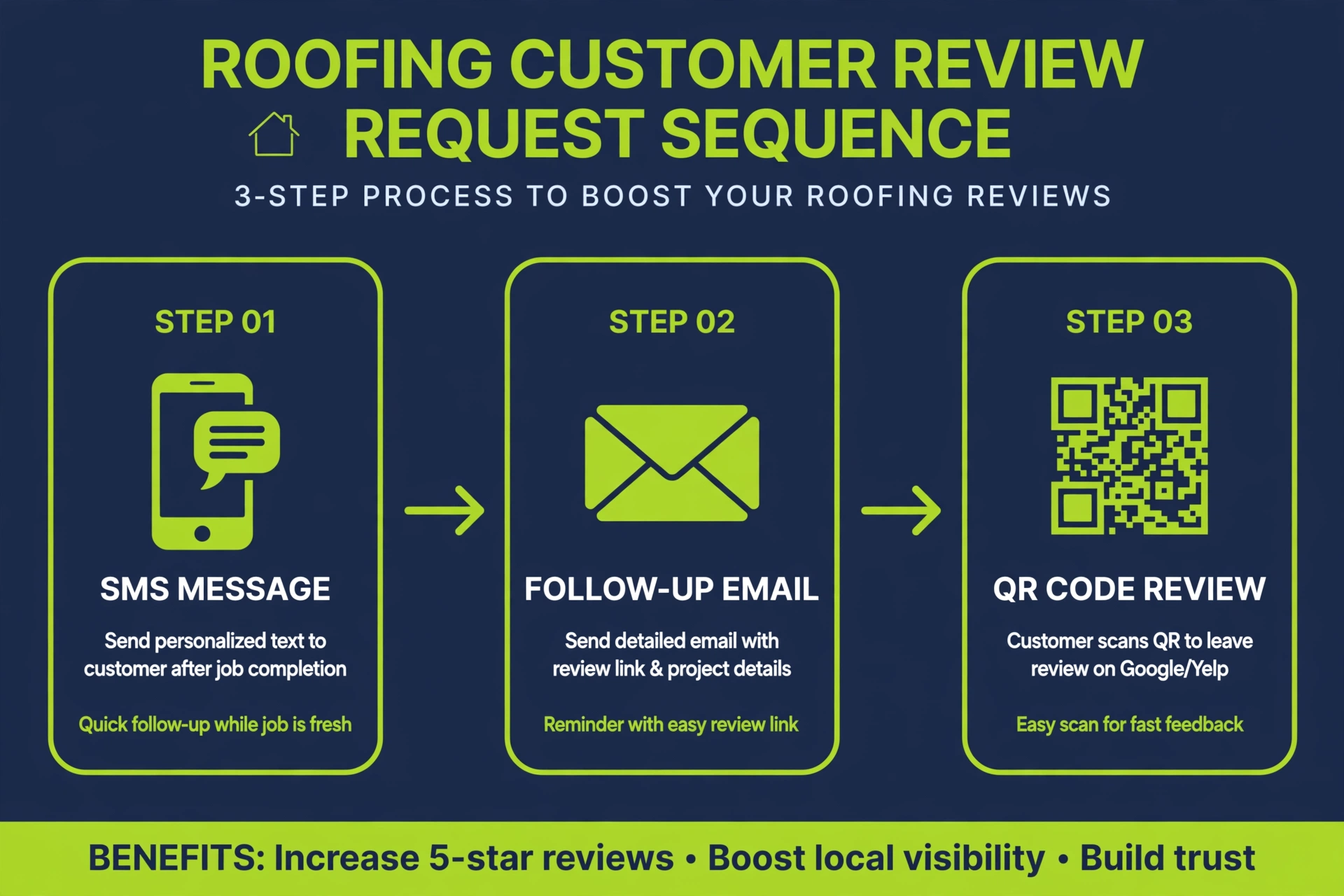
Here’s the complete review generation system that runs itself:
That’s the whole system. It’s not complicated. The roofing companies with 200+ reviews aren’t smarter than you — they just ask every time.
Bottom Line
Google reviews are the single highest-ROI marketing asset a roofing company can build. They cost nothing, they compound, and they directly determine whether the phone rings. The system is simple: ask every customer, ask at the right moment, make it frictionless, follow up once, and respond to everything.
This is exactly the kind of system RepuPilot builds for roofing companies — automated review requests that fire after every job, smart follow-ups, and a dashboard that shows your reputation growing in real time. The roofers who treat reviews as a system dominate their market. The ones who treat them as an afterthought wonder why the phone stopped ringing.
Frequently Asked Questions
How long does it take to build up 100 Google reviews as a roofer?
If you do 10-15 jobs per month and ask every customer with a 30-40% conversion rate, you’ll add 4-6 reviews per month and hit 100 reviews in about 18 months from zero. Companies that also reactivate past customers for reviews can cut that timeline significantly.
Do Google reviews actually affect my ranking in the map pack?
Yes. Google’s local search algorithm considers review quantity, velocity (how recently you’re getting them), and average rating. Businesses with more recent reviews consistently outrank competitors with stale profiles, all else being equal.
What’s a good star rating for a roofing company?
4.6 stars or higher is the target. Below 4.4, you start losing clicks to competitors. Below 4.0, your reviews are actively costing you jobs. If you’re under 4.4, focus on generating new positive reviews rather than trying to remove old ones.
Can I offer incentives for Google reviews?
No — Google’s policies prohibit offering money, discounts, or gifts in exchange for reviews. You can ask for reviews, but you cannot condition any reward on leaving one (or on leaving a positive one). Violations can get your reviews removed.
Should I respond to every Google review?
Yes. Responding to reviews signals to Google that you’re an active, engaged business, and it shows potential customers that you care. Keep positive-review responses short and genuine; keep negative-review responses professional and move the conversation offline.
How do I get my direct Google review link?
Open your Google Business Profile, go to the “Home” tab, and look for the “Get more reviews” card. Click “Share review form” to copy your direct link. This link opens the review window directly — always use it instead of linking to your profile.
What if a competitor leaves a fake negative review?
Flag it through your Google Business Profile (Reviews > Report review), choosing the appropriate violation reason. Google removes reviews that violate policy, though the process can take days to weeks. Meanwhile, post a calm public response so readers see your side.