
Storm season multiplies your call volume 3-5x — and multiplies every missed call with it. Here is the math on what the surge you never answered actually cost you, and the 60-second fix that catches it next season.
Yes. If your phones ring out during storm season, your company is losing the highest-margin work of the year to competitors who answer. A hail event concentrates six weeks of roof-replacement demand into ten days. Every unanswered call is a homeowner with an insurance claim who will be on someone’s roof by next week.
Storm season is the one week of the year when every call is a full, insurance-paid roof replacement — and the one week when your ability to answer the phone is at its worst. This post runs the surge math end to end: what the missed calls cost, why storm callers never call back, and the 60-second system that catches the surge your team physically cannot.
Quick Answer:
Storm season can push a roofer’s inbound call volume 3-5x as homeowners file hail and wind claims. When crews are booked and the office is overwhelmed, a large share of those calls go unanswered — each one a likely full replacement paid through insurance. An instant text-back on every missed call catches the surge your team physically cannot pick up.
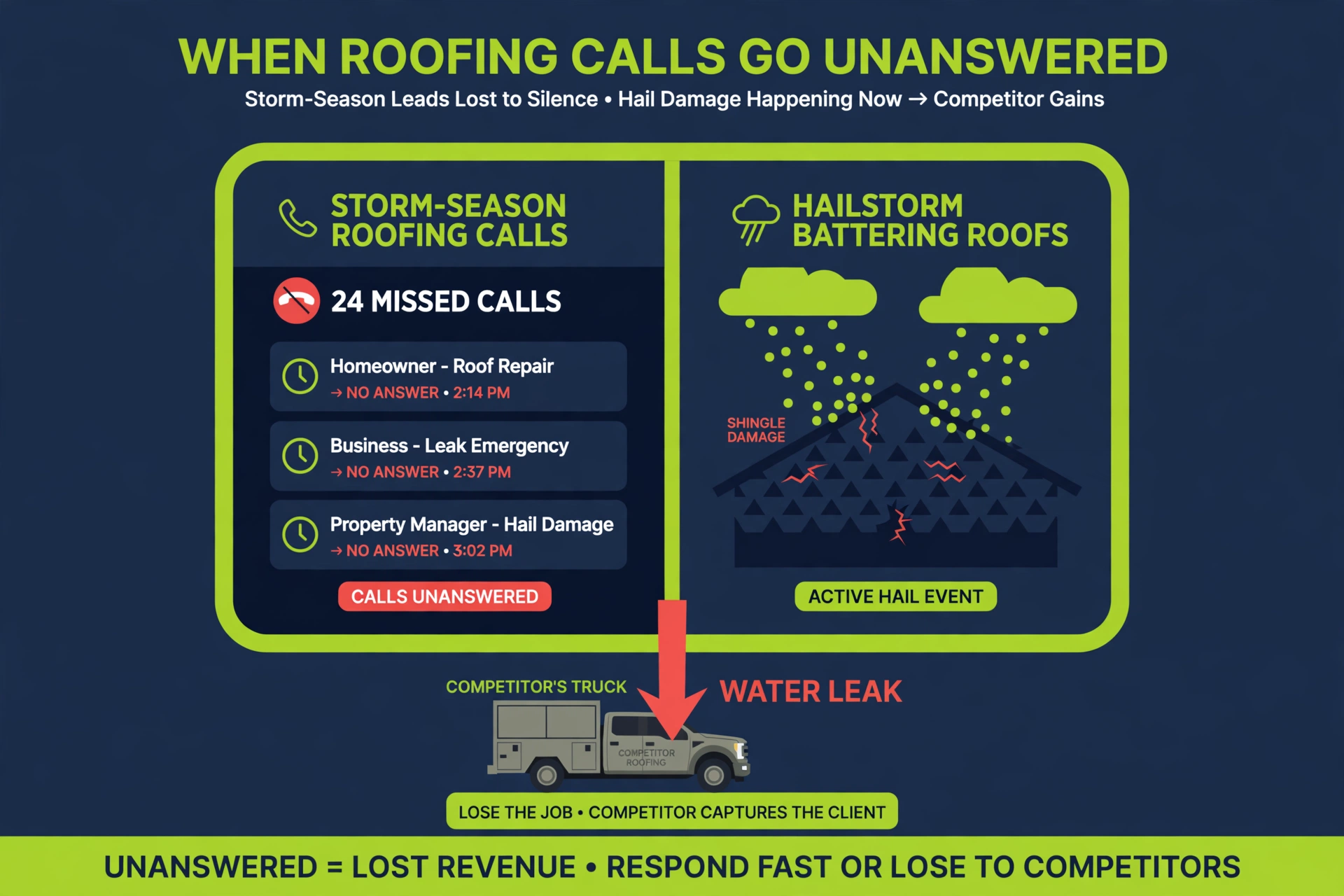
Why Does Storm Season Multiply Your Call Volume — and Your Miss Rate?
The Insurance Information Institute reported that severe convective storms — tornadoes, hail, straight-line winds and severe thunderstorms — caused $51 billion in U.S. insured losses in 2025, the third straight year above $50 billion (Triple-I, April 2026). Hail alone drove over $20 billion in insured losses in 2022, with 6,962 hail events in 2023. Each event is a localized demand spike: hundreds of homeowners in one zip-code radius discovering, within days, that they need a roof.
A roofer’s phone lives through this as a volume explosion: 40-60 inbound calls a week in a normal month can become 150-300 in the week after a major hail event (illustrative) — hail damage, wind-uplifted shingles, emergency tarping, inspection requests, and the first question everyone asks: “will my insurance cover this?”
Crew capacity and phone capacity break at the same time. Your estimators are in the field climbing roofs while your office person juggles an inspection backlog two weeks deep. The second, third, and fourth lines ring out or hit voicemail. During the one week of the year when every call is worth a $10,000-plus replacement, your ability to answer is at its worst. Volume multiplies 3-5x. Answer capacity does not multiply at all.
How Many Storm Calls Slip Through on a Normal Event Week?
Look at the ordinary ways calls leak during a surge. None of them feel like a system failure at the time.
After hours. Storms do not respect office hours. The biggest call windows after a hail event are 5-9 PM and weekends — if your office closes at 5, a chunk of the surge arrives to voicemail by default.
On-the-roof estimators. During event weeks your best closers are physically on roofs and ladders. They cannot take a call — and the office is already juggling a two-week-deep inspection backlog.
Stacked calls. One office staffer takes one call at a time. When four homeowners call in twenty minutes, three get voicemail.
The short window. Storm damage is perishable urgency. The homeowner who cannot reach you in five minutes is already dialing the next roofer on the list — the speed-to-lead math below shows why.
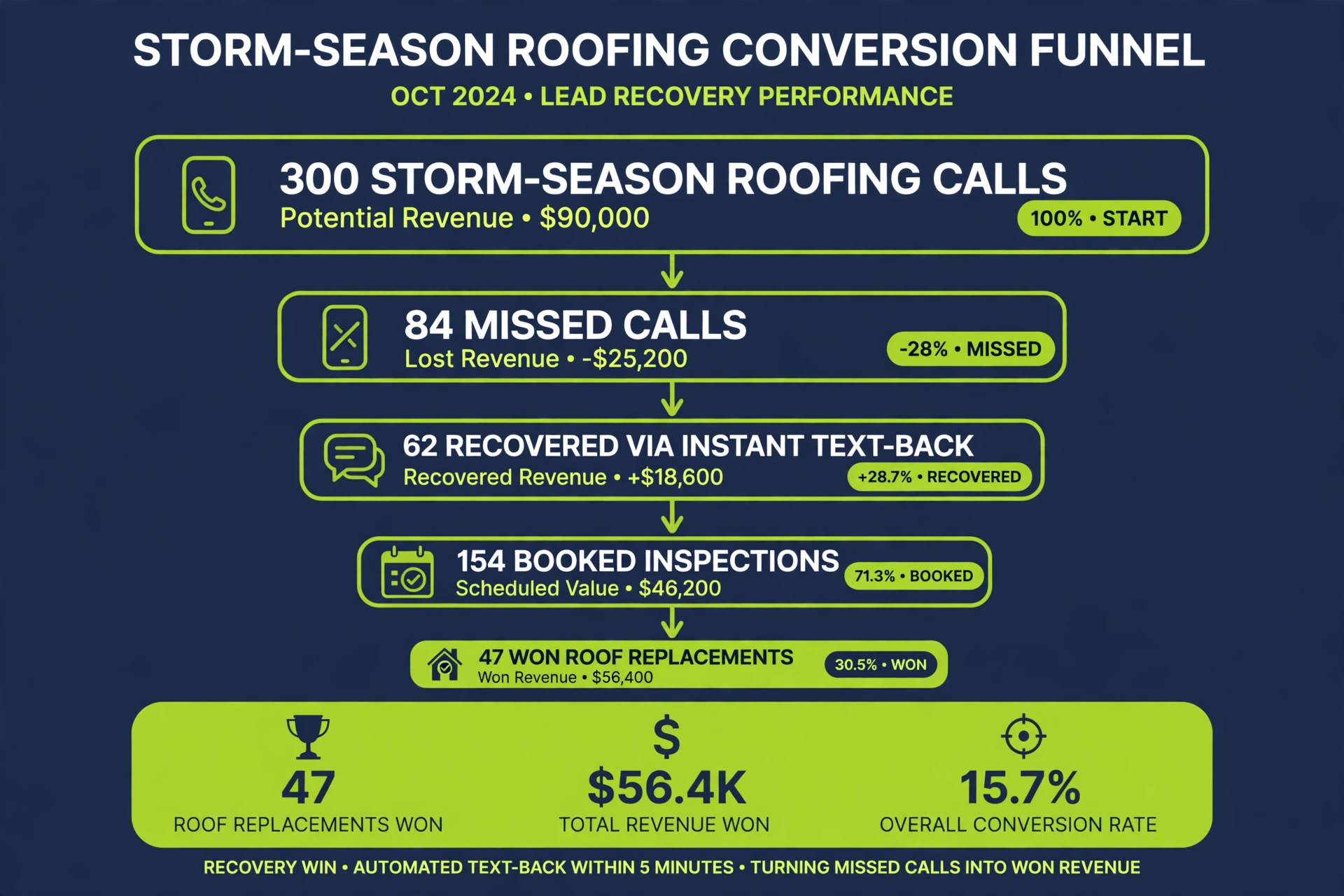
Put illustrative numbers on it. Take a metro roofing company with a healthy storm-season marketing presence: 300 inbound calls over the two weeks after a hail event (illustrative). With the office overwhelmed and after-hours volume unanswered, 28% go unanswered — 84 missed calls.
Eighty-four missed calls. Each one a homeowner with storm damage, an insurance deductible already accepted in their head, and a timeline measured in days. That is the surge, sitting in your voicemail, cooling by the hour.
What Does the Missed-Call Leak Cost in Real Dollars?
The worked example: all job-level math below is explicitly illustrative so you can see the shape of the leak; the benchmarks are real and sourced.
Setup: A metro roofer, two-week hail-event window, 300 inbound calls, 84 missed (28%). Average full-replacement job value: $10,500 (illustrative; substitute your own).
The non-return math. Of 84 missed calls, assume one in three eventually calls back and reaches you — 28 return, 56 do not. The 56 are not lost to voicemail; they are lost to the competitor who picked up. (Illustrative; the speed-to-lead research below explains why the majority never come back.)
The inspection and close math. Of the 56 gone, assume 40% would have booked an inspection — 22 lost inspections. Storm-season inspections close well: homeowners with insurance claims and visible damage are buyers, not browsers. At an illustrative 1-in-3 close rate, that is roughly 7 lost roof replacements.
The dollars:
- 7 lost jobs x $10,500 = $73,500 per hail-event window.
- A typical season brings 2-3 significant events in storm-belt markets: $147,000 to $220,500 per season.
And this is the conservative version. It assumes only 28% missed, only two-thirds of missed calls lost forever, and average job values. It does not count the neighbor effect — the homeowner you never called back lives on a street where three other roofs got replaced by whoever answered.
Run your own numbers in the free Revenue Leak Calculator: plug in your storm-season call volume, your missed-call rate, and your average job value to see the surge leak for your company.
Why Don’t Storm Callers Just Call Back Later?
Because the clock on a storm claim is not your clock. Three forces push the caller to the roofer who answers first.
First, the damage is getting worse in their head. A homeowner watching water spots spread across the ceiling does not experience your voicemail as a minor delay. They experience it as being ignored during an emergency. The next roofer is one tap away, and the phone is still in their hand.
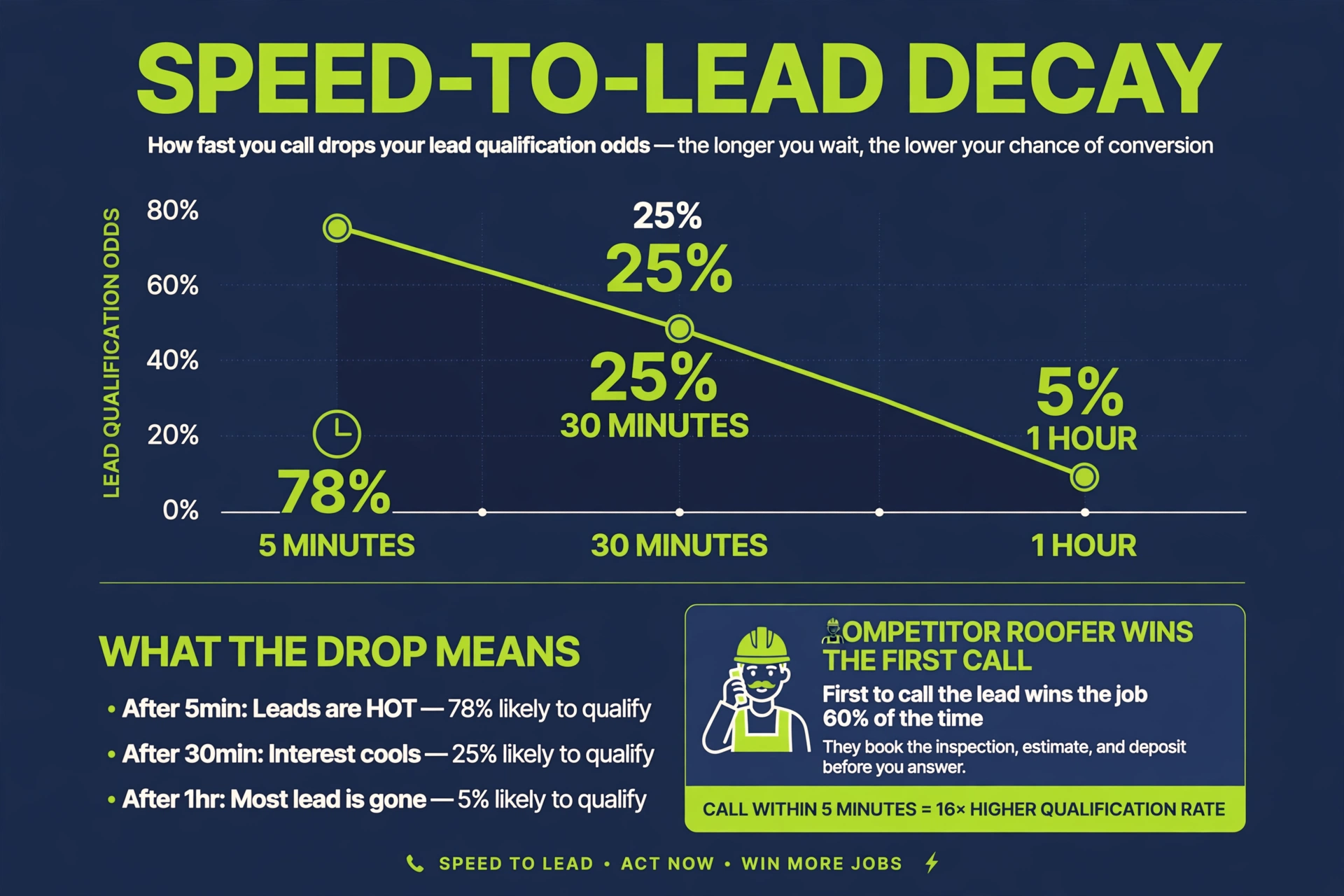
Second, the research on response time is brutal and old. The Lead Response Management study (Oldroyd / InsideSales.com, 2007, 15,000+ leads) found that contacting a lead within 5 minutes versus 30 minutes made contact 100 times more likely and qualification 21 times more likely. Harvard Business Review’s 2011 follow-up (Oldroyd, McElheran, Elkington, 1.25 million leads at 42 firms) found companies that reached a lead within an hour were nearly 7 times more likely to qualify it — and more than 60 times more likely than those waiting a full day. The same HBR audit found the average company took 42 hours to respond, and 23% of leads got no response at all. In storm season, the homeowner’s decision window is measured in minutes, and the competitor’s “response time” is the time it takes their phone to ring twice.
Third, the insurance clock rewards the early roofer. The roofer who answers first is usually the roofer present at the adjuster meeting, who writes the scope and supplements the claim. Once a roofer is on the claim paperwork, they are almost impossible to dislodge. The first conversation does not just win the inspection — it often wins the whole job.
Why Is Storm Season the Worst Possible Time to Miss Calls?
Because the surge is the highest-margin work of the year, concentrated into the shortest window. Consider what a storm-season job actually is:
Full replacements, not repairs. Storm damage that qualifies for an insurance claim is a full roof, not a patch — and the storm-season book is top-heavy with the $8,000-$15,000 upper end of replacement values.
Insurance-paid buyers. The claim covers the roof; the homeowner covers the deductible. Price resistance is structurally lower.
One-year filing deadlines. Most policies require claims within a year of the storm date. Demand concentrates into the months after each event and is perishable: the roofer who captures the inspection captures a buyer with a hard deadline.
And the part that stings: storm chasers know all of this. Out-of-market crews run 24/7 call coverage during event weeks, and their entire business model is answering the calls the local roofer misses. Every unanswered local call is a job that funds a competitor’s next market.
How Does the 60-Second Text-Back Plug the Surge Leak?
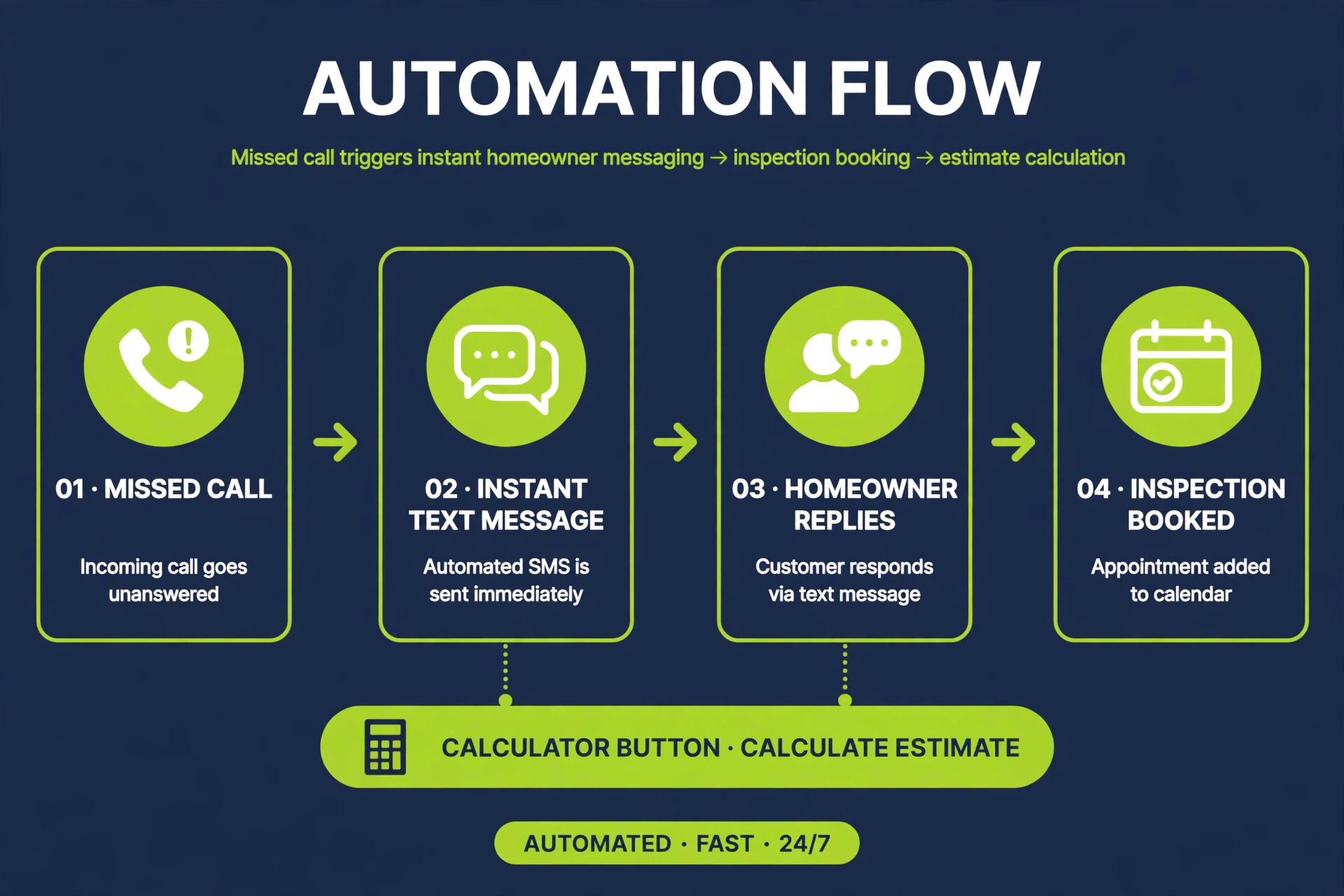
The operational fix is simple enough to run before next season. A missed-call text-back fires the moment a call goes unanswered — within about a minute — and texts the caller from your business number, instantly, even at 9 PM on a Saturday.
Here is the script framework that works for storm season — three short texts, sent in sequence:
Text 1 (immediate): “Hi, this is [Company] — sorry we missed your call! Dealing with storm or hail damage? Reply YES and I’ll get you scheduled.”
Text 2 (if they reply): “What’s your address? I’ll check whether your area was in the hail path and get an inspector out to you.”
Text 3 (booking): “You’re in the damage zone. I have inspection slots [Tuesday] and [Thursday] — which works for you?”
Why this works when voicemail does not:
- Speed. The text lands within a minute of the missed call — the Lead Response Management math says that minute is worth more than the next hour of callbacks.
- After-hours coverage. The text-back works 24/7 without a night-shift hire.
- Written record. The conversation lives in text. Your office sees the thread in the morning and picks it up mid-conversation.
- Qualification built in. The address question pre-qualifies: in the hail path or not, homeowner or renter. Your estimators stop driving to bad-fit inspections.
- Human handoff. The automation catches the call; a real person takes the booking.
This is not a replacement for answering the phone. It is a net under the calls you cannot answer — after hours, stacked calls, estimators on roofs. Every missed call that gets a text within a minute stops being a leak and starts being a lead.
Bottom Line
Storm season is the one time of year when roofing demand outruns every company’s ability to answer the phone — and the one time when every call is a full, insurance-paid replacement. At illustrative rates, 84 missed calls across a two-week hail window quietly becomes 7 lost roofs and $73,500, and a 2-3 event season doubles or triples it. Storm chasers have built entire businesses on that sentence.
The fix costs less than one recovered job: a missed-call text-back that fires within a minute, every time, after hours included. Run the worked example in reverse: the same 84 missed calls each trigger a text, and at illustrative recovery rates that becomes roughly 8 recovered replacements — $84,000 in a single event window that was previously leaking. This is exactly the kind of system RepuPilot sets up for roofing companies: every missed call gets an instant text, the conversation stays in your office’s inbox, and the surge you used to lose becomes inspections on the calendar. No new hires, no night shift.
Run your own numbers in the free Revenue Leak Calculator and see what your surge season leaked. Then plug the leak before spring storm season makes it expensive again.
FAQs
How much does a roofing company actually lose from missed calls during storm season? At illustrative rates, one two-week hail window leaks roughly $73,500: 300 inbound calls, 28% unanswered, 56 never returning, 22 lost inspections, 7 lost replacements at $10,500 each. A 2-3 event season scales that to $147,000-$220,500.
Why don’t storm-damage callers just leave a voicemail and wait? Urgency and options. A homeowner with active damage or an adjuster visit coming shops in minutes, not days — the Lead Response Management study found qualification odds 21x higher at 5 minutes versus 30. HBR’s audit found 23% of web leads got no response at all and the average response took 42 hours. The next roofer is one tap away.
What is a missed-call text-back and how does it work? Automation tied to your business phone number: the moment a call goes unanswered — no answer, busy, after hours — the caller gets a text within about a minute asking one qualifying question and moving toward booking an inspection. A real person takes over the thread from there.
How fast should the text-back fire after a missed call? Within a minute. The 5-minute rule from the Lead Response Management research (Oldroyd / InsideSales.com) is the outer edge: contact odds 100x higher and qualification odds 21x higher at 5 minutes versus 30. Every minute past the missed call is a minute the homeowner spends dialing your competitor.
Do storm chasers really win jobs just by answering faster? Speed is their main weapon. Out-of-market crews run dedicated call coverage during event weeks because they know local offices are overwhelmed. The first roofer to have a real conversation usually attends the adjuster meeting and writes the claim scope — and once a roofer is on the claim paperwork, they are nearly impossible to dislodge.
Can my office staff handle storm surge volume instead of automation? One person takes one call at a time, during office hours, until they are overwhelmed. The surge hits 3-5x normal volume, peaks after hours, and stacks multiple callers at once. A text-back covers the calls staff physically cannot — nights, weekends, stacked lines, estimators on roofs — and hands the thread to staff in the morning.
What should the text-back message actually say? Three short texts: (1) acknowledge the missed call and ask if it is storm/hail damage, (2) ask for the address to check the hail path and offer inspection slots, (3) confirm the booking. Keep each under a couple of lines and hand off to a real person before the conversation gets complicated.
Should the text-back run year-round or only during storm season? Year-round. Storm season is when the leak is biggest, but missed calls cost money every week. The same system that catches the 3-5x surge catches the everyday calls that ring out.